Showing posts with label Malawi. Show all posts

16/01/2012

Tensions in Malawi


From George Conger, first published in the Church of England Newspaper, under the headline Arab Spring coming to Malawi?:
Bishop James Tengatenga
The senior Anglican bishop of Malawi, the Rt. Rev. James Tengatenga, has denounced the government of President Bingu wa Mutharika as being out of touch and set on serving its own needs rather than those of the people.
....
In his address, Bishop Tengatenga called upon Malawians to be patient, but also warned that this patience should be predicated on the government accepting its responsibilities to repair the “malfunctioning system” of governance.
“As we enter another New Year on our long journey of waiting for the coming of our Lord, I urge you to be your best and wait with a purpose,” the bishop said, but “any person should be waiting with a purpose and that nobody should cheat another that things in our country are okay when the opposite is true."

This is not the first time the Bishop has expressed his views on the government and its leaders: Malawi Voice, May 2011.

He is also Chair of the Anglican Consultative Council, a role which may help protect him as a high profile critic of his government.

26/02/2011

Troubles in lake Malawi

At the consecration of Bishop Francis Kaulanda
The Diocese of Lake Malawi continues to be an troubled place.

Zodiak Malawi reports that the Bishop, Francis Kaulanda, has once again suspended again Father Dennis Kayamba.  He has been suspended twice before. On this occasion he is accused of refusing to report for duties to an assigned station at Wimbe in Kasungu.

However Dennis Kayamba has effectively counter-sued. He has lodged an paper with the District labour office demanding his dues from the Diocese covering the period 2003 to 2011.

Kayamba was suspended in 2003 on allegations that he joined a 'Forward in faith Movement' and misappropriating funds at St Annes Hospital.

In 2006 he was a prosecution witness alleging that Fr Rodney Hunter had been poisoned by his cook, Leonard Mondoma.  (In December 2010 a court found that Canon Rodney Hunter had in fact been poisoned though it acquitted Leonard Mondoma.) (Added later: see comment below for correction) 

In 2007 Kayamba was suspended for granting an interview to a Nation Newspaper reporter as part of his opposition to the appointment of Nick Henderson as Bishop.

Bishop Kalunda's appointed had been challenged in court.
The objections, which allegedly included an affidavit with 150 signatures, claimed that Kaulanda had “failed to account properly for money meant for church projects which he was supervising as archdeacon of Nkhotakota between 2000 and 2001.” 

A BBC 'from our own correspondent' account of the consecration of its new Bishop is here. (July 2010)

16/12/2009

Upper Shire strategic plan


The strategic plan of the Anglican Diocese of Upper Shire, Malawi has been published online here.

(The statements below differ from those at the head of the Zachimalawi report, which read like a earlier draft.

This seems to be the more polished version.)

Vision: A self-sustaining church that is Christ Centred and strives to serve humankind holistically.

Mission: The Anglican Diocese of Upper Shire is a Christ centred church that is commissioned to discipleship through the proclamation of the gospel, pastoral care and service delivery (both social and economic).

Core Values:
> Trust in God
> Love and compassionate in its ministry
> Transparency and Accountability
> Excellence in the way of doing things
> Ecumenical in its ministry
> Trust among its people
> Unity of purpose
> Upholding and defending the teaching of the Church
> Gender sensitive

Strategic Objectives:
> The following are the objectives of the Anglican Diocese of Upper Shire:
> To ensure nurturing the people of God by offering quality pastoral care.
> To strengthen the proclamation of the Gospel through out the diocese and beyond.
> To develop the capacity of both laity and the clergy for the furtherance of the Gospel in the Diocese.
> To provide essential services to both members and non members in fulfilment of its call.
> To attain economical empowerment for purposes of the fulfilment of the church's' mission and self edification.
> To increase the Dioceses' visibility and impact in the country and beyond.

Guiding Principles:
> Draw inspiration from the Gospel of Jesus Christ.
> Align itself and its operations to the Cannons of the Church of the Province of Central Africa and the Acts of the Diocese.
> Utilisation of available skills within and among the membership and then develop them further.
> Promotion of human development.
> Work in partnership with other like mind organisation.
> Promotion of self reliance through parish based self help projects.

These principles are then worked out in detail through the report. Long and short-term projects are missing, though I am sure there are many suggestions.

All here

31/05/2009

A brace of bishops in Malawi

Bishop Christopher Boyle, retiring from the Diocese of Northern Malawi

From Anglican Information

Upper Shire Diocese, Malawi:

ANGLICAN-INFORMATION reports that the consecration and enthronement of the Rev’d Brighton Malasa as bishop for the Diocese of Upper Shire, Malawi is to take place quietly on Sunday 7th June at the Cathedral of St Peter & St Paul, Mangochi.

Provincial bishops are wary of any potential objections at the ceremony. In the old colonial days Mangochi used to be called Fort Johnston and a spirit of defensiveness will be the theme of the day.

Brighton Malasa, as former Archbishop Bernard Malango’s one time chaplain and the provincial bishops’ imposed candidate, still attracts criticism in the Diocese of Upper Shire as an unwise choice. Latest reports speak of his unwillingness to conduct prayers.

Malasa has already moved into the Bishop’s residence and has been test-driving in the bishop’s car. On his consecration he will become the world’s youngest bishop with thirty – five years of episcopal oversight ahead of him Upper Shire.

Diocese of Northern Malawi:

Meanwhile, in the recently vacated Diocese of North Malawi clergy have been told by the bishops that they are to nominate one candidate only from amongst their own number for elections for a new bishop. The outgoing bishop Christopher Boyle, is shortly to take up a new position advising on immigration issues in the Diocese of Leicester, U.K.

However, a nomination to succeed him in the person of Fr Scott Wilson of All Saints Episcopal Parish, Weatherford, Texas has been made. Wilson who has led mission teams in South Africa and a Cursillo programme in Malawi was the ‘runner up’ to Bishop Boyle in 2001.

Unfortunately, since then Fr Scott Wilson’s parish, under his oversight, has joined a breakaway movement splitting off from the American Episcopal Church. As part of the former Diocese of Fort Worth his parish is now a member of the Common Cause Partnership – Federation of Anglican Christians in North America (A.C.N.A).

The status of this schismatic grouping is not certain and it is unclear whether it is in communion with the Archbishop of Canterbury. Certainly A.C.N.A. bishops were excluded from last year’s Lambeth Conference and the movement continues as a source of disruption within the Anglican Communion.

The Anglican Central African Province has never been associated with the schismatic North Americans despite efforts on the part of former Archbishop Bernard Malango to persuade it to break with the Archbishop of Canterbury.

With allegiance to such a body, should Wilson be elected it would cause some significant tensions between the bishops within an already troubled Province. Bishop James Tengatenga of Southern Malawi has just been elected to a major position in the Anglican Communion as Chair of the Anglican Consultative Council. This is one of the four ‘Instruments of the Anglican Communion’ and is a focus of world Anglicanism.

Nevertheless, such is the ferocity of the current struggles it too has been heavily criticised by the breakaway Americans and Tengatenga accused of being ‘open to manipulation’. Additionally, it is difficult to see Wilson working in the Province with the likes of the Rev’d Dr Chad Gandiya the recently elected Bishop of Harare, Zimbabwe, who has also been criticised by the Common Cause Partnership for his ‘liberalism’. Finally, what kind of relationship Scott Wilson would have with Bishop Trevor Mwamba of Botswana is unknown? Wilson’s new grouping has hysterically criticised Mwamba for being willing to associate with the American Episcopal Church and for suggesting that Africa might have other more pressing problems than those of religious infighting in the United States.

Fr Scott Wilson is reported to be preparing to visit the diocese of Northern Malawi next week. In which case he may need to do some hard explaining to the priests and laity who are largely unaware of his schismatic activities. He may also want to make his peace with his potential future episcopal colleagues who have been so vilified by A.C.N.A. and their supporters.

There is now potential for a divisive and schismatic scenario in Northern Malawi with the danger of an issue-based regime quite unlike the present. How the bishops of Central Africa respond to Wilson’s candidature will have the potential to affirm or destroy the Province’s status as a bona fide member of the Anglican Communion.

All eyes will be on what used to be an almost unknown part of the Communion but which over the past few years has become something of a bellwether if not a ‘basket case’. What the poor carpenter of Nazareth, in whose name this all takes place, would make of it all is anyone’s guess but he was rarely uncritical of those who misused their positions of authority.


Well? Any comment? The fact is that ACNA is not a recognised part of the Anglican Communion. But could collecting African sees be a way of blurring the lines?

If Wilson has left TEC to join ACNA (and I have no idea of these details) can even his nomination be valid? AI doesn't say where the nomination came from.

24/04/2009

Malasa appointed

The official Press Release from ACNS
The Church of the Province of Central Africa (which is the Anglican Church in Malawi, Zambia, Zimbabwe and Botswana) announces that the Court of Confirmation of the new bishop of the Anglican Diocese of Upper Shire met on 16th April, 2009 at Chilema Conference Centre Chapel at Malosa.

After six successive ballots for the nominated candidates failed to achieve the required two thirds of the votes cast on 16 February 2008, the election of the bishop was referred to the Episcopal Synod, which is the house of Bishops, in accordance with Canos and Constitution of the Church of the Province of Central Africa.

The Vicar General of the Diocese, Fr Brighton Malasa, was duly elected at the Episcopal Synod that was held in Lusaka on 16 December 2008.

We would therefore like to announce to all and sundry that Fr Brighton Malasa’s election as Bishop of the Diocese of Upper Shire in the Church of the Province of Central Africa was confirmed by the Court of Confirmation comprising the Dean of the Province, Bishop Albert Chama, Bishop Derek Kamukwamba – Central Zambia, Bishop Ishmael Mukuwanda – Central Zimbabwe, Bishop Robert Mumbi – Luapula, Bishop Trevor Musonda Mwamba- Botswana, Bishop David Njovu – Lusaka, Bishop James Tengatenga – Southern Malawi, Bishop Godfrey Tawonezvi – Masvingo, Very Revd Canon Michael Mkoko – Lake Malawi, Revd Dennis Milanzi – Commissary for Northern Malawi, Ven Revd Justice Msini – Commissary for Matabeleland, and Bishop William Mchombo – Eastern Zambia.

The court sat under the legal guidance and watchful eye of the Provincial Registrar, Canon Justice James Kalaile.

17/04/2009

Malasa elected

The Rt. Rev Albert Chama, Bishop of Northern Zambia and Dean of the Church of the Province of Central Africa.


From Anglican Information


Youngest bishop in history confirmed for the diocese of Upper Shire, Malawi

Former Archbishop Bernard Malango’s one time chaplain, thirty year old Brighton Malasa has been confirmed as the choice of the bishops of the Anglican Central African Province, to be the next Bishop of Upper Shire diocese.

This announcement follows a day-long Court of Confirmation held by the Provincial Bishops in Malosa, Zomba, yesterday, Thursday 16th April. The announcement comes as no surprise as Malasa was the Provincial Bishops own choice of candidate after his rejection by the electors of the Diocese of Upper Shire.

Malasa’s candidacy has been mired in resistance and controversy throughout with strong objections to his appointment and accusations of financial, and moral misconduct from petitioners in the diocese. These petitions failed to change the Provincial Bishops decision but for credibility’s sake acting Provincial Dean Albert Chama of Northern Zambia, who has been a strong advocate of Malasa, should now issue a comprehensive statement explaining how the bishops arrived at their decision after so much opposition.

Comments coming in from the diocese in the last few hours:

‘The people are very confused’.

‘It’s a tragedy’.

‘The news is being telephoned around with great sadness’.

‘I know this will anger quite a lot of members in the diocese but we have to abide by what has been given to us by those who opted to choose him (Malasa) for us’.

‘How can donors trust us in future, with this man and his record’.

‘Remember, not all leaders are chosen by God. Those chosen by HIM are identified by their conduct and character, so let's wait and see the conduct and character of the chosen one’.

‘We’ve got him for the next 35 years’.

14/04/2009

Choosing the wrong man in Upper Shire?

From Anglican Information:
ANGLICAN-INFORMATION has reported in previous editions the impasse in Upper Shire Diocese over the election of a new bishop. Unable to secure a majority at the original elections and against the wishes of the diocese, the Provincial Bishops have sought to appoint their own candidate, the Rev’d Brighton Malasa.

Malasa was originally scheduled to be approved at a Court of Confirmation to be held in Zimbabwe but this was cancelled after strong objections to the candidate and the holding of a Court outside Malawi. Now Malasa, is to be considered at a new Court of Confirmation to be held at the Diocesan headquarters in Malosa, Zomba on Thursday 16th April.

This second attempt represents an improvement in that priests and parishioners will be able to attend. Nevertheless, it also represents a serious conflict of interests for the Provincial Bishops in that they will be judging their own preferred candidate.
Serious objections continue regarding the extreme youth and inexperience of Malasa who at 30 years of age will become the youngest bishop in the entire Anglican Communion and possibly, we believe, in the world. Further, complaints about his financial dealings and personal life have been lodged with the Diocesan Registrar Justice James Kalaile who has significantly also been newly appointed to the Court of Appeal in Gambia.

ANGLICAN-INFORMATION has been asked to publish the following objections from members of Brighton Malasa’s own parish – originally in the national language of Chichewa they translate into English as follows:

From: Members of SS Peter and Paul Cathedral
Mponda Parish
P.O. Box 54
Mangochi

To: The Returning Officer
P/Bag 1
Chilima
Cc Diocesan Secretary and Archdeacon of Mangochi West

REJECTION OF REV B. MALASA TO BE BISHOP OF UPPER-SHIRE DIOCESE BY SS PETER AND PAUL CATHDRAL – MPONDASI – MANGOCHI

The Christians of the above named Church regarding the appointment of Rev. B. Malasa as Bishop of Upper – Shire by Provincial Bishops in Zambia on 17th December, 2008.

1. Rev. B. Malasa has not reached age to become bishop and doing so is making this diocese a playground and laughing stock.

2. He has no spirit of calling that is why he was not nominated (by the diocese of Upper Shire) when the nomination period came. He made a grave mistake by erasing the chosen names and writing in his own instead but still he did not survive the short listing.

3. He has no experience because he has served very few years, and that is why Anglican rites/traditions at the Cathedral have died completely since he was posted here.

4. He does not like to pray and no wonder on 24th December, 2008 at Midnight Mass he chased away Christians and there was no Mass.

5. Mattins and Evensong ended since he came, in fact the cathedral is not any longer a living church.

6. There is no cooperation between him and Executive and Church elders which is why the entire Executive resigned.

7. He does not account church property and finances. Many things at the Cathedral have disappeared since his coming here. He has wasted church funds.

8. Rev. B. Malasa drinks, without respecting himself, carelessly and shamefully and is an adulterer.

9. Previously, he announced here at Mpondasi Cathedral Church that he did not aspire for the bishopric because he is was young. Today we are surprised that is he has suddenly grown-up or become an adult now?

10. He will not co-operate with his fellow priests. How is the diocese going to function when there are divisions caused by him.

Therefore, it has shown already that while he has been Vicar General he has already, completely failed and he cannot manage the diocese because he is spiritually very poor.

With what we have written we at the Cathedral feel Rev. B. Malasa is not fit for this top-sacred position.

Signatories lodged with the Diocesan Registrar.


================
I am aware that some of these statements may be libellous. Nonetheless I reprint them as in the public domain and in an official document, but with no personal knowledge of the people concerned.

Yet the fact that they are libellous in itself is significant: no-one against whom such allegations are made publicly should be appointed bishop (or, for that matter, to any other position of public leadership) unless the allegations are publicly and sufficiently rebutted. These allegations are serious and question Mr Malasa'a faith and integrity.

If Brighton Malasa is appointed, and that appointment ratified without further enquiry and, in this case, the results of that enquiry being made public, then those who appoint him and those who ratify that appointment will, at the very least, be complicit in appointing a man in whom many people have no confidence and, at worse, are knowingly appointing a man wholly unsuited for the position.

It is not enough to receive sufficient votes, it is also important to be above reproach. It is not enough to have the support of other bishops, it is also essential to have sufficient goodwill from the laity, otherwise the work of being bishop can scarcely be done.

It is also an indictment of church order that our worship of bishops means that, once appointed, there is almost no means to critique or to constrain a bishop whose actions are inappropriate, ineffective, or plain wrong.

Becoming a bishop is like joining a gentlemen's club in Pall Mall - the only possible sanction is to be shunned by club members. The people over whom you have oversight are utterly irrelevant and powerless. And once in the episcopal club you can't be voted out.

23/03/2009

Hesitancy and disquiet


From Anglican Information

MALAWI – Diocese of Upper Shire: The recent failure of the Anglican Central African Provincial bishops to endorse their candidacy of the Rev’d Brighton Malasa as the new Bishop of Upper Shire diocese indicates a hesitancy about his extreme youth and more especially continuing allegations against him for embezzlement, immorality and drunkenness. The House of Bishops is divided between those who want a thorough investigation of Malasa (who was former Archbishop Bernard Malango’s one time chaplain) and those who want to push ahead. Laity and clergy keep a close eye and ear on the bishops, who are given to unguarded comments overheard as reported from Malawi below:

‘We are very embarrassed with some comments from some bishops from this Province of Central Africa saying that their proposed bishop “should not worry about accusations leveled against him” because they too were “in the same situation and we still went through courts of confirmation and consecrations”. This shows some of our bishops are spiritually bankrupt. Bishops need to be people with holiness, integrity, sound morals etc and not be bogus holy men.


ANGLICAN-INFORMATION observes that this is sadly historically true. The previous bishop of Upper Shire, Bernard Malango, for example, came from Zambia under cloud of accusations and a court case regarding embezzlement.

The correspondent continues with a widely felt concern that Malawian appointments are now being stage-managed by outsiders:

‘We are no longer Rhodesia and Nyasaland but Malawians in Malawi. We deserve respect as a church here in Malawi. We are fed up with such kind of behaviors because of your attitudes towards Malawi Church. Please forthwith stop and leave Malawians alone, no interference. Leave us alone for our future in Malawi as a church. After all do you contribute anything to Malawian Church for its growth? It’s the poorest church in the Province. And yet you boast on what white man left for you in your countries’.

ANGLICAN-INFORMATION notes that there are now three dioceses in Malawi and one in Zimbabwe, without bishops:

  • Lake Malawi, whose people still insist on a proper Court of Confirmation for their elected bishop.
  • Northern Malawi, now vacant following the resignation of Bishop Christopher Boyle who is returning to England as an assistant bishop in the Diocese of Leicester.
  • Upper Shire, where the people are challenging the imposed candidacy of Brighton Malasa. Harare, where an election for a new bishop is due in April.

.

02/03/2009

We wait to see


Bishop Cleophas Lunga of Matabeleland

From Anglican Information

MALAWI...Diocese of Upper Shire We have consistently reported extreme disquiet over the choice by the Central African Provincial bishops of the next bishop of Upper Shire diocese. There have been worries about their imposed candidate’s (The Rev’d Brighton Malasa) extreme youth. This has been coupled with serious accusations against him from parishes in the diocese regarding morals and embezzlement... ‘drunkenness, sexual immorality and misuse of church funds’.

ANGLICAN-INFORMATION hopes that wiser counsel may have prevailed, at least for the moment. As our correspondent reports:

‘The Court of Confirmation has been cancelled until a later date, not known as yet. The people here (in Upper Shire) are jubilant and praise the Lord for this cancellation. The question people have is why is there still to be another date when what they written is full of truth. They (the bishops) should just cancel the Court indefinitely because the imposed bishop has been rejected by parishes and especially by his home and own Cathedral parish of Mpondasi- Mangochi district. If a wife or own child tell people that dad soils the beddings is it true or not? The appointment was a disgrace to Upper Shire as far as behaviour of the proposed bishop is concerned. The Provincial bishops who made the appointment were and are blind and they need light to see. If they had evaluated Malasa’s term of office as Vicar General for the twelve months he worked they would have seen the problems. What type of leaders are they in this Province? Please remember us.’

ANGLICAN-INFORMATION observes that the attempt to ‘slip in’ the Court of Confirmation far away from the candidate’s diocese under the guise of a gathering in Zimbabwe did not allow the people (who could not possibly travel so far) to be represented. Ever since the disastrous Diocese of Lake Malawi Court of Confirmation in November 2005 (the consequences of which are still ongoing) Provincial Courts of Confirmation in the Central African Province have gained a reputation for ‘fixing’.

ZIMBABWE....Diocese of Matabeleland A welcome exception to the controversies of other episcopal elections in the Province also took place in Bulawayo, Zimbabwe this Sunday, 1st March as the bishops gathered for the consecration and enthronement of The Rev’d Cleophas Lunga. Lunga, a Zimbabwean who has been working in Coventry diocese, UK for the past five years as Team Rector of the Caludon Team Ministry was elected without controversy to the Diocese of Matabeleland last November. The Bishop of Coventry, Dr Christopher Cocksworth has said of Lunga, ‘he is an excellent priest who has given a great deal to the Diocese of Coventry.’

27/02/2009

Divisions harden in Upper Shire


From Anglican Information

In our last release we reported that the Court of Confirmation for the new bishop of Upper Shire, The Rev’d Brighton Malasa would be held on 3rd March. In fact it will be held on Sunday 1st March in Bulawayo, Zimbabwe. This is as far away from the Diocese of Upper Shire as the provincial bishops can manage, in order to avoid protests at their unpopular choice of candidate who is seen as an imposed choice.

A correspondent writes from Upper Shire:
‘The bishops issue is still in tense situation here. Confirmation in Bulawayo, Zimbabwe! - on 1st March 2009, but the question is why are they confirming a bishop when people in the diocese have raised issues concerning the imposed bishop’s morals?

These parishes have written against the proposed bishop: Malindi, Chinamwali, Nkope, Monkey Bay, Liwonde, Zomba (St. George’s), Mangochi Boma and his own cathedral parish. All these parishes make the same claims against him regarding drunkenness, sexual immorality and misuse of church funds.’

ANGLICAN-INFORMATION observes that these are very serious allegations, from a large number of the parishes in Upper Shire, against Malasa who will become the world’s youngest bishop if the consecration goes ahead.


=============

Whatever happens this cannot be good. What happens when the shepherds play dice with one another and ignore the sheep? What is the purpose of bishops separated from the people?

But, of course, if you were once Archbishop Malanga's chaplain, these questions will probably not weigh heavily in your prayers.

Presumably Brighton Malasa will have to be installed in his Cathedral as a symbol of unity of the church in Upper Shire and of the unity of the worshipping people with the church universal. He won't be the first bishop to be consecrated in the teeth of fierce opposition, and sometimes the local people have come to love a bishop they first opposed. But on the whole such opposition has been based on doctrinal division not accusations of personal impropriety; difficult appointments have been made where, taken by and large, the college of bishops were respected even if the individual was not. The prognosis here cannot be good.

To push through this appointment against such local opposition, not even, so far as I can see, taking opposition seriously enough to address and counter it, is a recipe for division and schism. Anglican polity is such that the only real power the laity have is to leave, to the diminishment of all concerned.


.

09/02/2009

Bakare to be forced out?

From Anglican Information

The Central African Provincial Synod undertakes Nolbert Kunonga’s work for him?

The synod of the Diocese of Harare, Zimbabwe has petitioned that Bishop Sebastian Bakare be allowed to stay in his caretaker role for a further year. This is to continue his courageous work in standing up to self-proclaimed ‘Archbishop’ Nolbert Kunonga and his Mugabe-backed violent regime.

However, the Provincial Synod has vetoed the request and insisted on new elections for a bishop for Harare in June this year.

This veto has emerged under the oversight of acting Dean of the Province, Albert Chama of Northern Zambia. There is a history stretching back to the now retired former Archbishop Bernard Malango (who was very close to Nolbert Kunonga) of pressure on Bakare due to complicated internal differences associated with the struggles in the wider Anglican Communion. In short it looks like Sebastian Bakare is being pushed out.

Given the nature of the nominating process in Harare there is a now distinct danger that Nolbert Kunonga could promote a candidate of his choice. His own election (overseen by Bernard Malango) was shrouded in mystery and intrigue. Thanks to the Provincial Synod decision, Nolbert Kunonga may yet achieve his avowed ambition to oust his old enemy Sebastian Bakare and replace him with a ‘more suitable’ candidate.

Such a tangled web of interconnected ecclesiastical and political machination is unfortunately characteristic of the Central African Province still under the oversight of Bishop Albert Chama.

Interpersonal episcopal power struggles, that are a mystery to outside observers, continue to defy logic in this troubled Province.

ANGLICAN-INFORMATION reports that in Upper Shire Diocese in Malawi, petitions (including one signed by 24 parishioners from his own church) have been lodged against thirty-year-old Brighton Malasa for ‘drunkenness, embezzlement and adultery’.

At the end of last year Malasa was the surprise choice of the Provincial bishops as new bishop of Upper Shire, despite stiff resistance from priests and people and the fact that he is exceptionally young and inexperienced. The recent Anglican Primates Statement covered by us and many other webcasts, which was critical of Kunonga and the Mugabe regime, is already looking a little jaded and pointless.

.

20/01/2009

Lay or episcopal power in Lake Malawi?

Canoeing on Lake Malawi


From Anglican Information

The Diocese of Lake Malawi:

Readers will recall that in July 2005 the electoral body of the Diocese of Lake Malawi and Central African Province voted by overwhelming majority to elect the Rev’d Nicholas Henderson of London, England as Bishop of Lake Malawi. Henderson has had a long and creditable history of involvement in the Diocese and his integrity or faith have never been questioned.

However, due to outside interference the then Archbishop of the Province, Bernard Malango, contrived to ensure that the subsequent but delayed Court of Confirmation was finally held in November 2005. This Court, which is now understood to have been uncanonically conducted, declared that the bishop-elect was of ‘demonstrable unsound faith’, without any evidence, any opportunity of redress or defence, or any indication of what actually constituted ‘unsound faith’. It is salutary to note that, apart from the now discredited Malango, two of those accusing Henderson of ‘unsound faith’ are now excommunicated and fighting a violent battle against the province in Zimbabwe.

Since this shameful episode priests and people have courageously stood up to the provincial bishops and insisted that justice be done and the whole case revisited. A three-year-long struggle between authoritarian bishops (reluctant to admit their fault and angry with what they see as a usurping by the laity) and the people has ensued.

At one point a resolution of this problem was almost achieved by the Rt Rev’d Trevor Mwamba of Botswana, as Dean of the Province, before he was summarily sacked by the then outgoing Archbishop Bernard Malango. Mwamba had agreed with the people to an independent Provincial Court. Bernard Malango replaced Trevor Mwamba with the current acting Dean Albert Chama of Northern Zambia who, as a Malango appointee, is resolutely opposed to dialogue or a Provincial Court. In these circumstances and as a last resort the people have charged the bishops with civil action in the judicial Court of Malawi. The whole saga is catalogued in full on our website.

We have been asked to issue the resolutions of the latest meeting of the House of Laity which are reproduced below:


Extract from the Minutes of a Meeting of the House of Laity,
Diocese of Lake Malawi Diocese held in St Peter’s Anglican Hall, Lilongwe, on Saturday 17th January 2009.

The purpose of the meeting was to update each other of what is going on in the diocese and to consider a way forward with the case which is still in court.

Resolutions:

1.
The Meeting agreed to wait for the court judgment on Thursday, 22nd January 2009 at 8.30 am. In this case the House of Laity is asking the Leadership of the Church for an inter-party hearing.

ANGLICAN-INFORMATION observes that this is a perfectly reasonable request and it is ridiculous that the bishops have resisted it and allowed a case to go to court.

2.
The House of Laity welcomes the news of confirmation of the children who have been waiting for the rite for along time. On condition that is done by the Bishop Biggers or any other bishop who is in good standing with the Laity.

The Laity feel this could be the beginning of civilized dialogue between leadership and Laity. This is a better way of handling spiritual issues.

ANGLICAN-INFORMATION has previously reported that the bishops had placed the diocese under an undeclared interdict, with a deliberate policy of deprivation of sacramental services. Bishop Jackson Biggers is formerly of Northern Malawi, now in retirement in Malawi. It should be noted that not all the serving provincial bishops are mistrusted by the people.

3.
On issue of keys laity is willing to surrender the keys if the Vicar General and the Dean engage with them in dialogue.

ANGLICAN-INFORMATION has previously reported the confiscation of keys for the diocesan vehicle, which was being misused, and the willingness of the people to engage in discussion about their return.

4.
The Laity also question why the leadership does not send communication regarding the outcome of the meetings held at provincial level which affect Lake Malawi diocese in good time. Instead we hear only these issues from the grapevine. The Laity believe that the Vicar-General is accountable to them, therefore he is under an obligation to inform the Laity of what is going on in the diocese. The Church lacks transparency in its dealing.

ANGLICAN-INFORMATION notes that the Diocese of Lake Malawi is emerging as a significant case (now being observed with interest in the wider Anglican Communion) where an old style authoritarian episcopal leadership is slowly being forced into the modern world. The bishops will have, at some point, to give way to a more authentic Anglican episcopal oversight of the ‘Bishop in Synod’ leading by consensus, not diktat.

If the last three remarkable years prove anything it is that no longer can the people be kept in the dark, no longer can bishops simply impose their will. Modern communications provide information and with information comes power and responsibility. In the long-run, once the bishops have grasped this fact, the much-troubled Central African Province will emerge the better.

Jean Msosa
Information
House of Laity Lake Malawi Diocese

.

Malawi Christians face up to the government


Rev Lazarus Chakwela


The Malawi Council of Churches (MCC), an umbrella body of all Christian Churches in the country has reaffirmed their commitment to guide and monitor the true observance of democracy and human rights.

The organization's General Secretary, Rev. Canaan Phiri told President Bingu Wa Mutharika and his cabinet ministers during the DPP National Convention in Blantyre that it would be a “huge mistake” for Churches in the country to keep silent, during situations, where democratic tenets, were not followed and respected.

“We have a God-given responsibility to guide this country for the good of the common man and women and future of democracy.
“We will praise, where praise is due and at the same time, we will criticize when something has gone wrong. We have a prophetic role to fulfill and we will maintain that at all cost to serve Malawi from doom,” said Rev Phiri. “It is our responsibility to correct any wrongs and tell the truth and we will not compromise this task,” said the cleric bluntly, while looking at Mutharika in the face.

Rev Phiri noted that for the past few years, political developments which have unfolded in the country have been very disturbing.

“Lately, we have witnessed some disturbing developments in the country, which have been embarrassing to mother Malawi. We would make sure that this trend does not continue,” said Phiri, amid a deafening silence.

The courageous cleric then told Mutharika that church leaders would be boycotting political rallies, if politicians would continue with “politics of insults”.

“It has been very disturbing to note that when we are asked to pray during political rallies, what follows next are insults. When we start boycotting some of these rallies, don't be surprised,” he said.

The cleric then asked all political leaders in the country to cultivate a good working relationship with the Church in order to “build a tolerant nation.”

===========

All credit to The Malawi Council of Churches, but this does sound ominous.

07/01/2009

Punishing the Diocese of Lake Malawi – an appeal to the Anglican Communion

ANGLICAN-INFORMATION reports that following our last issue ‘Diocese of Lake Malawi under interdict’ we have been asked to publish the letter below from Jean Msosa one of the senior lay members of the diocese.

Anglicans in Malawi have a strong sense of being part of the wider Anglican Communion and Jean Msosa’s letter is addressed to the Bishops of the Anglican Communion, a number of whom receive ANGLICAN-INFORMATION.

* * *

Dear Bishops of Anglican Communion,

Punishing the Lake Malawi Diocese at the Expense of Anglican Growth

I greet you all in the name of our Lord Jesus Christ in this New Year. My prayer is we have a good spiritual start.

I write this article to raise concern on the growth of our Church in Lake Malawi Diocese. At the moment we have not had our children confirmed for the past few years since our problems started in the Diocese.

My question is, are we serious about the growth of our Church? If we are why are we not resolving issues so that we can normalize the situation in the Diocese.

My worry is we are not helping our Church since some bishops in the leadership are punishing us the Christians who are fighting for justice. But the reality is there are many other Churches out there in Malawi which can take our children but how about the future of the Anglican Church?

As for us you know our stand. Nothing will move us from this Church regardless of what attempts are made to frustrate us. My prayer to the leadership of the Central African Church in this New Year is to make decisions which are guided by the Holy Spirit. Decisions which would not be questioned by Jesus if he came today.

Jean Msosa
Concerned Christian member of Lake Malawi Diocese

* * *

And from Canon Paul Wilson a lay canon of Birmingham Cathedral. (N.B. Birmingham Diocese, U.K. is a principal and long-standing link partner with the four Anglican Dioceses in Malawi)

The Diocesan Toyota Landcruiser

'I do not want to become embroiled in a debate about the rights and wrongs of the situation regarding the appointment of a Bishop to DLM. However - (and a quite big however) the Birmingham Diocesan Board of Finance channels very significant funds every year to all of the Malawi Dioceses in order that they may continue to function.

'We would very much like to see the keys for the Toyota Landcruiser* returned to the Vicar General so that this vehicle, which has been standing idle for so long, may be used for the purpose for which it was purchased. Because this vehicle is unavailable, I shall have to hire a car/van for my visit later this month.'

* * *
ANGLICAN-INFORMATION comments that this is a problem that the acting Dean of the Province, Albert Chama should have addressed long ago. The continued forced absence of the elected bishop of Lake Malawi means that control and oversight is lacking.

*The Diocesan Landcruiser has been kept out of use by the House of Laity for good reason. It was being used inappropriately by various clergy for their own private travel which including trading items across the diocese for personal gain.

.

06/01/2009

On Zimbabwe and Malawi

Ekklesia has a round-up of episcopal comment on Zimbabwe under the title Churches maintain pressure on Mugabe in Zimbabwe.

And George Conger has more information on the appointment of Rev. Brighton Malasa as Bishop of Upper Shire, Malawi here.

Concerned Anglican left a comment on a previous post suggesting that the underlying issue was "black/white racial". There is clearly some truth in this but it is not the whole truth. I guess the underlying issue is power, not least because bishops are powerful people in the church.

So, before the question of the right individual is addressed, there are some a priori presumptions that white people should not have power in African church (whether because of the colonial legacy, or because they cannot understand issues they way a local person would, or anxieties over their reception in the local and central governments of the countries concerned, or because they bring with them cultural assumptions which are not indigenous, or because they are tainted with Western social attitudes).

But it's not straightforward:

Former provincial secretary Fr. Eston Pembamoyo told The Church of England
Newspaper the “house was divided between those who said no to the mzungu [white
man] and those who said no to the black man.” Under Central African canon law
the diocese’s twelve electors and the Province’s nine electors must elect a
candidate by a two-thirds majority.

“Those who said no to the black man said so because they thought he was being imposed on the people because he is from another diocese, and those who said no to the mzungu said so because they thought it was not time now to look to the West for the Gospel,” he told CEN.

It is also about power within the electorate: how do powerful bishops retain their wider power but by ensuring they can dominate other bishops? A white man may not bend with the wind, but nor may a black candidate.

And in the case of Malawi it is also a case of the need (seen from the episcopal perspective) to reassert collective episcopal power over against the uppity laity and clergy who have even been prepared to use the courts against the bishops. Now, where would episcopal power be if clergy and laity didn't properly defer to it? Such independence could be infectious and must be stopped - or, from another perspective, celebrated.

The choice of the 'right' person has so many considerations, almost all of them political. Let us pray that Rev. Brighton Malasa is a good man, an intelligent man, and his own man.

Though George Congar's last sentence may reveal otherwise:
A former chaplain to Archbishop Malango, Bishop-elect Malasa has served as
vicar-general of the diocese since the archbishop’s retirement.


.

04/01/2009

Diocese of Lake Malawi under interdict

ANGLICAN-INFORMATION reports on another New Year in the troubled Central African Province.

In the Diocese of Lake Malawi the people have now been without their elected bishop for over three years due to the continued inability of the Provincial bishops to correct their spectacular faux pas at the subsequent Court of Confirmation. In November 2005 the ‘Court’ declared (without any evidence but under pressure from North American schismatic factions) that the bishop – elect was of ‘demonstrable unsound faith’.

Amongst those bishops who adamantly made the declaration, two are now excommunicated and waging a war of attrition against the Church in Zimbabwe, one has entered a discredited retirement abandoned by his American friends, and one is deceased. ‘Demonstrable unsound faith’ seems to be a relative concept.

Current provincial policy towards the Diocese of Lake Malawi has been to place the priests and people under an undeclared interdict, enacted as a policy of calculated neglect.

The bishops have therefore conducted a programme of minimal episcopal duties, hoping to crush any opposition, sap any will and through sheer frustration create a complaisant laity. This policy does not have the wholehearted support of all the bishops some of whom (sensibly) think it is counter-productive and disingenuous.

A typical recent communication from a layperson reads:
‘Since the disgraceful rejection of our dear man of God, the Rev Fr Nick, the
Diocese of Lake Malawi has been going through a tough time from the
bishops. As of now there are reports saying that the diocese is under
punishment for a period known only to the provincial bishops and they say that
they will decide on when to have a bishop.’

Remarkably, the people of the diocese remain in good spirits and vigilant. Far from suppressing or dividing them the bishops have succeeded in producing a renewed determination to see justice done. This essentially means convening the previously agreed independent provincial court to examine the failings of the original Court of Confirmation. However, this would be the very last thing that some of the original bishops would want for the obvious reason that it might (from their point of view) embarrassingly go the wrong way.

Result - New Year impasse - again.

24/12/2008

Christmas in the Diocese of Upper Shire

ANGLICAN-INFORMATION reports that on Christmas Eve 2008, just like the original nativity story, Christians in Central Africa are marking this time as one of great uncertainty with humble people in fear of the religious authorities, with a tyrant on the throne and with God’s start of hope still defiantly shining.

UPPER SHIRE DIOCESE, Malawi: People and priests are planning New Year meetings to discuss and consider their response to the strange announcement from the Central African Provincial Bishops that Brighton Malasa, a junior priest of only five years in holy orders is to be the next bishop of Upper Shire diocese.

If he is consecrated it will make him the youngest bishop in the entire Anglican Communion* with the prospect of 35 years in charge of Upper Shire ahead of him. Understandably, in a culture that respects wisdom, experience and age there is fear that this appointment is verging on foolishness.

* In 1950 the Rt Rev’d David Hand was elected aged 32 as an assistant
bishop in New Guinea.
Michael Nazir-Ali now of Rochester, England was first ordained bishop aged
35 to be Assistant Bishop of Southwark.
Bob Anderson was 42 when he was elected bishop of Minnesota, USA and
Paul Williams the new Area Bishop of Kensington, London who will be
consecrated early next year is 40.
In 2002 the Rt Revd Andodo Elneel of Kadugli, Sudan was 33 when elected.


We cannot find any examples in the last 100 years of a 30 year old bishop, not least one who is to be a diocesan. Either the Central African Provincial Anglican bishops are divinely inspired in their choice or they are being extremely irresponsible.

From Anglican Information.

19/12/2008

Boy Bishop for Upper Shire?

ANGLICAN-INFORMATION reports:

In a surprise move the current Vicar General Brighton Malasa of Upper Shire diocese, Malawi, has been appointed bishop of Upper Shire.

The Provincial Bishops of the Central African Province meeting in Lusaka, Zambia (well away from Malawi) have apparently heeded objections to their previous favoured candidate Alinafe Kalemba but instead produced an unexpected and questionable alternative.

No support for Malasa’s candidacy from the diocese had emerged at the original elections for a bishop in February this year.

Malasa is said to be only 30 years old the minimum canonical age for a bishop. His main qualification seems to be that he is a strong supporter of acting Provincial Dean Albert Chama of Northern Zambia.

Our correspondents have said:
‘But there is tension due to his age. It means he will be bishop for 35 years when he reaches 65 years as retirement is required. People have started meetings so that they voice out their observations. This has never happened in this Province and if not careful it will divide the Church in Upper Shire. Since this news has come out currently nobody has applauded but there have only been question marks.’

.

16/12/2008

Nets for Life


From The Daily Times, Malawi

When a net save life

It is both stinking and excruciatingly hot in the Lower Shire, more so during the rainy season, with the perennial floods that provide an environment
conducive for mosquitoes to thrive making malaria a common occurrence to an extent of becoming epidemic to the area.

Although the hype and attention directed towards the HIV/Aids pandemic is so enormous when compared to equally devastating killer diseases, it is still unfathomable that malaria still remains the number one cause of deaths in the world with an under five child succumbing to the disease every 30 seconds.

Anglican Church Diocese of Southern Malawi Vicar General Charles Saleya Masina, who was guest of honour at the function, thanked other faith based organisations for collaborating with NetsForLife in its endeavour to assist government fight malaria. He disclosed that during the second Phase, at least 3 nets will be distributed per family to cater for large families. The second phase has been funded by Episcopal Relief and Development (ERD), a church organisation based in New York to the tune of $300,000.

NetsForLife is a collaborative partnership of several foundations and NGOs and it implements integrated malaria prevention through a network of local faith based organisations and NGOs and is currently in 18 countries including Malawi. In Malawi, NetsForLife works with Anglican Church that is made up of four dioceses which are Upper Shire, Lake Malawi, Southern Malawi and North Malawi. The church was registered in 1974 and has been providing health and education services since the early 1900 as part of their mission in serving communities.

05/12/2008

A couple of books


I have recently found two books on Google Books which may be of interest (previews available).


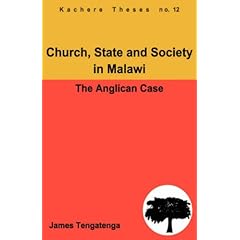
James Tengatenga,

African Books Collective, 2006

ISBN 9990876517, 9789990876512

223 pages


Missionary history in Africa asserts that political history on the continent
cannot be understood without an in depth understanding of the workings of the
missions: missionary activities and ideologies were central to political
consciousness. The Anglican Church was involved in society, education, health
and politics right from its first foray into Malawi. This study considers the
nature of the involvement of that Church in society, and how it engaged with the
State from its genesis in the colonial period through the post-independence
period to the new post-Banda political dispensation in 1994. It illustrates how
the Church was involved on both sides of the independence struggle; and
interrogates why it fell conspicuously silent thereafter.


The Steamer Parish: The Rise and Fall of Missionary Medicine on an African Frontier

Charles M. Good

University of Chicago Press, 2004

ISBN 0226302814, 9780226302812

487 pages


In the mid-1800s, a group of High Anglicans formed the Universities' Mission to
Central Africa (UMCA). Inspired by Dr. David Livingstone, they felt a special
calling to bring the Church, education, and medical care to rural Africans. To
deliver services across a huge, remote area, the UMCA relied on steamer ships
that were sent from England and then reassembled on Lake Malawi. By the
mid-1920s, the UMCA had built a chain of mission stations that spread across
four hundred miles. In The Steamer Parish, Charles M. Good Jr. traces the
Mission's history and its lasting impact on public health care in south-central
Africa-and shows how steam and medicine, together with theology, allowed the
Mission to impose its will, indelibly, on hundreds of thousands of people.
What's more, many of the issues he discusses-rural development, the ecological
history of disease, and competition between western and traditional medicine-are
as relevant today as they were 100 years ago.

And if you buy them from Amazon via the MCU Bookshop the MCU will receive a small percentage of the price.