Showing posts with label Urban church. Show all posts

16/07/2011

Lenin in the Cathedral

We attended the Durham Miners' Gala last Saturday (pronounced gay-la, not gar-la, if you're not from these parts; it's important). (Wiki, news report, BBC slideshow, Guardian Video)

I took a lot of pictures of the backs of people's heads
It was a tremendous day. We went at the invitation of a retired miner who says he's only missed 1 Gala since he first began at the pit. The brass bands played and over 100 banners marched past for hour after hour in a tremendous display of historic and current solidarity, community pride and a continued determination to fight for the workers against the bosses. There are no deep mines left in the area now.

The rain was on and off. As the very last band played outside the County Hotel the heavens opened and everyone was drenched. There was a band of young women playing (I'm not sure which band) and a police van with lights and barely audible siren pushed passed them. They were soaked to the skin, pushed out of order and never stopped playing - and they deserved and got the longest and loudest applause.

We didn't go the the race course for the fun fair or the speeches. We went, at the urging of our host, to the service at Durham Cathedral. 'Makes the hairs on the back of my head stand up' he said, but not mine.

The Cathedral was packed and there was a tremendous atmosphere. But the service seemed disconnected from the events outside. It felt like a standard Cathedral service tailored for this audience as they might for the Mother Union or Durham County Council Civic Service. Nothing about it echoed the enthusiasm or community feeling of the marchers. It didn't even pick up the religious iconography and slogans of the banners.  It certainly didn't pick up the dominant feeling of working class solidarity. Somehow the choir's anthem (Hubert Parry's Hear my words) just didn't cut it in style or content. Many sang the hymns but, where we were sitting at least, a lot didn't.

We also commemorated the deaths of 81 miners at Easington Colliery and 9 at Eppleton Colliery in two disasters 60 years earlier. Memories are long and these events are a constant reminder not only of the dangers miners face (one of the trapped Chilean miners was a guest of honour at the Gala) but also that these dangers and deaths were for the sake of the owners and bosses. (The industry had been nationalised in 1947.)

The sermon was a bit of a disappointment too. The motif was: coal, caused by sustained pressure, aeons later shaped the region and brought wealth and work. This time of pressure will also pass and new hope will grow (see what Sunderland has done).

It missed the note of opposition to pressure, of standing together against the oppressor who is not a force of nature but the beneficiary of an unequal society. It missed the fact that it is people who are crushed, not merely trees, in our inequitable ordering of society. It was, I think, meant to offer people hope despite the present troubles but it felt as though it was just counselling fatalism.

Perhaps I shouldn't have expected any different. After all the Church, epitomised in Cathedrals, embodies hierarchy and status, not nascent egalitarianism.

So I was highly intrigued that, amongst the new banners that the Bishop of Jarrow blessed, was that of Follonsby Lodge. The original had been destroyed in 1938 in a fire.

The banner has Lenin in the place of honour. (Wiki has the advice "Not to be confused with linen, a textile made from flax.")

J. Keir Hardie was a founder and leader of the Independent Labour Party. He was the first independent working class Member of Parliament.

Arthur Cook was leader of the National Union of Miners during the 1926 General Strike and subsequent lockout. (Autobiography)

George Harvey was one of the leaders of the Ruskin College strike,1909, a founder of the Plebs League and the Industrial Union of Britain. He was also the Wardley colliery check weighman.

James Connolly was a founder member of the IWW (the 'Wobblies'), the Irish Transport and General Workers Union and the Irish Citizen Army. He was executed by the British in 1916 after the failed Easter Rising.

What I'd love to know is, what was in the mind of the bishop as he blessed this banner?

04/07/2011

City and church

It's not enough, not nearly enough, merely to see the city as antithetical to God and churches as places of alternative discourse and practice (See my previous post Church and city).

Nalanda temple, Bihar, India. This ancient seat of learning 
flourished between the 5th and 12th centuries CE and is described 
as "one of the first great universities in recorded history."
It's also important to acknowledge and celebrate that cities are places of human flourishing. Cities hold a critical mass of people in structures that generate so much more than would be possible in communities with smaller numbers distributed further apart.

Universities are, perhaps, one of the oldest examples of this phenomenon: pack a lot of capable people together and they come up with so much more than any of them would achieve on their own.

The arts, culture, commerce, the intellect, engineering, cooking and, inevitably, crime all flourish in cities in ways that would never be achieved in an agrarian society.

The church has been part of and has benefited from this flourishing. As beneficiary it should thank God. It is enjoined to pray for the peace of Jerusalem (Ps 122:6) and those exiled from Jerusalem to Babylon were told to seek its peace and prosperity. (Jer 29:7). More to the point, the church has no choice. Almost everywhere is city or has been landscaped by the demands of the city (for food, water, power, labour, communications). It is inescapable.

The art or goal, it seems to me, is for the church collectively and faithful Christians individually to be in-and-apart-from the city. For most faithful people, I suggest, holy living is not a search for a world-denying asceticism but is a struggle to be both Christ-centred and engaged in the quotidian business of making a living, sharing family life, growing up and growing old. Christians are normal, but they choose in some way to set themselves apart.

I don't think there are any easy answers to the immediate questions: what might a proper 'apart' be - and what would be the criteria by which to judge - and how can the separateness  be a positive element in both personal growth and community engagement? These are questions of identity, to be lived out in practice in changing circumstances, characterised by judgements of value rather than doctrine, and all but impossible to determine in the abstract.

To stand apart can (should) give a critical distance by which Christians may both critique the secular world and contribute constructively to it; to do so while knowing that we are ineluctably part of the secular world should also place a critical brake on the tendency to self-righteousness and complacency.

I guess the only way is to keep practising.

01/07/2011

Church and city

I've been pondering on the theme of the Church in the city, specifically the church building, along these lines: 

The Cathedral in Bristol, UK
At least in England but probably in the Old World generally: 1) Until mediaeval times the church ordered reality: time (the hours, the seasons), space (parish and polis), politics (against both heretics and the 'infidel'), finance (no usury). It did so to embody and proclaim a God-centred cosmology. Cruciform churches were set at the heart of the city in a conscious representation of the ordering of the universe. Other religious institutions - schools, hospitals, monasteries and convents - also helped form the city around them.

Furthermore churches - to varying degrees - hosted the life of the city physically as well as spiritually: markets, court hearings, daily politics were conducted in their precincts.

2) Nowadays the opposite is the case. Churches exclude the quotidian business of the city and are largely excluded from the places it is conducted except, perhaps and in some places, for ritual and long-since-forgotten historical reasons. Whether they continue to dominate the skyline - or not - churches are now left as largely empty spaces visited by tourists and devotees.

For the most part this is a matter of regret and anxiety, not least financially. The Roman Catholic Church and the Church of England, and no doubt others, still remember in their bones and their ordering the days when they were at the heart of the city and the loss of this position still pains them. Bishops continue to be titled after cities. Cathedrals remind them of the place they have lost. The Pope may still address Urbe et Orbe.

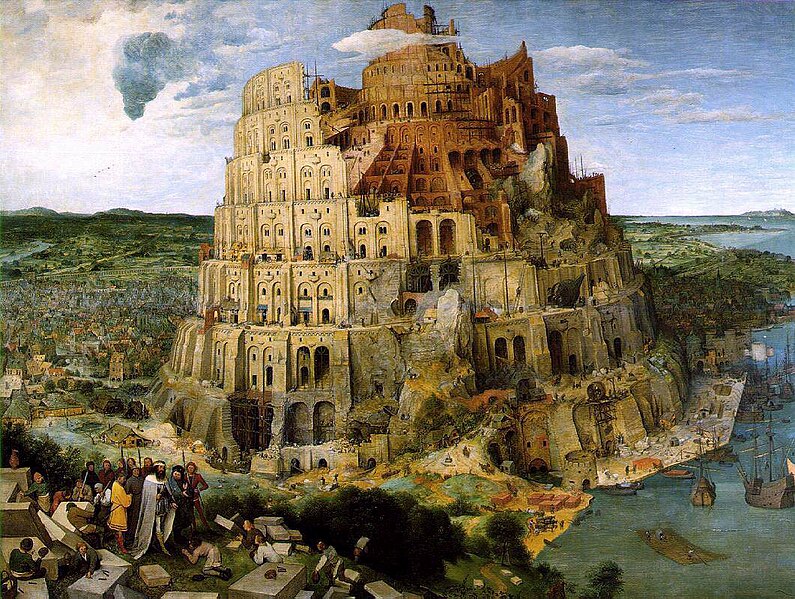
3) But the city is in many ways antithetical to the divine ordering of creation. (This largely from a superficial reading of Jacques Ellul’s The Meaning of the City). Cities order themselves by their own logic: once for warfare and now for commerce. Most profoundly they set themselves against God by their hubris: they are engines of human self-sufficiency and self-legitimation and, like Babel, they aspire to touch heaven by their own efforts (taking heaven here as a secular metaphor).


Pieter Bruegel the Elder, The Tower of Babel
4) To see churches as empty spaces in the city need not mean the acceptance of defeat or an invitation to despair. If the city is antithetical to the will of God then such empty spaces may have an equally profound role as mirror images to the hubris of the city.

Churches are not, of course, entirely empty (leaving the redundant aside, by definition). They are in fact alternative places: where death is not shunned but articulated, where an alternative to urban self-sufficiency is articulated, where people may receive help because they are in need, where there is quiet and healing and people are valued merely because they are children of God. They are places of prayer and worship through which we continuously re-orientate our relationship towards God.

The deliberate differentness of a church is inherently counter-cultural: the in-group language and concepts, the endorsement of dissentient values, strange ritual behaviour, clerical clothes and odd patterns of singing. It delights and puzzles me that (some) Christians who read newspapers that are deeply, even viciously, antagonistic to immigrants will still give money, food and time to support asylum seekers. The spiritual narrative of Christian faith, of self-giving, of death and the hope of resurrection, is deeply opposed to the narratives of success and value dominant in the city.

Church buildings may also be reversing mirrors of certain specific places in the city. The opposite of a prison or court cell – insofar as Christian practice is the opposite of policing and judgement. The opposite of databanks and the secure vaults of traditional banks – Christian knowing is indestructible (though not immutable), Christian treasures are not of this world and Church doors are (nominally) open to all. Churches are the opposite of secret places in people’s homes where trafficked women are kept enslaved. Churches are places of non-violence.

Christians and church structures are deeply conformist and have a strong tendency towards conservative social and political views and values. Yet the place that they value, because it is a place for prayer, is inherently a subversive space.