Showing posts with label Primates' Meeting. Show all posts

16/02/2011

Ascent of the Primates

Savi Hensman, writes in the Guardian's Comment is Free, on the 'Ascent of the Primates'.

She also points out that in 1968
Lambeth Conference recommended "that no major issue in the life of the church should be decided without the full participation of the laity in discussion and in decision".
Still, that was the end of the '60s and such democratic tendencies have been firmly ignored, marginalised and squashed since then. See my previous post.

The voice of the laity has almost no place in the centralised and curial world envisaged in the Covenant, as was evident from its inception. This is from a report to General Synod in 2007, responding the the Nassau draft which Jonathan Clatworthy and I wrote with John Saxbee, Bishop of Lincoln:
4.8 The absent laity 
Apart from a brief, factual, mention in §5 para. 6 the laity are invisible in this Draft Covenant.  If the Draft’s processes were to be implemented the voice of the laity would be utterly peripheral and rendered inaudible. This is a contradiction of an ecclesiology in which the Church is ‘the blessed company of all faithful people’ (Book of Common Prayer, 1662).  To marginalise the laity in decision making would be to hobble the body of Christ, to undermine the faithful work of the people of God, and to diminish the quality of ecclesial life.  
More prosaically the structures of the Communion rest on the shoulders of the laity. From local missions to international gatherings the Church relies on the finance overwhelmingly provided by lay people. If they are to be asked to pay for new or greatly expanded distant international structures they must first be persuaded of their value. 
 The only response has been silence. Not merely on the place of the laity but specfically on the finance. Why will no-one address the question of what implementing the Covenant will cost?

05/02/2011

End game

I am now confident that, at last, we have finally come to the beginning of the end of the schism in Anglicanism, though not in a way I had anticipated.

In the US (and Canada?) court cases over property are being settled in favour of the official church and to the dismay of the schismatics. For example: Pittsburgh, Fort Worth and British Colombia.  Legal actions are not finished, of course, but the end of the tunnel grows closer.

It seems that, in some places at least, this is leading to a shaking out of those who really want to go on ideological grounds and reconciliation with those who simply wanted to stay in the places they had always worshipped. The suspension of normal business inevitable with unresolved cases is now over and people can start to get back to normality - even though the landscape has changed.  The senior leadership of a Diocese can concentrate on their primary tasks of leadership, nourishing and dealing with the normal headaches of any organization.

Internationally, the GAFCONites now have sufficient internal cohesion and decision making structures to enable them to be a self-sufficient separate body. They will undoubtedly lay claim to the Anglican brand, at least for a while, but while this may be confusing it is just a minor irritant.
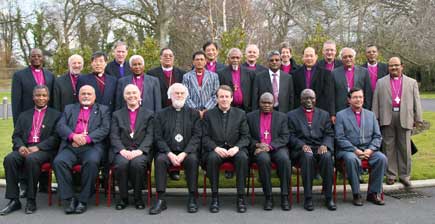
The Primates in the Dublin sun
I prefer the French: Réunion des Primats
Which leaves the rest of us and the extraordinary Primates' Meeting.

Days 1 & 2, once the preliminaries were over, focused on the substantive issues that Primates face in their own Provinces, not on the Communion itself.

Day 3 began with 'Primacy'. I suspect this is a hot issue now for two reasons. First, the Primates (who, being more elevated, see further than most) were trying to articulate their role in a Church that they can see has already changed - much ecclesiological reflection is post hoc self-justification. The second reason was evident in their method. They took a detailed look at the differences between their roles, activities and powers in the different provinces. This is about the polity of the church, not theology, about preparing to work better in the new Anglican Communion, whatever shape that will have.

The ecclesiological emphasis was also predominant on Day 4. The Archbishop of Burundi, Bernard Ntahoturi, presented the reflections of The Inter-Anglican Standing Commission for Unity, Faith and Order (IASCUFO), a merger of the Inter-Anglican Standing Commission on Ecumenical Relations and the Inter-Anglican Theological and Doctrinal Commission.  Snappy.
He told fellow Primates that the December meeting of IASCUFO in South Africa saw the members work in four groups: one studying the definition of ‘church’. Archbishop Bernard said, “We are asking: ‘Is the Anglican Communion a Church or a communion of Churches?’” The second group is looking at the Anglican Communion Covenant and resources for studying it. The third group is studying the Instruments of Communion, their theological meaning and how they relate to one another. The fourth group is considering the topic of ‘reception’, that is how the work of the Instruments and of ecumenical dialogues is communicated and understood at all levels of the Anglican Communion.
Day 5 concluded this ecclesiological thread with discussion of the Primates' Standing Committee.  It then moved to other matters: gender-based violence and 'a range of [other] issues of international concern'.

Archbishop Bernard Ntahoturi &
Primus David Robert Chillingworth
Press Conference: Photo ACNS
The briefing for Day 6 opened with a somewhat defensive note that 'These briefings have been prepared on a daily basis by Anglican Communion Office staff with oversight from a variety of Primates representing different parts of the Communion.'  They tidied up a number of documents for promulation and held a press conference (podcast - I listened but could barely hear most questions and wasn't much enlightened by the answers). They concluded with Communion.

The official papers are available here.

Primatology
I think George Conger is right: it is the end of the Communion we once thought we knew.

The Primates' meeting is to be a consultative forum with no powers of instruction or direction. Powerful and influential, certainly, but these stem from the role of participants within their own Provinces, not across provinces. As the Primus said in the press conference, this is a Communion of independent provinces.

Gonger is also right about the concentration of powers in the hands of the Archbishop of Canterbury.  The Standing Committee is to be the Archbishop's 'consultative council'. In effect the Diocesan structure of the English Church is writ global: the monarchical Archbishop rules and courtiers advise. They have no veto.

A Communion for the twenty-first century
So this would now seem to be the shape of the Communion:
  • Each province is autonomous.  
  • There is a stronger recognition of the differences of structure, decision making and distribution of powers within each province. Pressures towards harmonisation have been rebuffed.
  • The motif of 'family' has resurfaced, specifically in its aspect of 'blood is thicker than water', i.e. we disagree but continue together. Clearly this is only true for those family members who are prepared to stay together.
  • There is a renewed emphasis on regionalism, facilitated by the Primates' Standing Committee. This will be a difficult trick to pull off effectively: on the one hand the centralising agenda will still pull matters towards the Archbishop of Canterbury and, on the other, the defence of autonomy will pull people apart. However, if successful, regional groupings could well supply an intermediate layer of debate and discussion which will enable better co-ordination of a looser Communion to the benefit of all.
  • It is an ever more clerical Communion. Unless regional meetings include the laity as full participants they will reinforce the dominance of  bishops.
  • The more deliberative nature of the Lambeth Conference (if continued) and Primates' Meeting will leave a vacuum. Some people will always want clear and authoritative statements despite and because it's a murky and ambiguous world. There will still be a demand for the equivalent of Lambeth Conference Resolutions - but these should remain of moral and persuasive authority, given force only when incorporated in each separate province following their own distinct procedures . 
  • Power will flow to the Archbishop of Canterbury. Leadership of global deliberation will flow to the international consultative bodies. Thus power will flow to the Anglican Communion Office. Information and administration is power and it will all go though the ACO & Lambeth Palace staff.
  • The Anglican Consultative Council will be marginalised.  Like an English Deanery Synod it will make work for itself but its primary function now is merely to vote for (some of the) members of the Standing Committee of the Anglican Communion.  
  • The SCAC itself, which briefly looked as though it would hold the Communion's strings, will become a rubber stamp to endorse decisions made between the Archbishop of Canterbury, the General Secretary of the Communion, the ACO & Lambeth Palace staff.
The place of the Covenant in this is not clear.  Clearly the Covenant is not dead.  The logic of this shape of the Communion would marginalise it, perhaps draw any teeth, but the question remains: will the Covenant be an effective document or will it now join the honoured ranks of documents with little or no consequence?

I'm still afraid it's the former. If passed the Covenant contains so many powers-in-embryo that it will inevitably be used.

[Slightly amended 6/2/11]  

23/01/2011

To go forwards, look back

Bishop Mouneer Anis
The widely respected Bishop of Egypt, Mouneer Anis, has pushed another nail into the Communion's coffin.

In a conference speech he calls for a return to true Anglican values that are both Scriptural and conciliar.  Yet in asking to go back he is in fact setting off in a new direction.

He shares the general conservative analysis that in many parts of the Communion there was a generation of clergy and laity who were not grounded in Scripture and who do not believe in the credal essentials of the Christin faith.

But he also sees more of value in the Anglican tradition than many conservatives appear to.  In particular he would like to see the Lambeth Conference and the Primates' Meeting playing a truly conciliar role, giving them authority in matters of faith and order, including the interpretation of Scripture.

Not in Communion as constituted at present, of course, too much trust has been lost and too many have strayed from the orthodox path. And Lambeth 2008 lost almost every shred of its conciliar character with the mistaken idea that 'indaba' meant talking to no conclusion.

He calls on the churches of the Global South, together with other orthodox dioceses, to recover their Anglican heritage and remake it: new conciliar structures would set out the Anglican faith scripturally, definitively and authoritatively.

Bishop Anis is a man of integrity and ability.  He is standing with those who no longer have time for the Communion as it stands and who will no longer be distracted from his task by its time consuming dysfunctionality.

So (if Bishop Anis' words are heeded) the irony will be that the Covenant, nominally designed to hold the Communion together, will come to bind those who never wanted it in the first place.  Those who wanted a Covenant to discipline TEC and other provinces will go off and establish their own, conciliar framework.

22/01/2011

Primatial boycott

Global South Primates in Singapore last April
The primates of the Global South have set out (at least some of) the reasons they are not attending the next Primates' Meeting in Dublin.

Of course they point to the consecration of Mary Glasspool - and TEC's refusal to listen to the entreaties of other parts of the Communion - as the occasion for their decision.

But the complaint which evokes most of their righteous indignation is the manner in which the Dublin Meeting has been planned:
... there was hardly any timely and intentional prior consultation and collegial engagement of all concerned (or at least as many as reasonably possible) in preparing for the Meeting to ensure certain degree of significant and principally legitimate outcome to hold and move the Communion together. In light of the critical importance of the Meeting, the preparations are gravely inadequate. As it stands, the Meeting is almost pre-determined to end up as just another gathering that again cannot bring about effective ecclesial actions, ...
They asked for the meeting to be postponed, but they were disappointed.  Or, in other words, they were not able to dictate the agenda or the outcome or the timing.

They also set out their unconditional terms for their continued engagement in the Primates' Meeting and, I guess, other Communion processes:
Unless and until there is unequivocal commitment to honour the agreed basis of Lambeth Resolution 1.10 and implement the decisions of previous Primates’ Meetings (2005, 2007, 2009) expressed in the respective Communiqués, especially that of Dar es Salem 2007, it will only lead to further erosion of the credibility of the Primates’ Meeting and accentuate our failure to honour the work already done by them. (emphasis added).
It remains to be seen how many will actually boycott the meeting. I guess the number and the names will accurately reflect the line of schism. My suspicion is that the most hardline will absent themselves and leave, but that a fair proportion of conservative Primtes will attend and remain, maybe covenanted and certainly dissatisfied - but it will be clear that TEC will remain in the Communion and the western liberals will have won.

But the legacy will be unhappy for years to come.

24/10/2010

all in the same boat

Colin Coward, as always, makes some sensible - grown up - comments about the threatened boycott of the Primates' Meeting here.  he asks, "Should we expect senior Anglican leaders to behave in a mature, adult, non-abusive way?"

Who's looking where we're going?
I remember being told by an assistant  bishop that the Senior Staff of that diocese had once had a consultant in.  They did the lifeboat exercise (you know: what / who would you throw out if your survival was at stake, that sort of thing).   He told that individually they had scored around 80%; as a group they scored just 50%.

I think this is symptomatic.  Clergy are trained into individualism and don't know how to work together.  It becomes a way of life which does not change just because clergy become senior and have to manage people.  Indeed, Dioceses are structured around one person to whom all deference is given - neither factor encouraging effective corporate work.

I've met a couple of people who might attend the Primates' Meetings (one current and one previous) and I've read the words of others.  For the most part I have been impressed by their ability and piety, their perceptiveness and wisdom, as individuals.  It's such a shame that when they get together they can't seem to step from being the big cheese to being merely a large cog in the one machine.

So, yes, we should expect senior Anglican leaders to behave in a mature, adult, non-abusive way.  Or, at least, we should hope so.