Showing posts with label ACC. Show all posts

04/05/2012

Time to open up the ACC


The Anglican version of the Olympic
opening ceremony, ACC Nottingham 2005,
Photo: ACNS
The next meeting of the Anglican Consultative Council in Auckland, New Zealand, begins on October 27th. An outline of events is here (pdf).

Traditionally the ACC has been very circumspect about sharing its deliberations and the event programme says "The ACC needs to get on with its own work in relative privacy,".

But it's not 'its own work', it's the Church's work (and, we would hope, God's work). The secrecy, with only selective and carefully managed press releases coming out of the conference, followed by the bare list of resolutions, is wholly inadequate.
The role of the Anglican Consultative Council (ACC) is to facilitate the co-operative work of the churches of the Anglican Communion, exchange information between the Provinces and churches, and help to co-ordinate common action. It advises on the organisation and structures of the Communion, and seeks to develop common policies with respect to the world mission of the Church, including ecumenical matters. (Anglican Communion site)
From Dave Walker
The ACC is (a) a meeting of representatives from around the world, (b) consultative in its character and (c) of interest to a very large number of people around the world. Representatives should be audible to those they represent, consultation should (as much for its quality and comprehensiveness as for the benefit of others) be as public as possible, public interest is to be taken seriously as a sign of the engaged membership of the global communion.

I accept that members may not want to release the details of everything while debate is still going on. I accept that, occasionally, some matters may be confidential (though, having written that sentence, I puzzle over what would require confidentiality, and on what grounds). But what would be the harm in releasing transcripts or, at least, detailed summaries of each debate once the event is concluded?

Secrecy in government is both necessary and corrosive. As a rule I believe the balance should be struck by beginning with the presupposition that everything is public; exceptions should then be justified on a case by case basis according to previously agreed criteria.
Logo from the AnglicanChurch of Canada

But the ACC is not making judgments on commercial matters, nor dealing with information that's market sensitive. It's not debating matters which entail the disclosure of sensitive personal information. It's not a private club. There are no security implications of its debates. I even struggle to think of issues that it would simply want to hide.

So why is it so secretive? Why is information about its deliberations so sparse as to be almost vacuous? Whose Communion is it anyway?

Time for a new campaign: for an open minded, hearted, and voiced Communion.

05/02/2011

End game

I am now confident that, at last, we have finally come to the beginning of the end of the schism in Anglicanism, though not in a way I had anticipated.

In the US (and Canada?) court cases over property are being settled in favour of the official church and to the dismay of the schismatics. For example: Pittsburgh, Fort Worth and British Colombia.  Legal actions are not finished, of course, but the end of the tunnel grows closer.

It seems that, in some places at least, this is leading to a shaking out of those who really want to go on ideological grounds and reconciliation with those who simply wanted to stay in the places they had always worshipped. The suspension of normal business inevitable with unresolved cases is now over and people can start to get back to normality - even though the landscape has changed.  The senior leadership of a Diocese can concentrate on their primary tasks of leadership, nourishing and dealing with the normal headaches of any organization.

Internationally, the GAFCONites now have sufficient internal cohesion and decision making structures to enable them to be a self-sufficient separate body. They will undoubtedly lay claim to the Anglican brand, at least for a while, but while this may be confusing it is just a minor irritant.

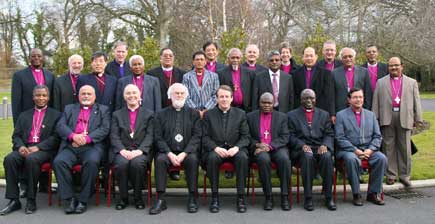
The Primates in the Dublin sun
I prefer the French: Réunion des Primats
Which leaves the rest of us and the extraordinary Primates' Meeting.

Days 1 & 2, once the preliminaries were over, focused on the substantive issues that Primates face in their own Provinces, not on the Communion itself.

Day 3 began with 'Primacy'. I suspect this is a hot issue now for two reasons. First, the Primates (who, being more elevated, see further than most) were trying to articulate their role in a Church that they can see has already changed - much ecclesiological reflection is post hoc self-justification. The second reason was evident in their method. They took a detailed look at the differences between their roles, activities and powers in the different provinces. This is about the polity of the church, not theology, about preparing to work better in the new Anglican Communion, whatever shape that will have.

The ecclesiological emphasis was also predominant on Day 4. The Archbishop of Burundi, Bernard Ntahoturi, presented the reflections of The Inter-Anglican Standing Commission for Unity, Faith and Order (IASCUFO), a merger of the Inter-Anglican Standing Commission on Ecumenical Relations and the Inter-Anglican Theological and Doctrinal Commission.  Snappy.
He told fellow Primates that the December meeting of IASCUFO in South Africa saw the members work in four groups: one studying the definition of ‘church’. Archbishop Bernard said, “We are asking: ‘Is the Anglican Communion a Church or a communion of Churches?’” The second group is looking at the Anglican Communion Covenant and resources for studying it. The third group is studying the Instruments of Communion, their theological meaning and how they relate to one another. The fourth group is considering the topic of ‘reception’, that is how the work of the Instruments and of ecumenical dialogues is communicated and understood at all levels of the Anglican Communion.
Day 5 concluded this ecclesiological thread with discussion of the Primates' Standing Committee.  It then moved to other matters: gender-based violence and 'a range of [other] issues of international concern'.

Archbishop Bernard Ntahoturi &
Primus David Robert Chillingworth
Press Conference: Photo ACNS
The briefing for Day 6 opened with a somewhat defensive note that 'These briefings have been prepared on a daily basis by Anglican Communion Office staff with oversight from a variety of Primates representing different parts of the Communion.'  They tidied up a number of documents for promulation and held a press conference (podcast - I listened but could barely hear most questions and wasn't much enlightened by the answers). They concluded with Communion.

The official papers are available here.

Primatology
I think George Conger is right: it is the end of the Communion we once thought we knew.

The Primates' meeting is to be a consultative forum with no powers of instruction or direction. Powerful and influential, certainly, but these stem from the role of participants within their own Provinces, not across provinces. As the Primus said in the press conference, this is a Communion of independent provinces.

Gonger is also right about the concentration of powers in the hands of the Archbishop of Canterbury.  The Standing Committee is to be the Archbishop's 'consultative council'. In effect the Diocesan structure of the English Church is writ global: the monarchical Archbishop rules and courtiers advise. They have no veto.

A Communion for the twenty-first century
So this would now seem to be the shape of the Communion:
  • Each province is autonomous.  
  • There is a stronger recognition of the differences of structure, decision making and distribution of powers within each province. Pressures towards harmonisation have been rebuffed.
  • The motif of 'family' has resurfaced, specifically in its aspect of 'blood is thicker than water', i.e. we disagree but continue together. Clearly this is only true for those family members who are prepared to stay together.
  • There is a renewed emphasis on regionalism, facilitated by the Primates' Standing Committee. This will be a difficult trick to pull off effectively: on the one hand the centralising agenda will still pull matters towards the Archbishop of Canterbury and, on the other, the defence of autonomy will pull people apart. However, if successful, regional groupings could well supply an intermediate layer of debate and discussion which will enable better co-ordination of a looser Communion to the benefit of all.
  • It is an ever more clerical Communion. Unless regional meetings include the laity as full participants they will reinforce the dominance of  bishops.
  • The more deliberative nature of the Lambeth Conference (if continued) and Primates' Meeting will leave a vacuum. Some people will always want clear and authoritative statements despite and because it's a murky and ambiguous world. There will still be a demand for the equivalent of Lambeth Conference Resolutions - but these should remain of moral and persuasive authority, given force only when incorporated in each separate province following their own distinct procedures . 
  • Power will flow to the Archbishop of Canterbury. Leadership of global deliberation will flow to the international consultative bodies. Thus power will flow to the Anglican Communion Office. Information and administration is power and it will all go though the ACO & Lambeth Palace staff.
  • The Anglican Consultative Council will be marginalised.  Like an English Deanery Synod it will make work for itself but its primary function now is merely to vote for (some of the) members of the Standing Committee of the Anglican Communion.  
  • The SCAC itself, which briefly looked as though it would hold the Communion's strings, will become a rubber stamp to endorse decisions made between the Archbishop of Canterbury, the General Secretary of the Communion, the ACO & Lambeth Palace staff.
The place of the Covenant in this is not clear.  Clearly the Covenant is not dead.  The logic of this shape of the Communion would marginalise it, perhaps draw any teeth, but the question remains: will the Covenant be an effective document or will it now join the honoured ranks of documents with little or no consequence?

I'm still afraid it's the former. If passed the Covenant contains so many powers-in-embryo that it will inevitably be used.

[Slightly amended 6/2/11]  

13/07/2010

Constitutional mayhem

One route through the constitutional hurdles

1) The actions of the Archbishop
If the Archbishop of Canterbury, merely by virtue of his office, has the effective power to instruct the Anglican Communion Office to sanction the US Episcopal Church (TEC) and threaten the Churches of Canada and the Southern Cone - then what's the point or power of the Standing Committee of the Anglican Covenant (SCAC)?

If the SCAC can be instructed, even by their Chair, are they not failing in their duty as trustees of the Communion?

What is the constitutional position of the Anglican Communion Office (ACO)? Is it entirely the arm of the SCAC or does it have powers in its own right or does the Archbishop of Canterbury command it, or parts of it?

2) TEC, ACC and the Covenant

The Covenant will create a new basis of Anglican fellowship - i.e. the community of those who sign. How will this group relate formally to the legally constituted ACC?
If TEC fail to sign the Covenant they cannot thereby, so far as I can see, be expelled from the Anglican Consultative Council (ACC) - unless the new (still secret) constitution makes it possible, which I doubt because of the time it's taken to create and agree the new constitution.
The supposition is that the Covenant group will call the shots of inclusion / exclusion. But by what mechanism? The SCAC is allocated certain roles in relation to the Covenant but the Covenanters (apologies, Scotland) are not given a voice or forum merely by virtue of their signatures. The ACC, which may contain non-signatories, remains the only formal assembly.

3) Accountability

The ACC elect most of the members of the SCAC either directly or by election of officers of the ACC who are thereby ex officio members of the SCAC. Can they also call the SCAC to account by virtue of the threat to vote them out? Is (as I suspect) the SCAC already effectively independent of the ACC, a position reinforced by the adoption of the Covenant?
The Archbishop of Canterbury is inherently unaccountable. Is it right that one unaccountable individual should be able to command some or all of the other Instruments of Communion?

4) The Primates’ Meeting

The Primates' Meeting has, I suspect, been effectively neutered in the allocation of the Communion's power, except insofar as it elects one third of the SCAC. It has been the focal point for a great deal of conservative rhetoric and frustration. A kettle with a tiny spout is liable to explode when it boils.

Anyway, anyone might be led to draw the conclusion that constitutional niceties are irrelevant and only actual power counts.


Covenanters praying in the countryside, watched by the Archbishop's horsemen?


01/05/2010

Fragments and secrecy

The ACC's new constitution has been voted for by at least two-thirds of the members of the ACC between their meetings in Nottingham, UK in 2005 and Kingston, Jamaica, 2009.

And (all credit to the managers in one sense) the constitution - and the Memorandum and Articles of the new charitable company - don't appear to have been leaked into the public domain.

So I asked around and the only reference my correspondent on General Synod could find to these changes was:

From the House of Bishops meeting January 2007


1. Deemed Procedure

The following Reports and papers were either agreed or noted under the House’s deemed procedure:
(iv) Anglican Consultative Council: Proposals for Constitutional and Procedural Reform
It scarcely makes the heart race. I could find no reference to it on the General Synod website.

The inference must be that the Church of England voted in favour of the changes and the bishops were informed. (I'm guessing that 'deemed procedure' means there was no debate in the House of Bishops.)

Who the 'Church of England' was that voted, I don't know - presumably the representatives on ACC. If so, they took a considerable amount on their own backs without public discussion - Synod is, after all, the Church of England by representation.


But I want to make a wider point: much too much has been done behind closed doors. If power can be accrued by discussion and deals in secret there is every reason to believe that this way of working will be embedded in the new structures of the Communion.

Those 'in the know' will have no incentive to share. Those who would like to be 'in the know' will have every incentive to learn the ways of discretion and secrecy.

This may make life easier in the short-term for power-brokers and bureaucrats but in the longer term it will sap the commitment and energy of the church, it will lessen the willingness to participate and engage with bigger questions, it will limit the quality of decision making, and it will engender increasing resentment amongst those who have no voice.

Furthermore such secrecy is a direct denial of the voluntary nature of Church membership. It is a denial of the episcopal nature of the Church in the sense that decisions won't be taken by bishops whether alone or in synod. Decisions will be taken by a few - some of whom may chance to be bishops - but most bishops will simply be told what has been decided. And some of the few will be lay people or ordinary clergy. But they will be few.

And for decisions read 'authority'. Authority in the church is leaching from bishop-in-synod to small groups of people in the loop.

To keep information amongst a small group is a rational and understandable response to the communications capacity of the internet. Most internet chatter (including this) is ill-informed, speculative, partisan, sometimes malicious and always a nuisance to those who are trying their best to undertake the serious task of church leadership.

But an equally rational response is to engage in a careful, planned, positive and informative manner, putting as much as possible into the public domain as soon as possible.

Of course every organization rightly and properly has to consider the public statements it makes and some things should not be posted for the world and her uncle to see. But let the presumption be in favour of openness and disclosure (including the rules as to what should not be disclosed and the timetables for making matters public). Some poeple will always fret and want more, but we will know where we stand.

We currently have the farce of a consultative body (the ACC) keeping their consultations secret. We have the offence of a governing body (the SCAC) being set up without any formal notification that it was being done - let alone the rules by which governance will be exercised.

We will end with the tragedy of a Church led by small groups in close touch with one another and increasingly distant from every other member. The attempt to concentrate authority and to make it forceful and effective (to cite the Windsor Report) will in the predictable result in a loss of credibility and deep unhappiness across the body of Christ.

14/02/2010

Discretionary money


Alongside the formal structures of the Anglican Communion are two linked funds to which members of the AC can apply for assistance.

On the global scale of things they don't offer big money (though no doubt invaluable to recipients) and they are not big funds. But they are significant in that, in addition to grant aid around the Communion, they also give the ACC a degree of flexibility and the potential for new developments at a Communion-wide level which would otherwise be very difficult to fund.

The funds are:

The Archbishop of Canterbury's Anglican Communion Fund (Charity Commission pages) It doesn't seem to have its own website.

and a US parallel - The Friends of the Archbishop of Canterbury's Anglican Communion Fund (website)

Funds are built up from a linked trust: the Anglican Investment Agency Trust (website, Charity Commission pages). Investment firms give the equivalent of "50% of fees from participating accounts."

There seem to be three main groups grants / beneficiaries:

  • A Personal Emergencies Fund for "urgent or critical medical needs of bishops, clergy, lay-workers, and their families or dependants." (Anglican Communion website - page looks old - 2001-2001? - and is not dated. I guess this fund was at some point rolled into the newer, larger, present fund.)

  • Grants to central Communion structures (not least the Office of the Anglican Observer at the United Nations, the Network for Inter Faith Concerns, and the Anglican Centre in Rome)

  • General grants (e.g. for new projects, to help rebuild after natural disaster and some new construction projects, to strengthen governance in weaker dioceses) Some headings are vague: 'to support the Church in Myanmar'; and some intriguing, e.g. Cuba: 'Relief for results of a sudden unexpected reduction of diocesan revenue by more than half'', though no doubt all are worthy.
All listed here. Go to 'Successful Grant Applications 1997-2007' and in the Annual Reports of the ABC's Anglican Communion Fund available through the Charity Commission site.

There are two key political points to be made about these funds.

First they shows the degree to which communion-wide work which is dependent on discretionary grants and, conversely, the limitations of central funds for innovative work.

Second, their personnel ae overwhelmingly UK and US - reinforcing complaints, especially from Africa, that the Communion continues to be run from Washington and London.


I can't tell much from the list of American Trustees though it is clear that Mr and Mrs Carr are the key people and all of them seem to be powerful money people - The Rev Steven K Green, for example, is (or was) Chief Executive Officer, HSBC Holdings.

The three trusts are closely linked through overlapping trusteeships and, in turn, overlap with the Standing Committee of the Anglican Communion. The trustees of the ABC's Anglican Communion Fund are nominated by the ACC, the AIA trust (above) and the Primates' Standing Committee. Others are co-opted (in 2008 - the Anglican Observer at the UN, the Bishop of Peshawar, Emmanuel Olatunji from the Council of Anglican provinces of Africa, and from USPG and CMS. There are three ex-officio trustees: the ABC himself, the Chair of the Inter-Anglican Finance Committee and the Secretary General of the Anglican Communion (sic) who is also ex officio on the AIA Trust.

The critical question will be: how can or will access to these discretionary funds be used as part of the 'relational consequences' which would, under the proposed Covenant, constitute the leverage of the centre over ostensibly autonomous Provinces?

08/02/2010

The centralised state of Anglicanism

Anglicanism now has centralised control over the organs of the Communion and the beginnings of central government in the Standing Committee of the Anglican Communion (see below).

Which raises the question of the manner in which such a body may, can and probably will exercise that control.

Current powers and duties
(Note: non-members are at a considerable disadvantage since it is known that there are new governing documents for the ACC but they are not yet public. I am assuming that no previous powers will have been discarded but it is impossible to guess what might have been added.)

Officially:
The role of the Anglican Consultative Council (ACC) is to facilitate the co-operative work of the churches of the Anglican Communion, exchange information between the Provinces and churches, and help to co-ordinate common action. It advises on the organisation and structures of the Communion, and seeks to develop common policies with respect to the world mission of the Church, including ecumenical matters. (ACC official site).
It is most unlikely that these verbs and roles: 'facilitate' 'exchange' 'help co-ordinate' 'advises' will change. These are servant ministries and will remain invaluable however the Communion develops.

But there are already other verbs and duties which arise from the charitable status of the ACO and the identification of the Standing Committee of the Anglican Communion as trustees. In particular,
Trustees can generally delegate certain powers to agents or employees, but will and must always retain the ultimate responsibility for running the charity. (The Essential Trustee, Charity Commission CC3)
The work may be done by others but the buck always stops with the trustees. It follows that the ACC and Primates may advise the trustees but they cannot instruct it.

The ACC and the Primates' Meetings are financed pout of the general funds of the SCAC.

Indirect powers
The SCAC also has some responsibility for some of the official international working bodies of the Communion. These include:

  • Ecumenical conversations
  • Commission on Mission and Evangelism.
  • United Nations Observer
  • Task Group on Theological Education.
  • Family Network.
The SCAC is responsible for their running costs, either wholly or in part, and by being a conduit through which money is channelled for specific purposes.

I have no way of knowing how independent these bodies are either in theory or in practice.

Informal powers
The SCAC is also responsible for the Anglican Communion website and for communicating the work of the Communion to a global audience.

The ACO sits at the heart of confidential communication and information networks and control of such information is an extremely important soft power.

There are also a couple of grant making bodies open to applications from members of the Anglican Communion closely aligned to the ACO.

Powers to be given to the SC if the Covenant is effected
I do not think that much will change quickly if the Covenant passes. I do think that change will only be in one direction: reinforcing the centre. The Covenant - both by its presence and by any use of its clauses directed at preventing unwelcome innovation - will be a steady engine driving the communion towards a more uniform and more centrally controlled body. In turn this will lead to demands for more (and more public) regulation of the way the central organs operate and thus a steadily greater legalisation of governance.

The final version has thrown out much of the legalistic language and procedures and also much of the sense of threat of sanctions which would meet any would-be doctrinal innovator. The strengthened affirmations of Provincial autonomy are welcome.

But the punitive mechanisms remain. They've simply been transferred from the document into the discretion of those administering the Covenant - the Standing Committee of the Anglican Communion. The powers - to declare that an action or decision is or would be “incompatible with the Covenant” (4.2.6) and to make reccommendations on the relational consequences of un-Covenantal innovation (4.2.5) - remain significant.

The SCAC won't merely 'reccommend' in a kind of avuncular way. Such a reccommendation would almost certainly already be cleared with the Primates' Meeting (5 of whose members would be reccommending), and be made with a fair sense of how the ACC might vote (if it came to a vote). Not to do so would risk losing sight of the issue in a battle over which body governed. Furthermore it would be a reccommendation from a body which controls access to much Communion-wide networks and the common purse.

And there is no need to wait for a crisis in a reactive way. The Covenant proposes to give the SCAC the duty to
(4.2.2) monitor the functioning of the Covenant in the life of the Anglican Communion on behalf of the Instruments (though this may in part be delegated to other committees or commissions)
This is duty of scrutiny and oversight which does not currently exist in the Communion and how it will be conducted is not at all clear.

How the SCAC works internally will become a matter of considerable interest. For example, it met in London in December 2009. The only statement from that meeting was in reponse to the TEC's nomination of a partnered lesbian as a candidate to be Bishop of Los Angeles, decisions in North America to permit formal blessings of same-sex partnerships (and, for balance, continued cross-border incursions). The statement reaffirmed the committee's commitment to the moratorium on such actions.

Does this bind all members, including the Presiding Bishop of TEC? Was the decision reached unanimously or by majority vote? Does its decisions bind all members equally? What weight do the Provinces give to its decisions? Indeed, are its decisions reported to all the Provinces governing bodies? And does this statement not constitute an attempt to interfere with the constitutional processes of a member church - itself a 'cross-jurisdictional intervention'?

Presumably the issue did not take up the whole of the three-day meeting. What other matters were on its agenda? Were absentees able to vote by electronic means? When will its minutes be made public? (Wry, cynical laughter.)

There are no visible checks and balances on the executive power being accumulated by the Standing Committee of the Anglican Communion - and none are envisaged in the Covenant.


Whatever happens, in case of future communion-wide disputes,

these people (and their successors) are the ones to lobby:
  • The Most Revd Rowan Williams ex-officio
  • Canon Elizabeth Paver (Vice Chair, England), a lay canon of Sheffield Cathedral, a former member of the Panel of Chairs of the General Synod of the Church of England and chair of the Board of Mirfield Theological College.
  • The Rt Revd Kumara Illangasinghe (Sri Lanka)
  • The Rt Revd James Tengatenga (Chair, Province of Central Africa) (see here and here)
  • Mrs Philippa Amable (West Africa)
  • The Most Revd Dr Mouneer Anis (Episcopal Church in Jerusalem & the Middle East, resigned) Primate
  • The Most Revd Dr Phillip Aspinal (Australia) Primate
  • The Revd Professor Ian Douglas (TEC) a passionate educator and activist for the worldwide mission of God. A recognized leader in The Episcopal Church and the Anglican Communion, Professor Douglas is a member of the Executive Council of the Episcopal Church, was a member of the Design Group for the Lambeth Conference 2008, and member-elect of the Anglican Consultative Council as a priest representing The Episcopal Church.
  • Dr Anthony Fitchett (Anglican Church in Aotearoa, New Zealand & Polynesia), a family doctor in Dunedin, New Zealand. He trained at Otago and worked as a house officer and registrar at Waikato Hospital. His involvement in the Anglican Church is at local, national and international levels. Dr Anthony became Lay Canon of St Paul’s Cathedral from 1996, was on the Dunedin Diocesan Trust Board from 2006 amongst many other things.
  • Dato Stanley Isaacs (Province of South East Asia), a lawyer by profession. He is the Senior partner of law firm called ‘Isaacs & Davis’ in Kuala Lumpur, Malaysia. He has been a member of the Diocesan Synod and Diocesan Standing Committee since 1980 and founding member of the Provincial Synod. Currently he is chairman of the Diocesan Properties Development Committee and Trustee of the Diocesan Investment Funds.
  • The Most Revd Dr Katherine Jefferts Schori (TEC) Primate
  • The Rt Revd Azad Marshall (Episcopal Church in Jerusalem & the Middle East) originally from Pakistan. Bishop Azad was Area Bishop of the Gulf from 1994 to 2007 and became the Bishop of Iran in 2007. He also is the Director of the Episcopal Inter Faith Center in Tehran, Iran.
  • The Most Revd Dr Barry Morgan (Wales) Primate
  • The Most Revd Henry Orombi (Uganda) Primate
  • Rev Janet Trisk (Southern Africa)
  • Ms Nomfundo Walesa (Southern Africa)
And, of course, the ACO staff - and all those (like the other Primates) who may have the ear of any of these people.


This list was taken from the Charity Commission website and from a press release - the biographical bits - from the last ACC meeting which identified the newly elected. It is odd that the Anglican Communion website does not prominently list the current members, the Trustees of the Communion. Perhaps they should include email / facebook / twitter links?

By the way, the site http://www.anglicancommunion.org/ seems to be a mirror site to http://www.aco.org/ - isn't that a neat symbol?


.


    07/02/2010

    The coup has already occurred


    One of the key objections to the Covenant was that it would lead to a concentration of power within the Communion and a centralising of decision making.

    That doesn’t matter now. Concentration and centralisation have already happened: the coup has occurred and very people seem to have noticed.

    (Some have, of course. See, from a couple of points on the spectrum, Mark Harris, Bishop Mouneer Anis, and the Anglican Communion Institute.)

    The Standing Committee of the Anglican Communion has become the executive body for the Communion and is in the process of arrogating more powers to itself. If the Covenant is passed it will become the governing body of the Anglican Communion.

    How we got here.
    1) Joint standing committees
    From its beginning the Anglican Consultative Council has had a standing committee in order to conduct its business between meetings. This is a sensible and unexceptional arrangement for many organizations, not least an elected body that meets every 3 years.

    In ACC-10 (Panama, 1996) joint meetings of the standing committees of the ACC and the Primates’ Meeting were noted as a ‘recent practice’. The hope, following a suggestion in the Virginia Report, was that the then Standing Committee of the ACC could be expanded ‘to allow an appropriate balance of bishops, clergy and laity, with consideration to age and gender’ [Resolution 6].

    At ACC-11 (Dundee, 1999) and 12 (Hong Kong, 2002) the ACC had its standing committee, the Primates’ Meeting had theirs, and there were also joint meetings. Matters were referred either to the ACC standing committee or to the joint standing committee depending on the nature of the business.

    In 2002 further constitutional revision was requested which was agreed at ACC-13 (Nottingham, 2005) [Resolution 4]. Five Primates were added ex officio to the membership of the ACC in a little class of their own and were appointed to the standing committee.

    In constitutional terms this is quite misshapen. The joint standing committee is thus only partly accountable to each of its different parents and its members are elected by different mechanisms and for different terms (I’m guessing, since the Primates’ mechanisms are entirely opaque). Politically, however, it makes perfect sense to bring the key people of the three most active Instruments of Unity together formally.

    Resolution 6 is indicative of the concern that members of the ACC must have had about their creation. They asked that the standing committee

    circulate the agendas of Standing Committee meetings to all members of the
    Council prior to meetings, and the minutes of the Standing Committee meetings to
    all members of the Council as soon as possible following the meetings.
    Only in this way could they possibly hope to keep any sort of watch on the activities of their runaway child.

    Most recently, at ACC-14 (Kingston, 2009) the ACC asked for a quid pro quo for their largess in allowing Primates privileged access to their Council. They requested that ‘an equal number of non-Primatial members of the Standing Committee [should attend] as non voting participants in the Primates' Meeting.’ Thus the boundaries blur still further. [Resolution 38]

    Furthermore, it would seem (resolution 39) that the ACC now has a new constitution which is operative, has had the assent of two-thirds of its members and yet has not been made public. If this is a straw in the wind it is a worrying indicator of the way the new communion will work.

    This is why the title ‘Standing Committee of the Anglican Communion’ does not appear in the resolutions of the ACC. But it was referred to by Bishop John Patterson in his concluding sermon:
    Anglican polity has always held that it is bishops in synod, or bishops in council, that are able to make decisions that guide the life of the church locally. For the Communion, the Primates’ Meetings cannot do that, although we should be able to look to our Primates for wise guidance and theological insights, but in my view that is quite different from making binding decisions
    from which the rest of the Church is excluded.
    We have now moved to seeing what we have known as the Joint Standing Committee of the primates and the ACC become more simply the Standing Committee of the Anglican communion, possibly meeting more than once a year, with the right balance of Primates, clergy and laity represented. That is a significant advance in the tightening of our structures, a significant advance in helping the four ‘Instruments of Communion’ work more cohesively together, without taking anything away from any of those Instruments.
    2) A charitable company
    In 1978 the ACC was registered as a charitable trust in England (no. 276591). Between 1999 and 2009 discussions led to agreement that the ACC should also be a charitable company. At ACC-13 Memorandum and Articles for this new company were endorsed though not made public – then or now. [Resolution 3] The finances of the ACC have been transferred to this new company.

    The detail of the rules is important (there has been dark discussion of a ‘secret’ constitution on some conservative sites). But there is a much more immediate and significant point. Trustees cannot be mandated by another body but must exercise their own discretion. Directors are legally responsible for the financial and other aspects of their company. They are autonomous.


    and the point of this is ...
    Thus is created the fifth instrument of unity of the Anglican Communion (if we forget, as everyone else apparently forgets, that this accolade was once formally given to Canon Law).

    The Standing Committee of the Anglican Communion is legally constituted, controls the finances of the Communion (except, on this latter occasion, the costs of the Lambeth Conference), and is embedded in the Primates’ meeting and the ACC. It is governed by the law of England and Wales. It gives an account to Companies House and the Charity Commission.

    No doubt it will also report to the Primates’ Meeting and the ACC. But, formally, this is now a courtesy. Neither of these bodies can instruct the SCAC and, if its members accepted such instruction, they would be at risk of breaching their duties as trustees and directors.


    The effect of the Covenant
    In this setting the Covenant takes on a new significance. The ACC has given all its powers (except those specifically reserved to the Council) to its standing committee (previous Constitution, Article 8). Presumably, though its procedural rules are not online, the same applies to the Primates’ Meeting.

    The point and effect of the Covenant is now this: to turn the Standing Committee of the Anglican Communion into a body which, whatever its origins, will have significant powers of governance in its own right – in fact, a whole new tranche of powers which do not currently exist.

    The Standing Committee of the Anglican Communion will thus become the regulator of relationships between Provinces. It will have the capacity to limit the degree of participation Provinces may have in the communion’s Instruments of Unity – and potentially also its commissions, working groups and other international bodies. All, that is, except one: invitations to the Lambeth Conference will remain in the personal gift of the Archbishop of Canterbury.
    .

    09/05/2009

    Turn up for the books (2)


    The Archbishop of Canterbury listening at the ACC

    Covenant - but not yet


    The ACC have endorsed the Covenant, which was no surprise, but have batted away the crucial Section 4 for further reflection and revision (The Lead; ENS; Colin Coward for Changing Attitude).

    They have handed the partridge to the poacher with the instruction, 'see what you can do with it'.

    The Joint Standing Committee of the ACC and Primates' Meeting will now have to decide what to do. As this Committee was to be given considerable powers under the RCDC (the latest version of where to centralise control of the Communion) this is unlikely to lead to a lot of change. The ACC has also given the Committee authority to approve their own deliberations. They have, however, specified that only existing members of the Anglican Communion shall receive a copy with a view to ratification.

    I guess the goal will be the minimum sufficient tinkering for acceptability. Nonetheless that will mean tinkering a little further away from a punitive or juridical approach.

    I still don't like it, whatever they do. Once in place the Covenant will sit on the (fat) books of Anglican documents until another leader or two comes along and says - 'this is unenforceable; give us the powers to make it work'. Little by little, dispute by disagreement, power will leach from the Provinces to the central structures. It's the ratchet effect: whoever heard of a major organization returning to the periphery powers it had once centralised?

    Still no word on budget, I note. Still no word on subsidiarity.


    .

    Turn up for the books (1)

    Rt Revd James Tengatenga

    On Friday May 8, 2009 the Anglican Consultative Council broke into enthusiastic applause with the announcement that the Rt Revd James Tengatenga was elected as the new chair of the Anglican Consultative Council.

    The official announcement and biography here.

    There is a suggestion - highly credible - that the 'schismatic camp' don't like him. Not surprising as he is on the International Board of the MCU's journal Modern Believing.

    (To be honest, I don't know what the Board does in practice. If it's active, it's not evident. But as a symbolic association the schismatics will be mightily displeased.)

    Nor should anyone expect him to be a western liberal (see here and here). Perhaps what his election represents is less about the split in TEC and more about the africanisation of the Anglican Communion - and an African who can straddle both the old (English & US dominated) communion and the new is ideally placed for such a post.

    I offer him my congratulations. I hope the next few years are more placid than the last