12/02/2011

Doors slammed shut! Windows blown open?

Observer chided me after my End game post not to be defeatist about the coming shape of the Communion and suggested I focus again on opposition to the Covenant.

I take both points. But first,

The war is over. Really.
Archbishop Fred Hiltz making a point
My basic assertion in that post, that the war is now over, was reinforced by an interview given by Fred Hiltz, Primate of Canada, who said,
But I have to say that this meeting was not in any way dominated by discussions around sexuality. In fact, you actually would have to pull very hard to find references to it in our plenary conversations, which is amazing…The last few primates’ meetings have just been dominated by that issue, [the] actions of certain provinces and the reactions of other provinces to those actions, people not going to the Eucharist. None of that happened, everybody participated fully in every aspect of the meeting…People were together at the Eucharist, they were together at tea, they were together at plenary, they were together for prayer, for meals. There was a real sense of community there… The blessing of same-sex unions was just not a big ticket item, not a topic of discussion at this meeting. Not only was it not a big ticket item but nobody was saying, “When are we going to get to this issue?” which was quite profound.
Likewise, with the [proposed Anglican] Covenant…there was a general feeling that…we need to let the provinces have the conversations…and we’re not going to enter into a big conversation about it until our provinces have spoken.
The point was made that a number of the people present would share GAFCON's attitudes on the key divisive issues. But for the first time for a long time the Primates' focus was on working together - a focus only made possible by those who were absent.

I stand by my description of how I see the Communion shaping up (centralised in the Archbishop of Canterbury, the General Secretary of the Anglican Communion and their respective officials, clericalised, women and laity further marginalised, the distance from centre to edge getting ever greater).

But I will make a significant qualification.

A kairos moment
The end of the civil war gives a brief moment for debate on what the Communion might look like. The idea of changing it has been very widely accepted. Significant changes have already been made. But we no longer need to look at the Communion through the lens of civil war or the foci of sexuality, biblicism and accusations of colonialism. These remain important issues but, fairly abruptly, the steam has gone out of them and the engine driving them has departed on a side-line.


So the qualification of my previous post is this: now is a brief moment for ecclesiological speculation which could lead to a different kind of understanding of the Communion.

What I have described as happening now is only one possible future. There are always alternatives.

An every member church
I would like to see a church in which every member is valued as a fully adult person and constituent of the church.  That is, valued as members of the church per se, consciously setting aside what have recently been prior questions of gender or sexuality (or, for that matter, any other irrelevant consideration).

In the Church of England lay members are not valued particularly highly.

I am sure it is different in other parts of the Communion though I don't know any of them well enough to know how it works in practice. One possibility in the new Communion might be debate on the place of laity-clergy-bishops and the different ways in which members are involved in and excluded from aspects of church life in different parts of the Communion.
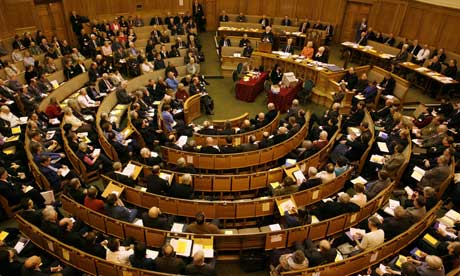
The Church of England's General Synod in session
In the Church of England, for example, lay people do not directly elect their representatives on the Church's governing bodies. Those on a parish's electoral roll elect members of deanery Synods. They are the constituency which elect members of Diocesan and General Synod. In the 1960s when the synodical structures were being created there was much discussion of the cost of universal suffrage in the Church. To put it another way, it was decided that the laity weren't worth the money - even though it was also pointed out that it was the laity who provided the money.

(A sidelight to illustrate my point. I did a Google search for pictures for this post. In the first few pages of each search there were lots of pictures of General Synod, one or two of a Diocesan Synod in session, none of a Deanery Synod meeting. Not even worth the record.) 

You can also see members' (lack of) importance in the way information is collected. No Diocese can communicate directly with its members because it does not have a list of them. Dioceses collect the numbers of people on electoral rolls (because numbers are important) but not names and addresses, except for parish officers and elected representatives.

The whole ethos of the CofE is monarchical. The further from the monarch - princes, to be more accurate - the less important people are. Deference remains rife. Like the British state the Church is a constitutional monarchy but, unlike the state, the Church puts relatively little emphasis on the constitutional half of the equation.

There was once a previous opportunity to debate these issues
Fifty years ago there was a brief flowering of publications and debate about the laity in the church spurred and supported by the World Council of Churches' Department of the Laity and the sense that the times they were a'changing.  It didn't last.
Bishop John Robinson
Bishop John Robinson was a prominent participant. In A New Reformation? he promote a new vision of an ‘accepting church’ which met people where they were and accepted them for who they were. This church would comprise small nuclei of people scattered like seeds through the world. By contrast church structures, which sustained barriers of clericalism, professionalism and sexism were potentially heretical. They would have to be overcome by a truly lay theology which would find ‘... its creative source to be the engagement of the laos in the life of the world.’ (p. 63). This lay-centric church, by contrast with what it inherited, would be a reinvigorated community, true to its nature as an instrument of God’s Kingdom.

The enthusiasm didn't survive and more conservative voices won the day. In 1959 Robinson proclaimed that great things were afoot in the Church of England, the tide had turned. In 1969 he wrote in On Being the Church in the World that the tide had indeed turned, but 1960 had proved to be the high water mark, not the beginning of a new ecclesiastical order.

General Synod was first proposed in 1953. In 1965 its structures might have been agreed but were sent back for more work. By 1969, when finally agreed, the place of the laity had been further weakened. For example, one of the roles of the Deanery Synod is to debate matters which are debated in Diocesan Synod. In the earlier draft they were to do so 'beforehand'. To debate issues before the debate at Diocesan Synod would have given Deaneries a significant influence in the affairs of the Diocese. To debate matters after a decision is irrelevant. In 1969 the word 'beforehand' had been removed - and I don't believe that change was ever publicly acknowledged or discussed.

The Covenant
My desire for an every member church is one root of my continuing opposition to the Covenant.

Even if the unsavoury and punitive aspects of Section 4 were removed the Covenant would still serve to reinforce the centralising of power and strengthening of hierarchy. It will make the distance from pew to decision-making even further than the miles that already divide them. It will further marginalise ordinary members of the church. It is time to look again at the base on which the whole organization of the church stands. Now is, I think, a brief opportunity to do so.

Doctrine, ethics, spirituality, worship, polity are all essential and constitutive - and are all meaningless unless they are embodied in the daily lives of ordinary faithful Christians. So, act for every member of an every member church and

Vote against the Covenant 

10/02/2011

Funny old world

It's an odd thing, the blogosphere. Posts that leave me feeling smugly pleased with myself attract no comments at all.

I thought 'End game' was stodgily written on a weekend spent ploughing through porridge. But it seems to have been picked up and to have annoyed Philip Turner of the ACI, of all people, and for what it didn't say, of all reasons.

I admit to being quite chuffed.

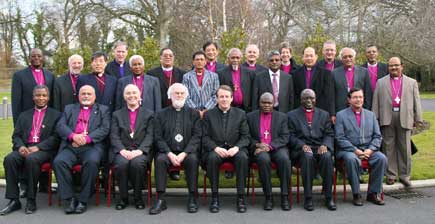
Addressing the Primates in Dublin
What's even more odd is that I agree with Dr Turner, if only to a limited degree. I agree that the concentration of monarchical powers in bureaucratic structures is wholly undesirable and deleterious to the well-being of the Communion.

But for Turner to suggest that 'Clearly a bureaucratically structured federation of autonomous churches meets with his [my] approval.' on the basis of what I have not said is going well beyond the evidence. He could not be expected to look further at my blog but I sincerely hope no-one reading it would deduce that I am at all pleased or satisfied with this turn of events.

On precedent
Turners' complaint that 'It would appear that precedent now means nothing.' is an interesting point. He may mean the term legalistically but I hear it in historical terms. Historical precedent used to be a significant argument (at least in the councils of the Church of England) but it was an expansive concept: to find an historical precedent for some development you wished to make in the present was a strong, but not sufficient, supporting argument in your favour.

I agree that there has been a general dismissal of precedent, but not in Turner's terms. The elevation of biblically-based arguments to be the sole and sufficient grounds for justification of change in the church has very largely driven out historically-based debate and argument. I would like to reassert the importance of historical method and understanding alongside biblical, theological, ecclesiological and other grounds in faithful Christian argumentation.

Historically (at least in the Anglican Communion) the concentration of monarchical powers is indeed unprecedented. But we didn't arrive at it all at once - it has emerged from a series of steps, each a small precedent, taken over the last few years without (I believe) conscious design at the beginning of that process. It is as though the tide has withdrawn and we can suddenly see what is left after the storm has reshaped the beach. Though, just to be clear, I don't think that makes it right.

But I do think it's a bit disingenuous of Turner to generalise quite so far from the disavowal of one particular precedent, the
“enhanced responsibility” Lambeth requested the Primates assume nor to subsequent actions by the Primates intended to exercise that responsibility.
This was substantively rejected sometime ago. And there are other, more collegial and less domineering, descriptions of and statements about the Primates' Meeting that are also precedents.

The coming Communion
I am amused that Dr Turner attributes so much to me on the basis of what I don't say. So such, in fact, that 'Bagshaw’s view of an Anglican future gives the lie to all that God is up to ...' Really? Maybe he's right but all I thought I was doing was describing what I saw happening. I wasn't seeking either to praise or bury it.

Perhaps (and I've done this myself) he's merely using my post as a mirror, conveniently positioned so as to reflect his own views back to him, albeit reversed.  In his writing I see a desire for one particular future for the Communion, in mine he sees no particular future at all. Perhaps both are caricatures?

I am, however, more narked than entertained by one aspect of Turner's article. He accuses me of describing the people in GAFCON as 'minor irritants'. If he'd read the piece more carefully he'd would have seen this was not so. I predicted that GAFCON would 'undoubtedly lay claim to the Anglican brand' and this would be confusing. The confusion, not the people, is the minor irritant.

He and I have been on opposite sides of the trenches in the late civil and although I cheerfully oppose all that the ACI and GAFCON stand for and propound I have never doubted nor impugned their personal or collective conviction, faith or integrity and I hope (and will apologise if I have) that I have never written so casually.

I think Dr Turner agrees with my basic point that we are now looking at the end of the conflict and the beginning of a new pattern of Anglicanism. Yet he does so from the unsuccessful side. He says (and he seems to specialise in being horrified),
amongst those absent from the Primates' Meeting ....
I am horrified by the future Bagshaw foresees because in it he appears to find no meaningful place for those who absented themselves from the Dublin meeting. 
Turner's missed the meaning of the word 'absent'. Those who chose not to be present have chosen not to participate in the councils of the Communion. They were accorded meaningful respect at the meeting but the terms on which they might have attended were not acceptable to the majority. They may be in the right but they are not in the driving seat. Perhaps Turner should explain what meaning (and, presumably, influence) those who absent themselves should have, and why.

Anyway,
All told I'm tickled to have niggled the good Dr Turner.  As to my own views, there's already a half-written post on the way I would like to see things change, though I don't think I'll be able to finish it before the weekend. It would no doubt horrify Dr. Turner should he chose to read it.

*   *   *


And thanks, I think, to Pluralist 


07/02/2011

Whereas ...

The Diocese of East Carolina has voted against the Anglican Covenant.
The 128th Diocesan Convention of the Episcopal Diocese of East Carolina

Whereas, as they say a lot, the Covenant
  1.  sets out a statement of faith, mission and interdependent life for the Communion
  2.  raises the Instruments of Unity to 'governing bodies with unprecedented power'
  3.  states that questions may be raised about another provinces' actions but gives no process for doing so
  4. has the stated purpose to aid proclaiming the gospel, offering God's love, maintain the Spirit in the bond of peace and enable 'all God's people to attain the full stature of Christ' - and yet 'yet can be read as creating a Church of full members, second class members and former members.(ACC 4.2.7)', and
  5. despite the democratic structure of TEC they would be asked to 'submit our processes of discernment to the will of an ill-defined body without checks and balances'
They are happy to keep talking, but do not approve the covenant.

THEREFORE BE IT FINALLY RESOLVED that this 128th Convention of the Diocese of East Carolina requests that the Executive Council of the Episcopal Church to express our desire that any future Covenant presented to this The Episcopal Church represent more truly, and with greater clarity and full recognition of voices of laity and clergy, our Anglican tradition and Christian faith.

Good for them.  It's a small voice against the noises of those who want a covenant and it's very welcome.

05/02/2011

End game

I am now confident that, at last, we have finally come to the beginning of the end of the schism in Anglicanism, though not in a way I had anticipated.

In the US (and Canada?) court cases over property are being settled in favour of the official church and to the dismay of the schismatics. For example: Pittsburgh, Fort Worth and British Colombia.  Legal actions are not finished, of course, but the end of the tunnel grows closer.

It seems that, in some places at least, this is leading to a shaking out of those who really want to go on ideological grounds and reconciliation with those who simply wanted to stay in the places they had always worshipped. The suspension of normal business inevitable with unresolved cases is now over and people can start to get back to normality - even though the landscape has changed.  The senior leadership of a Diocese can concentrate on their primary tasks of leadership, nourishing and dealing with the normal headaches of any organization.

Internationally, the GAFCONites now have sufficient internal cohesion and decision making structures to enable them to be a self-sufficient separate body. They will undoubtedly lay claim to the Anglican brand, at least for a while, but while this may be confusing it is just a minor irritant.

The Primates in the Dublin sun
I prefer the French: Réunion des Primats
Which leaves the rest of us and the extraordinary Primates' Meeting.

Days 1 & 2, once the preliminaries were over, focused on the substantive issues that Primates face in their own Provinces, not on the Communion itself.

Day 3 began with 'Primacy'. I suspect this is a hot issue now for two reasons. First, the Primates (who, being more elevated, see further than most) were trying to articulate their role in a Church that they can see has already changed - much ecclesiological reflection is post hoc self-justification. The second reason was evident in their method. They took a detailed look at the differences between their roles, activities and powers in the different provinces. This is about the polity of the church, not theology, about preparing to work better in the new Anglican Communion, whatever shape that will have.

The ecclesiological emphasis was also predominant on Day 4. The Archbishop of Burundi, Bernard Ntahoturi, presented the reflections of The Inter-Anglican Standing Commission for Unity, Faith and Order (IASCUFO), a merger of the Inter-Anglican Standing Commission on Ecumenical Relations and the Inter-Anglican Theological and Doctrinal Commission.  Snappy.
He told fellow Primates that the December meeting of IASCUFO in South Africa saw the members work in four groups: one studying the definition of ‘church’. Archbishop Bernard said, “We are asking: ‘Is the Anglican Communion a Church or a communion of Churches?’” The second group is looking at the Anglican Communion Covenant and resources for studying it. The third group is studying the Instruments of Communion, their theological meaning and how they relate to one another. The fourth group is considering the topic of ‘reception’, that is how the work of the Instruments and of ecumenical dialogues is communicated and understood at all levels of the Anglican Communion.
Day 5 concluded this ecclesiological thread with discussion of the Primates' Standing Committee.  It then moved to other matters: gender-based violence and 'a range of [other] issues of international concern'.

Archbishop Bernard Ntahoturi &
Primus David Robert Chillingworth
Press Conference: Photo ACNS
The briefing for Day 6 opened with a somewhat defensive note that 'These briefings have been prepared on a daily basis by Anglican Communion Office staff with oversight from a variety of Primates representing different parts of the Communion.'  They tidied up a number of documents for promulation and held a press conference (podcast - I listened but could barely hear most questions and wasn't much enlightened by the answers). They concluded with Communion.

The official papers are available here.

Primatology
I think George Conger is right: it is the end of the Communion we once thought we knew.

The Primates' meeting is to be a consultative forum with no powers of instruction or direction. Powerful and influential, certainly, but these stem from the role of participants within their own Provinces, not across provinces. As the Primus said in the press conference, this is a Communion of independent provinces.

Gonger is also right about the concentration of powers in the hands of the Archbishop of Canterbury.  The Standing Committee is to be the Archbishop's 'consultative council'. In effect the Diocesan structure of the English Church is writ global: the monarchical Archbishop rules and courtiers advise. They have no veto.

A Communion for the twenty-first century
So this would now seem to be the shape of the Communion:
  • Each province is autonomous.  
  • There is a stronger recognition of the differences of structure, decision making and distribution of powers within each province. Pressures towards harmonisation have been rebuffed.
  • The motif of 'family' has resurfaced, specifically in its aspect of 'blood is thicker than water', i.e. we disagree but continue together. Clearly this is only true for those family members who are prepared to stay together.
  • There is a renewed emphasis on regionalism, facilitated by the Primates' Standing Committee. This will be a difficult trick to pull off effectively: on the one hand the centralising agenda will still pull matters towards the Archbishop of Canterbury and, on the other, the defence of autonomy will pull people apart. However, if successful, regional groupings could well supply an intermediate layer of debate and discussion which will enable better co-ordination of a looser Communion to the benefit of all.
  • It is an ever more clerical Communion. Unless regional meetings include the laity as full participants they will reinforce the dominance of  bishops.
  • The more deliberative nature of the Lambeth Conference (if continued) and Primates' Meeting will leave a vacuum. Some people will always want clear and authoritative statements despite and because it's a murky and ambiguous world. There will still be a demand for the equivalent of Lambeth Conference Resolutions - but these should remain of moral and persuasive authority, given force only when incorporated in each separate province following their own distinct procedures . 
  • Power will flow to the Archbishop of Canterbury. Leadership of global deliberation will flow to the international consultative bodies. Thus power will flow to the Anglican Communion Office. Information and administration is power and it will all go though the ACO & Lambeth Palace staff.
  • The Anglican Consultative Council will be marginalised.  Like an English Deanery Synod it will make work for itself but its primary function now is merely to vote for (some of the) members of the Standing Committee of the Anglican Communion.  
  • The SCAC itself, which briefly looked as though it would hold the Communion's strings, will become a rubber stamp to endorse decisions made between the Archbishop of Canterbury, the General Secretary of the Communion, the ACO & Lambeth Palace staff.
The place of the Covenant in this is not clear.  Clearly the Covenant is not dead.  The logic of this shape of the Communion would marginalise it, perhaps draw any teeth, but the question remains: will the Covenant be an effective document or will it now join the honoured ranks of documents with little or no consequence?

I'm still afraid it's the former. If passed the Covenant contains so many powers-in-embryo that it will inevitably be used.

[Slightly amended 6/2/11]  

31/01/2011

A different Church

What kind of church?
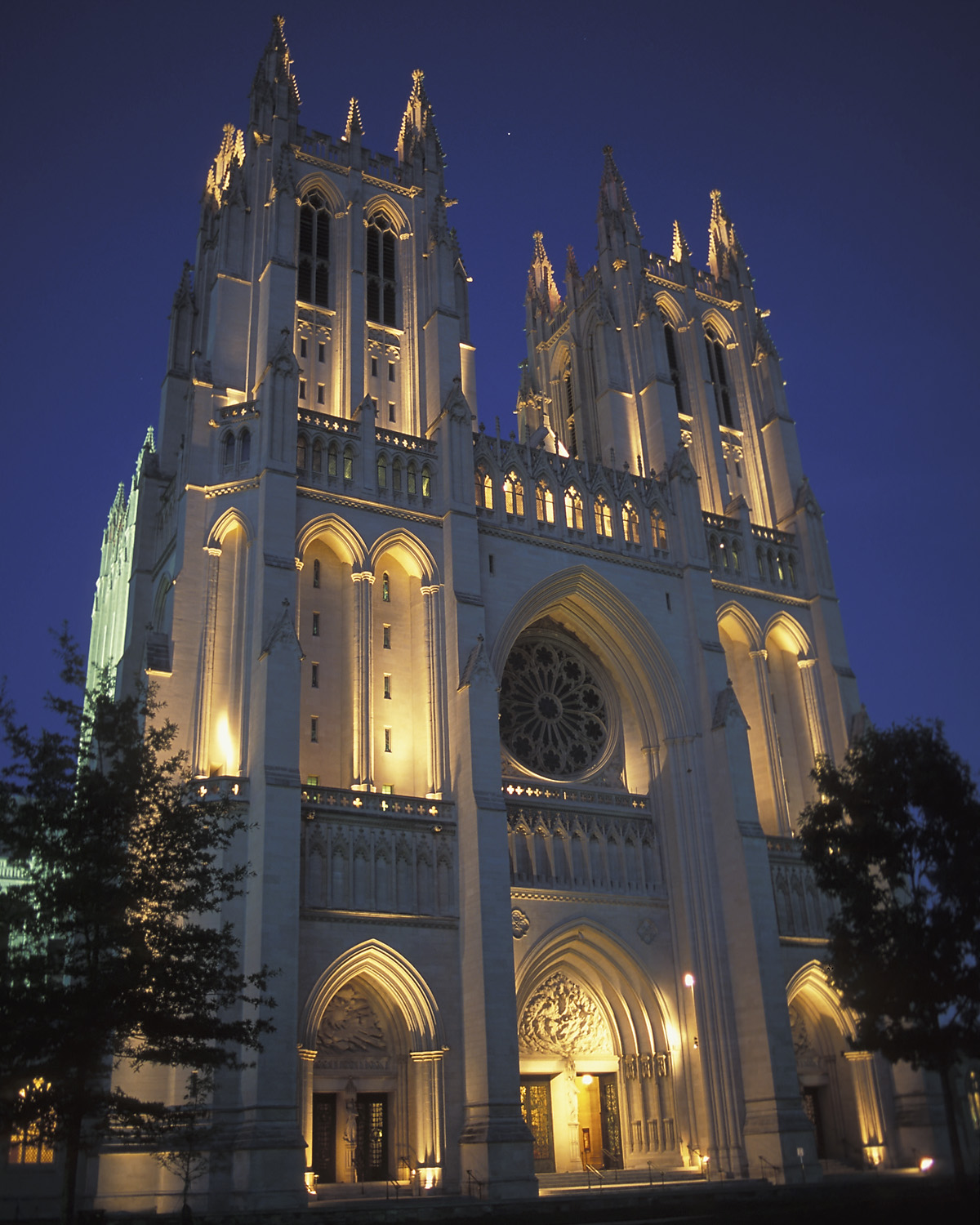
Washington National Cathedral


The question of whether homosexuals should be full members of the church has been the occasion of conflict or, more exactly, it became the focal point of a much deeper and pre-existing conflict.

The underlying compliant has always been that the western church, of which TEC is seen as the forerunner and epitome, has subordinated itself to secular mores, values and agenda.

Instead, say the conservatives, a church should ground itself wholly in scripture and thence oppose the secular world and its values.

In-and-against
I think this is a false dichotomy.

I would assert that every church is inevitably and inescapably in-and-against the state (both secular society and government). The walls of a church are porous, they allow in secular ways of thinking whether those taught in universities at one end of the spectrum or those held privately beneath the public radar at the other end. Their walls also hold their distinctiveness: the Christian faith (as inherited and as lived), special buildings, clear leadership and most important, communal worship.


Ecclesiology 
I suggest that more fundamental questions are: in the context of in-and-against the state, what is the church itself? What could it be?

The critique from conservatives is that the church should be against the state (both secular society and where they fall short of Christian values, secular governments too). A church should proclaim a redemptive critique of the society in which it is set. I note, for example, the statements of the Church in Nigeria criticising corruption and other aspects of the Nigerian State as well as Western morals.


For these conservatives, the authority, content and imperative with which to make such a critique lies wholly in Scripture.

Liberals are not merely perceived to have failed in this redemptive proclamation but to have taken a spiritually fatal step further. They have embedded secular values and structures in the church itself, displacing scriptural values. Thus liberal democratic notions have been allowed to reshape (some of) Anglicanism along secular lines which are antithetic to the things of God. Conservatives regard this as an ecclesiological impossibility, hence the rhetoric of a ‘new’ faith or religion.

Their alternative is an ecclesial monarchy: as God is Lord of the Church so too archbishops and bishops should be lords within an episcopal church.

Ironically this is particularly important for those who put so much weight on the authority of scripture. The authority of scripture is essentially anarchic: everyone who can read the Bible is their own interpreter and, in citing scripture, everyone has the authority of God.

Therefore those who believe that Christians should come together in ordered communities of any sort and who believe that scripture is the sole and sufficient source of authority for that community have a problem. The problem is solved by making church leaders authoritative and authoritarian.


Thus the Word of God was liberated from the control of the Catholic Church and Protestants then imprisoned the reader.

Mouneer Anis
I believe Bishop Mouneer Anis to be a devout and honest conservative and a good spokesman for that strand of Anglicanism. He is utterly convinced of the exclusive authority of scripture and yet still wants to hang onto the importance of Anglican tradition as far as, and so long as, it accords with his valuation of scripture.

He gives examples of the Church of England, and the Anglican Communion, repeatedly reasserting the centrality and authority of scripture. Be because these statements are not binding they are insufficient. As a result the Church has fallen away from the rectitude it once held into its present morass.

He forgets the deeply Erastian nature of the Church of England from the honestly named 1533 Submission of the Clergy Act onwards. He forgets the legacy of conformity to state and society which the CofE bequeathed to much of the Communion – the CofE rejoiced in being the ‘national’ church in as many meanings as it could sustain. He uses statements from the past, like proof-texts, selectively and in a wholly ahistorical manner.

Anis’ remedy is a conciliar-command structure for the church. Difficult or contested questions should be debated by those with the authority to do so (primarily bishops and primates). Once a decision is reached it would then be binding on all believers. Again, he omits to mention that such powers currently reside in a province (depending on its own constitution) and that to grant these powers to the Communion would be a significant innovation.

He also, incidentally, wishes to ‘start Biblical literacy programs’ - to encourage people to read the Bible and, no doubt, to ensure they do so correctly.

A different church
Mouneer Anis is talking about a different church from the one he has inherited.

Conservatives want a command structure where there never was one. They want a church which is wholly and exclusively scripture-based, though Anglicanism never was. They long for a church whose function is to oppose the standards and values of the society in which it is set, forgetting that the Church of England has always been willingly subordinate to the state.


And this is why schism is inevitable.

Undoubtedly some kind of modus vivendi over homosexuality could have been worked out, given time, not least because the vast majority of people are bored with the fight and want to get on with life. We could all learn to agree to disagree over degrees of in-or-against the state practised in the different national settings of the church. The re-assignment of power in the Communion as a result of the conflict is being worked out through the Covenant at the moment.

But conservatives want much more. They want a new church, one never before seen in Anglicanism. Their ecclesiology will not fit into the same shoe as the majority ecclesiology of Anglicanism. Therefore there must be division. Working things out is not an option.

Only this won’t be another Great Ejection, more like a dribbling apart.

30/01/2011

Covenant count: 3 provinces have signed

ACNS tells us that more provinces have signed up to the Covenant,
Archbishop John Holder
The Archbishop of the Province of the West Indies has announced that his Province has adopted the Anglican Communion Covenant. It is the third to do so officially, the others being the Anglican Church of Mexico and The Church of the Province of Myanmar.
It may be that Archbishop John Holder of the West Indies is doing so on a false prospectus:
“Our understanding is that it is not an exclusive document; it does not exclude, but rather it helps to lead people to reflect on their role as Anglicans, and identify their responsibilities as members of the Communion.
“There are no penalties involved if you do not follow the Covenant and that’s an Anglican approach. We try and keep away from penalties. It is not punitive. It invites the members of the Communion to follow a different way, to remember their responsibilities to other members of the wider community, to respect where others are in their journey.”
Or - and I guess this is where South Africa is coming from - these are the terms on which the Province has assented: and any attempt to promulgate penalties will be ignored.  Only that will be in the time of a new generation of Archbishops and who can tell what they will do, being given a power they do not currently possess.

Or, more cynically, this is the public line to convince people they have no reason not to sign.  It is, after all, a fair statement of what the Covenant says - just so long as you ignore (a) the origins of the idea, (b) the publicly stated goal of excluding The Episcopal Church in the US and the Anglican Church of Canada, (c) previous drafts of the Covenant and (d) the institutional framework within which the Covenant will be implemented.

And given the role of the previous Archbishop of the West Indies in creating the Covenant it would have been most impolitic not to join in.

Ramsey wouldn't have liked it

Archbishop Michael Ramsey
Jared C. Cramer over at The Lead has a thoughtful critique of the Covenant based on his study of the theology of Michael Ramsey.  It's worth reading in full.

He contrasts Ramsey's understanding of relationship between living faithfully within the tradition we have received and the documentary inheritance of faith.  For example,
Ramsey consistently praised the “non-confessional” approach of Anglican Christianity, glad that the truth of God expressed in the creeds is a sufficient standard for Christian belief. ...
When Ramsey was in ecumenical meetings, he had deep doubts about the possibilities of engaging the profoundest matters of theology through “high pressure drafting,” asking, “Why should such procedures be the medium through which the Holy Spirit speaks to the Church?” (James B. Simpson, The Hundredth Archbishop of Canterbury (New York: Harper & Row, 1962), 134)
Cramer's final paragraph says,
... One can clearly see the mechanism for separation in the Anglican Covenant, but it is much harder to see the mechanism for deep and abiding relationship. An approach to unity based upon forced policies and lists of doctrine and church principles results in precisely the same problem that created the sin of schism: the idea that one’s own perception of Christian faith is the one that is normative. At the end of the day, however, neither the Primates’ Meeting, nor the (Anglican Consultative Council, nor the SCAC, nor any other group will succeed in telling one bishop or group of bishops with whom they should consider themselves in Communion or in strained relationship. The unity which the Covenant purports to seek will remain out of reach.
Yes. Exactly. But will Ramsey's present successor, whose mind is at least as subtle as Ramsey's was, get the point?

24/01/2011

How authority is transferred

Signing the Covenant will slowly, inexorably convert the Anglican Communion from a family of Churches into one global Church.

Of course it will always carry the DNA of its heritage - not least its anglo-centric culture, its propensity to fit comfortably, complacently with secular power structures, and its manner of grumpy accommodation to changing times and circumstances - it will never be another Roman Catholic Church or World Lutheran Federation.

But it will become a single Church and the Standing Committee will slowly mutate into its government.  You may think this is a good thing, but I don't.  I would like those who do think this development is desirable to campaign for it openly and honestly.  But the opportunity for them to do so has now passed.

The key mechanism by which authority and power will be transferred from currently autonomous churches to the centre lies in section 4.2 of the Covenant.

Photo by Scott Gunn & pinched from KinnonTV
Any signatory may question (4.2.3) a decision or actions of another signatory body or, indeed, decisions or actions they are considering taking.  In itself this would seem to be a good and proper means by which mutual accountability is effected. It sets in motion a process (albeit one that is currently opaque) with the possible result that the central organs of Anglicanism will make a determination of the issue. As things stand at present they can't impose their determination - merely recommend 'relational consequences' (4.2.7).

But don't be deceived.  Once a determination is made it will be 'the teaching of the Anglican Communion', even if no province enforces 'relational consequences'.  From that point on there will be two classes of teaching: (1) official, Communion-wide teaching and (2) local, provincially authorised teaching.  Anomalies will become more visible. The pressure will only be in one direction: to harmonise teaching across the Communion and to do so by seeking more and more central decisions.

I guess that relatively few disputes will in fact trigger the official conflict resolution mechanism.  More likely provinces will look over their shoulders, will self-censor and will seek the informal opinion of the Standing Committee before they act.

And, steadily if unevenly, official, Communion-wide teaching will grow and local decision amking, and confidence in local decision making will shrink.

I also guess that, as soon as the tension drops and decisions are no longer measured as homophobia/homophilia, the very bitterness of the conflict from which we are beginning to emerge will entice all provinces to be more sensitive to one another.  Junior players in today's war will become the Archbishop-Generals of tomorrow. They will seek to effect the lessons they thought they'd learned while fighting.

So: formal determinations, informal organisational actions and personal predilections will all tend in one direction: centralisation.  And once powers have stepped, drifted, been gifted to the centre they will not be returned.

Perhaps, looking some way ahead, the following generation will rediscover the term 'subsidiarity'; perhaps some archivist will read the Windsor report and find it there.   But by then it will be too late, the Anglican Communion will have been rebadged as The Anglican Church.

23/01/2011

To go forwards, look back

Bishop Mouneer Anis
The widely respected Bishop of Egypt, Mouneer Anis, has pushed another nail into the Communion's coffin.

In a conference speech he calls for a return to true Anglican values that are both Scriptural and conciliar.  Yet in asking to go back he is in fact setting off in a new direction.

He shares the general conservative analysis that in many parts of the Communion there was a generation of clergy and laity who were not grounded in Scripture and who do not believe in the credal essentials of the Christin faith.

But he also sees more of value in the Anglican tradition than many conservatives appear to.  In particular he would like to see the Lambeth Conference and the Primates' Meeting playing a truly conciliar role, giving them authority in matters of faith and order, including the interpretation of Scripture.

Not in Communion as constituted at present, of course, too much trust has been lost and too many have strayed from the orthodox path. And Lambeth 2008 lost almost every shred of its conciliar character with the mistaken idea that 'indaba' meant talking to no conclusion.

He calls on the churches of the Global South, together with other orthodox dioceses, to recover their Anglican heritage and remake it: new conciliar structures would set out the Anglican faith scripturally, definitively and authoritatively.

Bishop Anis is a man of integrity and ability.  He is standing with those who no longer have time for the Communion as it stands and who will no longer be distracted from his task by its time consuming dysfunctionality.

So (if Bishop Anis' words are heeded) the irony will be that the Covenant, nominally designed to hold the Communion together, will come to bind those who never wanted it in the first place.  Those who wanted a Covenant to discipline TEC and other provinces will go off and establish their own, conciliar framework.

22/01/2011

Primatial boycott

Global South Primates in Singapore last April
The primates of the Global South have set out (at least some of) the reasons they are not attending the next Primates' Meeting in Dublin.

Of course they point to the consecration of Mary Glasspool - and TEC's refusal to listen to the entreaties of other parts of the Communion - as the occasion for their decision.

But the complaint which evokes most of their righteous indignation is the manner in which the Dublin Meeting has been planned:
... there was hardly any timely and intentional prior consultation and collegial engagement of all concerned (or at least as many as reasonably possible) in preparing for the Meeting to ensure certain degree of significant and principally legitimate outcome to hold and move the Communion together. In light of the critical importance of the Meeting, the preparations are gravely inadequate. As it stands, the Meeting is almost pre-determined to end up as just another gathering that again cannot bring about effective ecclesial actions, ...
They asked for the meeting to be postponed, but they were disappointed.  Or, in other words, they were not able to dictate the agenda or the outcome or the timing.

They also set out their unconditional terms for their continued engagement in the Primates' Meeting and, I guess, other Communion processes:
Unless and until there is unequivocal commitment to honour the agreed basis of Lambeth Resolution 1.10 and implement the decisions of previous Primates’ Meetings (2005, 2007, 2009) expressed in the respective CommuniquĂ©s, especially that of Dar es Salem 2007, it will only lead to further erosion of the credibility of the Primates’ Meeting and accentuate our failure to honour the work already done by them. (emphasis added).
It remains to be seen how many will actually boycott the meeting. I guess the number and the names will accurately reflect the line of schism. My suspicion is that the most hardline will absent themselves and leave, but that a fair proportion of conservative Primtes will attend and remain, maybe covenanted and certainly dissatisfied - but it will be clear that TEC will remain in the Communion and the western liberals will have won.

But the legacy will be unhappy for years to come.

17/01/2011

Creeds, orthodoxy and the Covenant

There are, I think, three groups of questions about the relationship of creeds to orthodoxy:

First, substantive questions:
What must be believed?  What may be believed?  What must not be believed?
Second, interpretative questions:
In what manner must or may or must not these beliefs be held?
Third, determinative questions:
Who decides? And by what mechanism?
The creeds were devised as a way of dividing orthodox from heterodox, friend from foe, in the first four hundred years, give or take, of the Christian Church.  They were originally working documents purporting to encapsulate and express truths which were eternally present but only contingently expressed.

Standing stones on Lewis
By use and antiquity the creeds' propositions have become the inner citadel of What Must Be Believed.  They set out the core intellectual framework of Christianity.  Assent to the Apostles' and Nicean/ Constantinopolitan Creeds is a prerequisite of knowing oneself and others to be orthodox.

The Athanasian creed is widely accepted but out of fashion. Many are uncomfortable with the 'damnatory clauses' that top and tail it.
(In 1872 Archbishop Tait declared to Convocation that ‘not a soul in the room or in the Church of England takes the damnatory clauses in their plain or literal sense.’ The clauses caused ‘distress and alienation of mind’, he said, and were heard as ‘savage words’.)

But the Creeds are not clear like a line on a map.  I suggest that the the individual clauses of the Creeds, and the Creeds as a whole, mark the borders between orthodox and heterodox like standing stones on moorland, way-markers in a complex geography.  All the stones are pretty mossy and chipped by now and, though some have slipped over and smaller ones have fallen from view, most are still clearly visible.

What has changed, repeatedly, is the intellectual and social landscape in which the stones are set.  Sometimes that change has been slow and barely noticed by those who trek across it.  At other times change has been convulsive. This is nothing new, nor is it new to say that the pace of change is quicker too.  I believe this latter observation has been made since the early nineteenth century but it could well have had a longer history. However, it is this combination of shifting contexts and ancient stabilities that make orthodoxy both possible and inexorably problematic.

Therefore:

How do we remain faithful to the witness of the standing stones whilst the landscape is changing around us in unpredictable ways?
And how do we do so in a world which is changing in both different directions and at different speeds in different parts of the world?
The Church of England has only had power to determine its own doctrine from 1974 (in the Worship and Doctrine Measure) and only had this confirmed by the courts in 1992 (over the ordination of women as priests).  Now it's too late: ecumenical agreements and rapid globalisation mean that the CofE is no longer sufficiently autonomous to state and sustain its own doctrine.

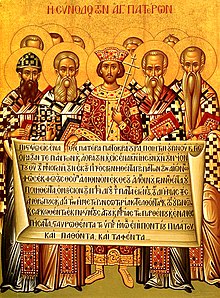
Icon depicting Emperor Constantine
(center) and the Fathers of the
First Council of Nicaea (325)
as holding the Niceno–Constantinopolitan
Creed of 381 - Wikipedia
The Covenant offers only the beginnings of a mechanism for determining doctrine. Any party to the Covenant may question the actions of another if it has concerns. The mechanisms that then follow are only sketched in and will have to be (endlessly) elaborated - but they do look as though they have the potential to be a quasi-judicial mechanism for determining doctrine.

Will it work?  It won't.  I can say this with confidence having looked at the Church of England's attempts to use courts to determine doctrine in the nineteenth century.  

Leaving all theology aside there's a simple matter of group psychology.  Say Province A is convinced that Province Z has stepped beyond the bounds of orthodoxy.  It asks a court - or Covenant mechanism - to determine that Province Z is heterodox.  The process decides Province Z is not unorthodox.  Result: Province A is livid, they refuse to accept the finding, and instead attack the whole process.  In effect Province A cedes authority over doctrine to the central mechanism only when it supports their own a priori convictions, never when it finds against them.  

The inability to resolve doctrinal disputes without a shared mechanism leaves everyone exhausted and frustrated. Ironically, though by no means inevitably, it's more likely to keep people together. The attempt to do so within a shared mechanism is likely to stoke up resentment, deepen difference and fuel dissension. In a globalised world the conflicts will be global: every blogger and their cat will want a say, every Chancellor and Vicar General will guard their interests with vigour. 

The standing stones will still be there. But until the day there is one Great Church (as envisaged by some ecumenical Protestants just after the Second World War) no church will be big enough to make definitive judgements.  In fact the opposite tendency is stronger: attempts to enforce agreement generate schism.


15/01/2011

Dear Archbishop

all just too much
Lesley Fellows, moderator of the No Anglican Covenant Coalition, wrote to the Archbishop of Canterbury.

After a while, having received no reply, the letter was posted on the NACC blog:
Firstly, the Covenant creates a two-or-more-tier Communion, as we know that some Provinces will not or cannot consent to it. ...  Jim Naughton has said that the Covenant institutes "governance by hurt feelings". This seems counter to the gospel imperative of not judging others, but bearing with them and concentrating on the logs in one's own eye. A two-tier Communion does not represent unity.
Secondly, it seems unlikely that one can 'make forceful the bonds of affection'. ...  The Anglican Covenant is in reality a contract between parties where the trust has broken down. It may seem to you that this is the only way forward, but a better option is to remain a single-tier Communion, allow people to leave if they must, but keep the door open for their return. Any alternative position cedes too much power to those willing to intimidate by threatening to walk away.
Thirdly, in many countries, such as England, centralised institutions are breaking down and being replaced by networks. ... The Anglican Communion, which is a fellowship of autonomous churches, is well placed to thrive in the challenges of this age. If we adopt the Covenant, then we will be less able to be mission-focused in our own culture because we will be constrained by the Communion's centralised decision-making. ... At this point in history, we need more flexible relationships, not a tightening of bonds.
I implore you to reconsider your support of the Anglican Covenant. I have the greatest respect for you as a person of God and for the role of Archbishop of Canterbury. However, I feel the Covenant is in a way like suicide - it is a permanent solution to a temporary problem. ...  [here in full]
The letter concludes saying with a request for dialogue with the Archbishop,  I guess that's not going to happen.  After all, the less he says publicly the lower the profile of the issue and the fewer hostages to fortune he will give.  And, anyway, he talks to important people.

No more Anglican Information

The group which was Anglican Information have decided that their work is done.

There will, therefore, be no more posts from them.  I, for one, will be sad as this (admittedly episodic) blog will be considerably impoverished as a consequence.

Anyone (whether from that group or otherwise) who would like to contribute comments, perspectives, news from other parts of the Anglican world - whether African or otherwise, whether regularly or occasionally - is warmly invited to get in touch.

08/12/2010

Shabby and callous treatment of a faithful priest in the Diocese of Lake Malawi.

Fr Bryghton Mankhaka on his wedding day


Fr Bright Mankhaka R.I.P.


The tragic death of Father Bright Mankhka, a young Malawian priest in the Diocese of Lake Malawi, on 1st December following a serious road accident, has revealed a callous approach to a man who has faithfully served the Anglican Church as a priest over many years.


ANGLICAN-INFORMATION have received a number of reports about this tragic case of vengeful action which we report as follows:


Bright Mankhaka’s funeral took place on 2nd December where he was buried outside his home church (a church he helped to build) in Bumphula, Ntchisi. A correspondent writes, “many people from all walks of life came to pay their last respects to Fr Bright and to console his young widow Gertrude. He was described as humble, hard-working and dedicated to God’s will.”

However, prior to his death internal political squabbling had led to a star chamber report condemning Fr Bright without it seems any evidence or reason. Dated 27th September 2010, a group of priests under the instruction of the new Bishop of Lake Malawi, Francis Kaulanda, produced the following originally secret report leaked to us and now widely available in the diocese:

‘A report on Rev. Bryghton Mankhaka

Lord Bishop Francis Kaulanda, as per your instructions that we, Canon A.M. Mkoko, Venerable Machemba, Venerable F. Dzantenge, Venerable M. Chilase, Venerable Gumbwa, Rev Fr. S. Matumbo and Canon Christopher Mwawa; interviewed the said priest, I am pleased to present to you the panel’s observations as follows:

i. He is a problem of problems
ii. He has no repentant heart
iii. He is not ready for the priesthood
iv. He is not sure of himself
v. He is not ready to abide by the Canonical obedience
vi. He has shown no remorse
vii. He is not ready to return [the diocesan] motorbike

Recommendations

He is not fit to be hired as priest in this Diocese or elsewhere

Rev’d Canon Christopher K. Mwawa
Chairman of the Panel’

ANGLICAN-INFORMATION observes that it would be hard to find such a shoddy piece of unqualified criticism anywhere. As a report it says nothing of the background or reasons for the seven accusations levelled against Mankhaka and rests essentially as a work of malicious libel. It is astonishing that Bishop Francis Kaulanda has accepted it.

We understand that it was effected during the two week long period that Fr Bright lay unconscious in hospital on life-support and led to the shockingly uncharitable circumstances surrounding the subsequent attempt to bury Fr Bright as a non-religious layman.

A correspondent writes: “Bright’s tragedy has opened up clandestine devilish machinations of some priests of the Diocese of Lake Malawi. When the accident happened we informed the Diocesan Chaplain … he came to see Fr Bright on a Wednesday, after the accident which happened on Monday evening. I understand that the Bishop came to see him on the following Thursday
(he has otherwise been in the U.K. including during the time of the funeral). However, we were surprised that the following Sunday no announcement was made or even a mention of him in the prayers.

The Diocesan Secretary refused to offer any kind of support for Fr Bright during his hospitalization or his funeral, saying ‘as a diocese we do not know him as a priest and he must be buried as laity’.

We have seen the Report of the Panel and this has surprised many members of the Church because they did not expect such heavy handedness to be given to a fellow priest who has committed no crime … the diocese has disowned him and only a few personal friends have been to see him. It is very unfortunate as the new Bishop (Francis Kaulanda) promised the Church a new beginning and to bury all past differences ... there are elements that want divisions to continue and are playing the tribal card in church. Now it is Likoma vs Ntchisi and Nkhota-kota etc. It is very pathetic to say the least. Fr Bright was victimised.”

ANGLICAN-INFORMATION notes that another correspondent writes: “In an act of compassion some of Fr Bright’s fellow priests debated the decision of the Report Committee and agreed (bravely) to bury him with the honours of an ordained Priest of the Anglican Church and he was interred as such. They had to open the casket to dress him in his priestly attire.”

So we sadly report another disgraceful picture from the Diocese of Lake Malawi, Province of Central Africa, of hard-hearted, vindictive and unchristian action meted out to a man lying on a life support machine for no reason other than that he had fallen out with the ruling elite.

A full explanation from Bishop Francis Kaulanda is now required.

Want to have your say? Comment below

or visit

our companion blogsite:

http://anglican-information.blogspot.com


03/12/2010

Not a real Church?

Perhaps I was wrong in my belief (yesterday) that the mystical hierarchy model of the church is practically defunct.

Lesley Fellows at Lesley's Blog (and referring back to the Church Mouse) highlights the contrast between the silence around the offer of Methodists to join the CofE and the brouhaha surrounding the Ordinariate created to enable Anglicans to join the Roman Catholics.

Perhaps, she speculates, the Catholic model of the Church is still so strong that the Methodists don't really count: they are not a real Church.

Perhaps, though she doesn't mention this, it is simply a matter of Anglican arrogance, even snobbery.

It is interesting to watch a vicar enter a meeting room.  You can often spot them a mile off: collar to the fore, they emanate an air of confidence, the presupposition of a right to be present and the expectation of being taken seriously, whatever the context.  (Not every one of them, of course, and a good number of those that do would be horrified to have it pointed out to them. I guess I did much the same in my vicaring days and I'm not convinced I've entirely lost it.)

I suspect the presupposition of a representative of the Established Church, a certain standing in society, an organization which builds vicars up and congregational deference which means that many never get the corners knocked off, all contribute to this arrogance.  A high view of priesthood would certainly contribute to this attitude but it seems to apply to vicars wherever they are on the candle.

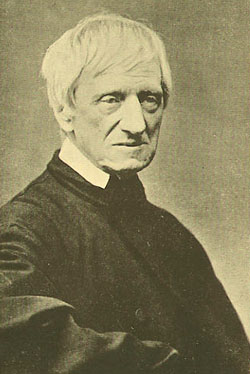
John Henry Newman
As John Henry Newman said in Tract 1 (1833):
... on what will you rest the claim of respect and attention which you make upon your flocks? Hitherto you have been upheld by your birth, your education, your wealth, your connexions; should these secular advantages cease, on what must CHRIST’S Ministers depend? Is not this a serious practical question? 
And maybe some residue of his next comment remains:
We know how miserable is the state of religious bodies not supported by the State. Look at the Dissenters on all sides of you, and you will see at once that their Ministers, depending simply upon the people, become the creatures of the people. Are you content that this should be your case? Alas! can a greater evil befall Christians, than for their teachers to be guided by them, instead of guiding?
His solution was,
There are some who rest their divine mission on their own unsupported assertion; others, who rest it upon their popularity; others, on their success; and others, who rest it upon their temporal distinctions. This last case has, perhaps, been too much our own; I fear we have neglected the real ground on which our authority is built,—OUR APOSTOLICAL DESCENT.
(from Project Canterbury)

While I would heartily reject Newman's answer it is interesting that the question remains cast in much the same terms: how do the clergy know who they are, individually and as a class, except by placing themselves over against the laity?

02/12/2010

Formation

I signed off yesterday's post and then thought: 'formation', as you do.

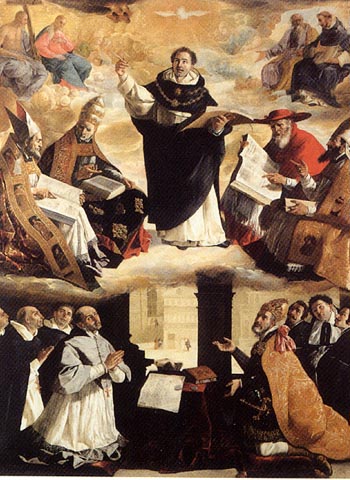
"St Thomas, Count of Aquino, Dominican Friar and
the Angelic Doctor of the Catholic Church
understood hierarchy and taught popes
and bishops, emperors and kings,
 how to exercise it." 
For the most part the idea of formation has traditionally been focused on priestly formation in the more Catholic tradition: the shaping of a malleable man into a priest; and thence the shaping of a priestly elite more educated, more deeply spiritual, more endowed with the qualities of leadership and pastoral wisdom than the laity.  An elite defined by being separated out from ordinary people.

Add in a belief that, in the divine hierarchy, to be a priest is to be nearer God than the laity and yet to be a priest is to be but the shadow of a bishop's closeness to God, and you have a powerful, driving ideology which once achieved great things in the Church.

Yet it is an ideology which is now almost (not quite) intellectually and practically defunct.

The concept of formation remains significant, however, and deserves to be revisited.  Just how do we form, shape, create disciples - lay, clerical and episcopal disciples - adequate to the tasks of mission, service, holiness in today's world? How do we form the whole church, not merely a top slice of it?

This is the perennial task of the church: to make real and consequential what it is to be a Christian today. To reverse this sentence: the way Christians act and speak (as Christians rather than as, say, engineers) is what it  means to be Christian.  Christians form the Church which formed them.

This is based on an epistemology profoundly antagonistic to the epistemology which saw the universe as fixed in a great pyramid stretching up towards God in which the most Godly humans stood just a feathers' breath below the angels.

To the contrary, it is based on the understanding of a world continually coming into being, in which every moment closes down some possibilities and opens up new ones, in which beauty and passion are as important as facts and analysis, in which ideology (theology, world-view, common opinion) is an essential building block in the creation of organizations, and organizations are essential to the development of knowledge and understanding.

That is: the Church is as the Church does.  As the Church does, so its members corporately make real the idea of the Church that they embody and enact.  Each action closes down some possibilities and opens others.

Clearly some decisions and actions have much more extensive and longer-lasting consequences.  Some (do I need to mention the Covenant?) appear to be much more likely to close down options than to create new opportunities.  The rhetoric of order and discipline is intended to signal that the desirable path of formation is to curtail and prevent innovation and new expressions of faith.

Fun in St Neots Church
But instead of putting 'discipline' and 'order' first, foremost and final as the concepts which should guide the formation of the future Church, I suggest we should look for other ideas.  Perhaps holiness and compassion, devotion, sacrifice and, who knows, even fun can be guiding concepts.

Though I would add quickly that I am not opposed to either discipline or order per se. I think both are necessary elements of any structure.  I recognise the reality of sin in any church or group.  I think, however, that when discipline is needed it will be because of some failure of the Church. The actions of discipline and the re-imposition of order should be seen as causes of shame and sorrow, occasions for repentance, not celebrated as guiding principles of the Communion.

I also suggest that the ontological hierarchy which so elevated bishops remains with us in a changed, and cheaper, version.

The Catholic tradition placed hierarchy on the foundation of divine law made visible in natural law.  In the Anglican Church that foundation is (a somewhat dated) organizational thesis.  The centralization of the Church, the elevation of the primates, the focusing of power in the General Secretary and the Archbishop of Canterbury, is being pursued for organizational efficacy: to better enable the control of member churches.

Surely we can do better than this.

01/12/2010

Why worry?

The Covenant is, as I've said before, part of a twin strategy to change the Communion for ever.  Most recently the focus has been on the Covenant for two reasons: it's now out for adoption by Provinces, and because it is a document in the public domain.

Covenanters: Bishop Gregory Cameron and
Archbishop Drexel Gomez in 2009
The second (chronologically the first) part of the strategy has had much less attention.  This is the creation of the Standing Committee of the Anglican Communion (SCAC). This is because change has been done in long slow steps, many of the changes have been buried in official documents, it has been seen as a matter in internal concern, and because documentation has been less easy to find.  And it's dull.  A Covenant has a symbolic resonance in the Church; constitutional change has not.

The Constitution of the Anglican Communion is now on the ACC page of the Anglican Communion website.  A Q&A style presentation of the Standing Committee is here.

The changes in the constitution of the Communion would give effect to the proposals contained in the Covenant; the Covenant would would give significant powers to the Standing Committee of the Communion (and here).  It would, in effect, make the SCAC a new Instrument of Communion in its own right.

The result of the changes that have already taken place and those which the Covenant may instigate would change the nature of Anglicanism for ever.

The consequences will, over time, stretch right to the heart of each church.  It may be that this will be a good thing (though I don't see it myself) but surely it can't be good to do this by default, without informed consent, without some sharing and general acceptance of a vision for the future.

First, it will turn the Communion into a Church, instead of a family of Churches (irrespective of who's in and who's out).

Local synods will grow less independent, autonomy will be constrained, episcopal authority will be circumscribed.  I don't think this will happen all at once; I think it will happen step-by-step, issue-by-issue and probably with no-one outside the Anglican Communion Office taking stock as it goes on.

From here to eternity, via the SCAC
Second, it will stretch the distance between pew and centre still further.  There's already a long distance between pew and General Synod, let alone pew to Archbishop.

To turn this round: ordinary worshippers will feel even further from the places decisions are made.

Third, the manner in which these changes have already been effected will predispose the manner of future decisions.

In particular the bureaucratic-political nature of the Church will be reinforced with the great majority of people effectively excluded by an glass wall from decision making.  The international elite of fixers and global leaders will talk to one another and operate in ways that most others (including all but the best funded and staffed lobby groups) will not be able to follow, let alone influence.

What is already an overwhelmingly clerical church will become even more so.

Fourth, the voluntary nature of adherence and expression of faith will shrink still further.  In 1828 the repeal of the Test and Corporation Acts in England effectively made membership voluntary.  That fact has never been part of the church's self-image.  Instead, monarchical (strictly princely) attitudes have characterised the exercise of episcopal authority, mirrored by excessive deference.  In England at least lay members of the Anglican Church are subjects, not citizens.

Fifth, there will be an impact at the local, parochial and deanery level.  Curiously the tendency to ignore or circumvent the rules, and for self-confident clergy to do their own thing, may grow stronger. (This capacity is an internalisaton of monarchical attitudes turned back against the official monarch).

The future of the Anglican Church?
For most people, most of the time, I guess the greater likelihood will be that initiative is further stifled, passivity, dependence and deference will continue to be the order of the day, and the effective engagement of the laity in making decisions that will realise the potential of the people of God will continue to be minimised.

Sixth, there will be a little less money in the local church and an even higher ratio of (relatively better paid) senior clergy and bureaucrats to regular worshippers.

*   *   *

Sometimes I wonder why I worry.  I was once ordained and now I am without episcopal permission to officiate (no-one's refused - I just haven't asked).  This leaves me (and other retired / resigned clergy in this position) unable to be members of the Church.  There is simply no space for us in the constitution.

But I do worry.  The shape, flavour, rhetoric, financing, decision-making, trust, suspicion, competence, clarity, history, vision, style, values, ethos of any organisation predispose how it functions on the ground.  All of these elements are predominantly set by the top. The words and actions of the few senior leaders are setting the church on a particular spiritual path to the future.

I have not seen or heard anything in the debate around the Covenant any official consideration of its impact in the pew.  It's all about inter-Provincial relationships, as though they were separable from the people who constitute the membership, the foundations, the purpose of the Church.  And who are the source of its funding. Could we not seek to shape the Church as though it served the spiritual needs and potential of the people of God?


Covenant between God and the people of Papua New Guinea, signed by the Prime Minister, 2007