I've created a page with my guesses as to how the different provinces and member churches might vote on the Covenant.
It is prefaced with a pile of caveats. I don't have any insider knowledge and I wouldn't be at all surprised if the equivalent table at the ACO had many differences from mine.
So I'd very much appreciate any information, hints, even gut feelings that might add to the reliability of the guesses. Please let me know in the comments box - I'll attribute the contributions unless told not to. Thank you in advance.
Showing posts with label Anglican Communion. Show all posts
15/04/2012
01/04/2012
A globular Communion
My guess is that defeat in England will not stop those who see the Covenant as the future of the Communion.
They will continue to try to persuade provinces to sign up, probably adding the argument that England will come on board after 2015.
Death of the Covenant from other causes
But the Covenant will die nevertheless. What will kill it are the internal contradictions within the Communion itself. It simply will not be fitted into a single document.
Consider the GAFCON churches. I blogged long ago about the different attitudes of Global South Churches towards the Covenant (I see my maths was no good then and it's not improved). This diversity is, I believe, still the case. The Southern Cone and the West Indies have already declared their adhesion to the Covenant. But I can't see Nigeria, Uganda or Kenya signing up (though, of course, any of these guesses are hostages to fortune).
I can also see a number of churches (the US, perhaps Canada) simply not coming to a decision at all.
Either way, the presupposition that membership of the Anglican Communion means uniform relations between all participants (whether as fact or ideal) has broken down in practice. I anticipate this is likely to be confirmed in organizational structures - and the longer some push for the Covenant the worse will be the collapse of the ACO, its Networks and Ministries, when it does happen.
The Covenant entailed the explicit declaration of uniform relations between participants. It is likely to contribute to its opposite - the formalisation of uneven relationships. In effect we end up, not with the end of the Communion, but with a significantly different configuration.
(I confidently predict that, when churches self-identify in this way, they will not choose 'lump' as the official designation.)
A significant bonus of this reshuffling of relationships is that it need not necessarily threaten bi-lateral or multi-lateral links at parish, diocesan or organizational level. The Mothers' Union in Africa, for example, can remain strongly associated with the MU in London even when the churches officially belong to differing clusters.
Not managing the Communion
Mapping such Anglican-heritage churches will be a difficult and undoubtedly fluid exercise. Managing a globular Communion will be impossible.
Instead of 44 autonomous provinces and member churches there will be, say, half a dozen primary lumps each with their own communication structures, decisions about interoperability, and lumps within lumps. Each lump will have varying degrees of interaction with each other lump, and the distinct members of every lump will each have differing associations across the globular whole.
The fact is this kind of development is already happening. The Covenant would have fitted ill with those who assent to the Jerusalem Declaration. Some provinces are sharing theological education initiatives. Some already recognise bodies which are not in communion with the rest.
These circumstances will eventually force change in whatever central structures survive. (So too will money, but that's another story.)
My suggestion would be that the term, idea and value of 'manage' should be discarded. In its place should be 'facilitate', 'enable', 'resource' and similar terms: explicitly servicing the various lumps on their own terms. In this the internet offers a huge potential.
The Communion's existing networks should not be co-opted to further the ACO's centralising mindset but could be great assets in supporting and resourcing the agenda's of the various lumps - learning from one another but allowing the component parts to use what
Of course, these observations are neither a blueprint nor at all adequate to the task. I offer them only as starting suggestions of how the Communion might develop in the decades to come: not towards 'A Church', but towards servicing the Church which is already here.
These developments would also make a mess of ecumenical convergence on a global scale. But I think it would be more honest, and ultimately more fruitful, to base the search for ecumenical convergence in the reality of church life, and not on a notion of what church life might become.
And, by way of warning, in searching for suitable images I also came across Bonini's Paradox:
They will continue to try to persuade provinces to sign up, probably adding the argument that England will come on board after 2015.Death of the Covenant from other causes
But the Covenant will die nevertheless. What will kill it are the internal contradictions within the Communion itself. It simply will not be fitted into a single document.
Consider the GAFCON churches. I blogged long ago about the different attitudes of Global South Churches towards the Covenant (I see my maths was no good then and it's not improved). This diversity is, I believe, still the case. The Southern Cone and the West Indies have already declared their adhesion to the Covenant. But I can't see Nigeria, Uganda or Kenya signing up (though, of course, any of these guesses are hostages to fortune).
I can also see a number of churches (the US, perhaps Canada) simply not coming to a decision at all.
Either way, the presupposition that membership of the Anglican Communion means uniform relations between all participants (whether as fact or ideal) has broken down in practice. I anticipate this is likely to be confirmed in organizational structures - and the longer some push for the Covenant the worse will be the collapse of the ACO, its Networks and Ministries, when it does happen.
The Covenant entailed the explicit declaration of uniform relations between participants. It is likely to contribute to its opposite - the formalisation of uneven relationships. In effect we end up, not with the end of the Communion, but with a significantly different configuration.
| A globular protein - PyruvKinase, I think, - and a way of visualising the Communion? |
The death and re-birth of the Communion
I think we will end up with a globular Communion - clusters of provinces coming together on what are basically grounds of congeniality (in which social and theological attitudes all have an important place).
Some of these lumps will have members (ACNA and other groups with which the Communion in not currently in Communion) which are not recognised by those in other lumps. Some lumps (one including Nigeria, for example, and another including TEC) may not talk to one another. But for the most part churches which primarily identify with one lump will maintain a variety of formal and informal links with churches in other lumps.
(I confidently predict that, when churches self-identify in this way, they will not choose 'lump' as the official designation.)
| Mothers' Union members meeting in West Africa |
Not managing the Communion
Mapping such Anglican-heritage churches will be a difficult and undoubtedly fluid exercise. Managing a globular Communion will be impossible.
Instead of 44 autonomous provinces and member churches there will be, say, half a dozen primary lumps each with their own communication structures, decisions about interoperability, and lumps within lumps. Each lump will have varying degrees of interaction with each other lump, and the distinct members of every lump will each have differing associations across the globular whole.
The fact is this kind of development is already happening. The Covenant would have fitted ill with those who assent to the Jerusalem Declaration. Some provinces are sharing theological education initiatives. Some already recognise bodies which are not in communion with the rest.
| Mapping complexity, in this case networks of climate change sceptics and supporters. Similar tools could be used for the Communion |
My suggestion would be that the term, idea and value of 'manage' should be discarded. In its place should be 'facilitate', 'enable', 'resource' and similar terms: explicitly servicing the various lumps on their own terms. In this the internet offers a huge potential.
The Communion's existing networks should not be co-opted to further the ACO's centralising mindset but could be great assets in supporting and resourcing the agenda's of the various lumps - learning from one another but allowing the component parts to use what
Of course, these observations are neither a blueprint nor at all adequate to the task. I offer them only as starting suggestions of how the Communion might develop in the decades to come: not towards 'A Church', but towards servicing the Church which is already here.
These developments would also make a mess of ecumenical convergence on a global scale. But I think it would be more honest, and ultimately more fruitful, to base the search for ecumenical convergence in the reality of church life, and not on a notion of what church life might become.
And, by way of warning, in searching for suitable images I also came across Bonini's Paradox:
Everything simple is false. Everything which is complex is unusable.
25/03/2012
A personal postmortem
Please forgive the unrelieved bullet points. This list has grown over the last few weeks as the defeat of the Covenant began, surprisingly at first, to look possible.
Comments particularly welcome
The Covenant
The Anglican Communion
Schism and the Anglican Communion
If the Covenant is finally defeated it represents a rejection of, I guess, two decades of re-structuring of the Communion. This will have a profound impact, but it will be schism (not defeat of the Covenant) which will have the biggest effect.
The Instruments of Unity(!)
The internet and church governance
The Church of England
What I'm pretty sure will not be learned
Comments particularly welcome
The Covenant
- I doubt the Covenant is dead, but it is symbolically wounded.
- There is a good chance it will die if (a) sufficient global leaders are luke-warm, even if their provinces vote in favour, or (b) schism ensues. There is a possibility it will return to General Synod after summer 2015 - though it will presumably have to go through the Section 8 referral process again.
- There is a possibility that Communion leaders will simply ignore the fact that England (and others) have rejected it and carry on regardless. This would be visible first in appointments to the various Communion-wide boards and bodies.
- Even a failed Covenant will have a legacy, e.g. a shared credal statement, conflict prevention and resolution mechanisms.
- What's not clear is whether Covenant churches will set off in a shared direction on their own initiative. I guess not, unless the ACO supports and leads it.
The Anglican Communion
- The signs are that there will be widespread opposition to the Covenant in TEC - not least because they anticipate being its first victims. If they decline to join the Covenant:
- what will happen to their financial contribution to maintaining the Anglican Communion (and the additional costs of implementing the Covenant)? Could they, perhaps transfer funds to bi- and multi-lateral links of various forms, circumventing the ACO?
- I guess GAFCON is key. If they (or most provinces including the biggest African ones) decide to walk apart for the rest then this will (finally) crystallize the schism. They will add to their number conservative groups in the West (and the Philippines) - which in turn will sharpen existing divisions in the CofE in particular.
- There has been an upsurge (or, perhaps, just an increase) of information and interest in the structure and organs of the Anglican Communion - as opposed to solely diocese-diocese links - amongst diocesan synod members and perhaps a little more widely.
- The CofE will no longer lead the AC in the same way (or, as strongly). But: the AC structures and bureaucracy are still focused on London and will be for the foreseeable future.
Schism and the Anglican Communion
If the Covenant is finally defeated it represents a rejection of, I guess, two decades of re-structuring of the Communion. This will have a profound impact, but it will be schism (not defeat of the Covenant) which will have the biggest effect.
- The decision(s) on schism are in the hands of those who wish (or threaten) to leave.
- Insofar as the Covenant (and the exclusion of TEC/ACoC) was the price of remaining in the Communion then some provinces may leave. Personally, let them. Blackmail is no basis on which to build communion.
- The Communion will be weakened by schism. But life goes on.
- There will be a(nother, probably internal) root-and-branch review of the structures of the AC, of its style of operating, its communications and its leadership.
- The present and next ABC will be in a very difficult position. As chief promoter of the Covenant in a province which has rejected the Covenant he will straddle two modes by which provinces relate to one another.
- The legal and effective relationship between Covenanted and unCovenanted churches with the ACC is wholly unclear. Presumably any Covenant business at the next ACC will have to be separated out of the ACC agenda in some way.
- The ACC is, I think, faced with a choice: to become (a) the Synod of the Anglican Church, (b) peripheral and of little consequence except as the electorate for the Standing Committee, (c) an effective and multi-directional consultative body.
- The Primates embody the divisions of the Communion. This won't change. But if members continue to absent themselves as a form of blackmail the Primates will also (as at Nassau) effect the schism.
- The Anglican Communion Office simply has to sit tight. Power will accrue to it more through division and conflict than through harmony.
- Similarly, the Standing Committee gains power from all changes across the Communion. Only Schism will weaken it and, even then, it will be the key body to co-ordinate a response (e.g. to pick up the pieces as some established links break down, and to be the key conduit of communication during the divorce).
- There are more general questions about the growth of international Ministries and Networks under the wing of the ACO. To what extent will their work be driven / distorted by the Covenant and/or the partial adoption of the Covenant? Will the budget just keep growing?
The internet and church governance
- The internet enabled relatively lonely anti-covenant voices (bloggers) at the start of the campaign to hear one another and to develop their arguments
- It enabled an international group to come together on the basis of personal opinion, not place in the system.
- The internet was little used by those developing the Covenant except for official statements (and, presumably, for internal communications). They largely failed to use it to explain their programme or to assess support.
- However it gave bloggers easy access to official documents.
- The dominance of voices in the blogosphere from the UK and US and, to a lesser extent, NZ and Australia, shows again the uneven distribution of cheap access to the internet and excludes or marginalises voices from other parts of the Communion.
- It is unlikely that the powers-that-be will ignore the persuasive impact of the internet again. Whether they will also learn the lesson that their culture of secrecy needs to shrink markedly is another question.
The Church of England
- The defeat will echo round the CofE's structures of governance for some time to come.
- It puts a question mark against the relationship of bishop to diocese (or, at least, to diocesan synod). Some will draw the lesson that new ways must be found to reduce opposition to the leadership; others, that better - more open, more 2-way communication - working relations between leadership and the rest of the diocese is needed.
- Synodical government itself came under great strain. Win or lose, the tactics used by some bishops, and the Covenant's inherent overweaning character, was designed to marginalise voters and thus, to diminish the whole system of synodical government. This was possible because it had been steadily weakened over years. The normal tone of deference, the occasional note of 'fear' of opposing the bishops, the appeal to loyalty as a motive to vote, all undermine rational and prayerful decision making.
- The premium placed on the univocal character of the House of Bishops in recent times may either be reinforced or called into question.
- Will liberals feel emboldened again (after 20 years of Evangelicals making the running)?
- If so, will an increasingly liberal Church of England move further away from the churches of the Global South, schism or no schism?
- Establishment will be untouched by this - though it might have been had the Covenant been implemented.
What I'm pretty sure will not be learned
- That monolithic structures are not an appropriate ideal for the C21 church - and therefore moving from a distributed to a more consolidated structure is undesirable.
- That 'the people' 'members' are full persons in the Church, not an afterthought. Consequently,
- that the church is best governed by inclusion, not by small coteries, at every level.
- That shifts in the technology of communication are followed by changes in social structures.
- That it is time the CofE considered its ecclesiology (including its many partnerships with the Anglican Communion, ecumenical agreements and links with civil society) in some frame other than the Establishment.
Not that anyone would ask, but I won't have a moment's envy for the next Archbishop of Canterbury. Apart, of course, from missing out on his tied cottage.
13/02/2012
Anglican Refugee and Migrant Network
A press release from the Anglican Communion News Service (ACNS) intrigued me because of the work I do. I've not heard of the Anglican Refugee and Migrant Network and so I did a bit of ferreting round the Anglican communion site to find out more - necessary because there is no link to it in the 'Networks' section of the site, and the website's own search engine is very selective.
In May 1992, meeting in Amman, Jordan, the Anglican Refugee and Migrant Network called on Anglican Churches throughout the world to use their influence with their respective national governments to eradicate conditions creating refugees. At the subsequent ACC9 meeting this formed part of the background to a resolution concerning Palestinian deportees:
Resolved, that this Joint Meeting of the Primates of the Anglican Communion and the Anglican Consultative Council calls on the Israeli Government to comply immediately with United Nations Resolution 799, returning Palestinian deportees to their homes in the West Bank and Gaza;In 1998, at the request of the Archbishop of Canterbury, the network was re-established by the Archbishop of South Australia, Ian George. It then aimed to be
... a forum for the exchange of information, ideas and encouragement to Anglicans around the world who are supporting refugees and advocating for their better treatment. (ACNS 2527)
| The principle of non-refoulment |
In 2009 ACC14 welcomed its re-establishment (again) and that the Province of Hong Kong hosted it. (Proposal, .pdf, from which some of this history is taken.)
In March 2011 the notes of the Standing Committee of the ACC included the paragraph,
The Anglican Refugee and Migrant Network has a new co-ordinator the Revd Catherine Graham who will be located in Hong Kong, the Province that is a significant supporter of the network. Canon Kearon said he believed that networks that had such support from a Province were often the ones that were most active and productive. “I think that’s the model for the way forward, Provinces adopting networks,” he said.Process, not product, was clearly the most important thing to note. However, now, in February 2012 under the odd description of Anglicanism's 'newest network', ACNS 5035 reports
A letter sent to nearly 800 diocesan bishops by the Revd Terrie Robinson, in her role as Anglican Communion’s Networks’ Co-ordinator, introduced ARMN’s new co-ordinator, the Revd Catherine Graham, and asked them to share with her insights and information from their dioceses about issues of refugees or migration.
Revd Robinson is looking for statistics, which could be overwhelming if a large number reply and not much use if only a small number do. UNHCR Global Trends (.pdf) is probably a better source.
any information you are able to give concerning the church’s mission and ministry among, or on behalf of migrants, internally displaced people and refugees. This work might cover a broad range, for example, helping congregations to become aware of global situations giving rise to the displacement of people and the gospel imperative to respond to those in need; providing pastoral care and opportunities for worship for new arrivals; offering practical support.
which I reckon is excellent. Anything gets my vote that might help people see migrants as real people who are worthy of assistance and who, in my experience, are often very capable themselves but facing adverse circumstances created by the host country.
The Network’s objectives are:
- To share information, ideas and experience, and to provide affirmation and mutual support for front-line programme-workers and programme-managers working with refugees and migrants on behalf of the Anglican Church through the creation of an active informal network.
- To provide, when appropriate, practice-based information and briefing to the Archbishop of Canterbury, the Primates, other Anglican Church leaders, and the Anglican Observer to the UN, to inform and strengthen their prophetic, advocacy and pastoral work on behalf of refugees and migrants;
- To promote awareness, concern and commitment to action within dioceses and parishes, to the benefit of local refugees and migrants;
- To encourage and collaborate with the wider ecumenical family and other faiths in promoting active ministry to refugees and migrants;
- To help tackle the root causes contributing to the creation of refugees and migrants through advocacy;
- To network with other institutions working on behalf of refugees and migrants; and,
- To develop and share theological reflection on the causes, issues and consequences relating to refugees and migrants.
Tackling root causes is a big task. But for a thought provoking reflection on a world without borders by Bridget Anderson, Senior Research Fellow at COMPAS at the University of Oxford, I recommend:
28/02/2011
Any chance of a fair debate?
I had been preparing a post in praise of soft power in the church.
The 'soft' power I have in mind is opposed to coercive power: education, discourse and debate as opposed to command and enforcement.
But the post became stuck and just seemed naive. Soft power is still power: how can anyone ensure it is used well? Is coercive power needed to guarantee that soft power is not misused? What checks and balances are possible? (Curiously checks and balances seem easier to describe and implement for coercive power.)
The recent press release from the No Anglican Covenant Campaign - Call for fair process and honest debate - illustrates the problem.
It's not just that NACC has been sidelined. It's that debate as a whole has been sidelined:
So how can the leadership of the Communion be brought to book for their wilful misuse of power? At the moment they can't. Blog posts may annoy them and campaigns may provoke an inappropriate put-down but neither is more than a momentary annoyance.
And the Covenant will make things worse. It is designed to create new central powers and to grant the Communion coercive powers against its members under certain circumstances (to be 'effective and forceful').
Furthermore the lesson for those in power is that this form of soft power works. The Covenant will be achieved without any need for people in the pews or in clerical collars to worry their heads about it.
It is a self-reinforcing process. If keeping all but a tiny minority out of the loop leads to substantive change and more powers accrue to those inside the loop then, doing it again will only give the few even more powers, and again ...
What is lost is perfectly evident to those outside the loop: the effective engagement of the membership.
Each time we go round the loop those on the inside identify themselves more strongly as knowing what's best for the Church, as actually being the Church, to the ever greater exclusion of those outside. Criticism (never mind a campaign) is not merely annoying, it is disloyal. No-one need listen to disloyalty.
Nor will this culture remain within the elite circles of the Communion's central command. In the hierarchy of the Church each successive ring will follow the centre's lead, learn its lessons, and shape itself to fit the circle above.
My response is to seek a more open and honest discussion on the nature and proper exercise of power in the church. It is to call for a church in which every member is valued. But what I fear is more likely is that those at the centre of the Communion are in fact creating a highly unstable and potentially dysfunctional structure wholly inadequate to the needs of an interconnected world.
As facebook and twitter enable some to bring down governments the leadership of the Communion has built up a bunker mentality. It cannot be to the good.
See also: my recent blog posts Players and audience, a look at the pitiful official Study Guide, Q&A, C-, and a paper from 2007 Bouncing the Covenant through the Anglican Communion (.pdf) which identified the strategy of avoiding any serious debate.
The 'soft' power I have in mind is opposed to coercive power: education, discourse and debate as opposed to command and enforcement.
But the post became stuck and just seemed naive. Soft power is still power: how can anyone ensure it is used well? Is coercive power needed to guarantee that soft power is not misused? What checks and balances are possible? (Curiously checks and balances seem easier to describe and implement for coercive power.)
The recent press release from the No Anglican Covenant Campaign - Call for fair process and honest debate - illustrates the problem.
It's not just that NACC has been sidelined. It's that debate as a whole has been sidelined:
November 2010 — When the Church of England debated the Anglican Covenant, official materials prepared for General Synod members made no reference to the concerns of critics or to the case against the Covenant. This was in marked contrast to what happened in 2007, when the House of Bishops agreed that an additional briefing document presenting opposing arguments should be circulated to all General Synod members in advance of the debate.(Note: I had some part in the 2007 paper. In fact this was a last minute concession and we were not allowed to submit a paper on the recently published Draft Covenant, but only on the principle of a Covenant and on the paper Towards An Anglican Covenant which was already redundant by then.)
November 2010 — When Modern Church and Inclusive Church placed advertisements critical of the proposed Covenant in the church press, and when the No Anglican Covenant Coalition was launched, Covenant sceptics were criticized by senior church officials for going public and "campaigning" instead of remaining silent.
December 2010 — When the draft Covenant was formally referred to English dioceses, the referral document provided a random list of quotations from the last General Synod debate, with pro‐and anti‐Covenant remarks mixed up together, followed by a purely pro‐Covenant presentation.
January 2011 — A request by Covenant opponents to the Business Committee of General Synod to circulate material setting out the case against the Covenant was rejected.
February 2011 — The Anglican Communion Office issued an official study guide and list of questions and answers for international use that neither provide a balanced look at the issues nor fairly represent the views of those critical of the Covenant.And yet: power is needed in any structure - it's what makes the thing go.
So how can the leadership of the Communion be brought to book for their wilful misuse of power? At the moment they can't. Blog posts may annoy them and campaigns may provoke an inappropriate put-down but neither is more than a momentary annoyance.
And the Covenant will make things worse. It is designed to create new central powers and to grant the Communion coercive powers against its members under certain circumstances (to be 'effective and forceful').
Furthermore the lesson for those in power is that this form of soft power works. The Covenant will be achieved without any need for people in the pews or in clerical collars to worry their heads about it.
It is a self-reinforcing process. If keeping all but a tiny minority out of the loop leads to substantive change and more powers accrue to those inside the loop then, doing it again will only give the few even more powers, and again ...
What is lost is perfectly evident to those outside the loop: the effective engagement of the membership.
Each time we go round the loop those on the inside identify themselves more strongly as knowing what's best for the Church, as actually being the Church, to the ever greater exclusion of those outside. Criticism (never mind a campaign) is not merely annoying, it is disloyal. No-one need listen to disloyalty.
Nor will this culture remain within the elite circles of the Communion's central command. In the hierarchy of the Church each successive ring will follow the centre's lead, learn its lessons, and shape itself to fit the circle above.
My response is to seek a more open and honest discussion on the nature and proper exercise of power in the church. It is to call for a church in which every member is valued. But what I fear is more likely is that those at the centre of the Communion are in fact creating a highly unstable and potentially dysfunctional structure wholly inadequate to the needs of an interconnected world.
As facebook and twitter enable some to bring down governments the leadership of the Communion has built up a bunker mentality. It cannot be to the good.
See also: my recent blog posts Players and audience, a look at the pitiful official Study Guide, Q&A, C-, and a paper from 2007 Bouncing the Covenant through the Anglican Communion (.pdf) which identified the strategy of avoiding any serious debate.
12/02/2011
Doors slammed shut! Windows blown open?
Observer chided me after my End game post not to be defeatist about the coming shape of the Communion and suggested I focus again on opposition to the Covenant.
I take both points. But first,
The war is over. Really.
My basic assertion in that post, that the war is now over, was reinforced by an interview given by Fred Hiltz, Primate of Canada, who said,
I stand by my description of how I see the Communion shaping up (centralised in the Archbishop of Canterbury, the General Secretary of the Anglican Communion and their respective officials, clericalised, women and laity further marginalised, the distance from centre to edge getting ever greater).
But I will make a significant qualification.
A kairos moment
The end of the civil war gives a brief moment for debate on what the Communion might look like. The idea of changing it has been very widely accepted. Significant changes have already been made. But we no longer need to look at the Communion through the lens of civil war or the foci of sexuality, biblicism and accusations of colonialism. These remain important issues but, fairly abruptly, the steam has gone out of them and the engine driving them has departed on a side-line.
So the qualification of my previous post is this: now is a brief moment for ecclesiological speculation which could lead to a different kind of understanding of the Communion.
What I have described as happening now is only one possible future. There are always alternatives.
An every member church
I would like to see a church in which every member is valued as a fully adult person and constituent of the church. That is, valued as members of the church per se, consciously setting aside what have recently been prior questions of gender or sexuality (or, for that matter, any other irrelevant consideration).
In the Church of England lay members are not valued particularly highly.
I am sure it is different in other parts of the Communion though I don't know any of them well enough to know how it works in practice. One possibility in the new Communion might be debate on the place of laity-clergy-bishops and the different ways in which members are involved in and excluded from aspects of church life in different parts of the Communion.
In the Church of England, for example, lay people do not directly elect their representatives on the Church's governing bodies. Those on a parish's electoral roll elect members of deanery Synods. They are the constituency which elect members of Diocesan and General Synod. In the 1960s when the synodical structures were being created there was much discussion of the cost of universal suffrage in the Church. To put it another way, it was decided that the laity weren't worth the money - even though it was also pointed out that it was the laity who provided the money.
(A sidelight to illustrate my point. I did a Google search for pictures for this post. In the first few pages of each search there were lots of pictures of General Synod, one or two of a Diocesan Synod in session, none of a Deanery Synod meeting. Not even worth the record.)
You can also see members' (lack of) importance in the way information is collected. No Diocese can communicate directly with its members because it does not have a list of them. Dioceses collect the numbers of people on electoral rolls (because numbers are important) but not names and addresses, except for parish officers and elected representatives.
The whole ethos of the CofE is monarchical. The further from the monarch - princes, to be more accurate - the less important people are. Deference remains rife. Like the British state the Church is a constitutional monarchy but, unlike the state, the Church puts relatively little emphasis on the constitutional half of the equation.
There was once a previous opportunity to debate these issues
Fifty years ago there was a brief flowering of publications and debate about the laity in the church spurred and supported by the World Council of Churches' Department of the Laity and the sense that the times they were a'changing. It didn't last.
Bishop John Robinson was a prominent participant. In A New Reformation? he promote a new vision of an ‘accepting church’ which met people where they were and accepted them for who they were. This church would comprise small nuclei of people scattered like seeds through the world. By contrast church structures, which sustained barriers of clericalism, professionalism and sexism were potentially heretical. They would have to be overcome by a truly lay theology which would find ‘... its creative source to be the engagement of the laos in the life of the world.’ (p. 63). This lay-centric church, by contrast with what it inherited, would be a reinvigorated community, true to its nature as an instrument of God’s Kingdom.
The enthusiasm didn't survive and more conservative voices won the day. In 1959 Robinson proclaimed that great things were afoot in the Church of England, the tide had turned. In 1969 he wrote in On Being the Church in the World that the tide had indeed turned, but 1960 had proved to be the high water mark, not the beginning of a new ecclesiastical order.
General Synod was first proposed in 1953. In 1965 its structures might have been agreed but were sent back for more work. By 1969, when finally agreed, the place of the laity had been further weakened. For example, one of the roles of the Deanery Synod is to debate matters which are debated in Diocesan Synod. In the earlier draft they were to do so 'beforehand'. To debate issues before the debate at Diocesan Synod would have given Deaneries a significant influence in the affairs of the Diocese. To debate matters after a decision is irrelevant. In 1969 the word 'beforehand' had been removed - and I don't believe that change was ever publicly acknowledged or discussed.
The Covenant
My desire for an every member church is one root of my continuing opposition to the Covenant.
Even if the unsavoury and punitive aspects of Section 4 were removed the Covenant would still serve to reinforce the centralising of power and strengthening of hierarchy. It will make the distance from pew to decision-making even further than the miles that already divide them. It will further marginalise ordinary members of the church. It is time to look again at the base on which the whole organization of the church stands. Now is, I think, a brief opportunity to do so.
Doctrine, ethics, spirituality, worship, polity are all essential and constitutive - and are all meaningless unless they are embodied in the daily lives of ordinary faithful Christians. So, act for every member of an every member church and
I take both points. But first,
The war is over. Really.
| Archbishop Fred Hiltz making a point |
But I have to say that this meeting was not in any way dominated by discussions around sexuality. In fact, you actually would have to pull very hard to find references to it in our plenary conversations, which is amazing…The last few primates’ meetings have just been dominated by that issue, [the] actions of certain provinces and the reactions of other provinces to those actions, people not going to the Eucharist. None of that happened, everybody participated fully in every aspect of the meeting…People were together at the Eucharist, they were together at tea, they were together at plenary, they were together for prayer, for meals. There was a real sense of community there… The blessing of same-sex unions was just not a big ticket item, not a topic of discussion at this meeting. Not only was it not a big ticket item but nobody was saying, “When are we going to get to this issue?” which was quite profound.
Likewise, with the [proposed Anglican] Covenant…there was a general feeling that…we need to let the provinces have the conversations…and we’re not going to enter into a big conversation about it until our provinces have spoken.The point was made that a number of the people present would share GAFCON's attitudes on the key divisive issues. But for the first time for a long time the Primates' focus was on working together - a focus only made possible by those who were absent.
I stand by my description of how I see the Communion shaping up (centralised in the Archbishop of Canterbury, the General Secretary of the Anglican Communion and their respective officials, clericalised, women and laity further marginalised, the distance from centre to edge getting ever greater).
But I will make a significant qualification.
A kairos moment
The end of the civil war gives a brief moment for debate on what the Communion might look like. The idea of changing it has been very widely accepted. Significant changes have already been made. But we no longer need to look at the Communion through the lens of civil war or the foci of sexuality, biblicism and accusations of colonialism. These remain important issues but, fairly abruptly, the steam has gone out of them and the engine driving them has departed on a side-line.
So the qualification of my previous post is this: now is a brief moment for ecclesiological speculation which could lead to a different kind of understanding of the Communion.
What I have described as happening now is only one possible future. There are always alternatives.
An every member church
I would like to see a church in which every member is valued as a fully adult person and constituent of the church. That is, valued as members of the church per se, consciously setting aside what have recently been prior questions of gender or sexuality (or, for that matter, any other irrelevant consideration).
In the Church of England lay members are not valued particularly highly.
I am sure it is different in other parts of the Communion though I don't know any of them well enough to know how it works in practice. One possibility in the new Communion might be debate on the place of laity-clergy-bishops and the different ways in which members are involved in and excluded from aspects of church life in different parts of the Communion.
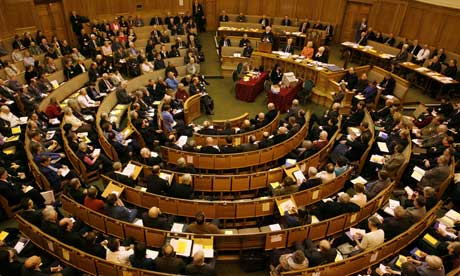
| The Church of England's General Synod in session |
(A sidelight to illustrate my point. I did a Google search for pictures for this post. In the first few pages of each search there were lots of pictures of General Synod, one or two of a Diocesan Synod in session, none of a Deanery Synod meeting. Not even worth the record.)
You can also see members' (lack of) importance in the way information is collected. No Diocese can communicate directly with its members because it does not have a list of them. Dioceses collect the numbers of people on electoral rolls (because numbers are important) but not names and addresses, except for parish officers and elected representatives.
The whole ethos of the CofE is monarchical. The further from the monarch - princes, to be more accurate - the less important people are. Deference remains rife. Like the British state the Church is a constitutional monarchy but, unlike the state, the Church puts relatively little emphasis on the constitutional half of the equation.
There was once a previous opportunity to debate these issues
Fifty years ago there was a brief flowering of publications and debate about the laity in the church spurred and supported by the World Council of Churches' Department of the Laity and the sense that the times they were a'changing. It didn't last.
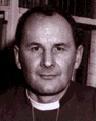
| Bishop John Robinson |
The enthusiasm didn't survive and more conservative voices won the day. In 1959 Robinson proclaimed that great things were afoot in the Church of England, the tide had turned. In 1969 he wrote in On Being the Church in the World that the tide had indeed turned, but 1960 had proved to be the high water mark, not the beginning of a new ecclesiastical order.
General Synod was first proposed in 1953. In 1965 its structures might have been agreed but were sent back for more work. By 1969, when finally agreed, the place of the laity had been further weakened. For example, one of the roles of the Deanery Synod is to debate matters which are debated in Diocesan Synod. In the earlier draft they were to do so 'beforehand'. To debate issues before the debate at Diocesan Synod would have given Deaneries a significant influence in the affairs of the Diocese. To debate matters after a decision is irrelevant. In 1969 the word 'beforehand' had been removed - and I don't believe that change was ever publicly acknowledged or discussed.
The Covenant
My desire for an every member church is one root of my continuing opposition to the Covenant.
Even if the unsavoury and punitive aspects of Section 4 were removed the Covenant would still serve to reinforce the centralising of power and strengthening of hierarchy. It will make the distance from pew to decision-making even further than the miles that already divide them. It will further marginalise ordinary members of the church. It is time to look again at the base on which the whole organization of the church stands. Now is, I think, a brief opportunity to do so.
Doctrine, ethics, spirituality, worship, polity are all essential and constitutive - and are all meaningless unless they are embodied in the daily lives of ordinary faithful Christians. So, act for every member of an every member church and
Vote against the Covenant
10/02/2011
Funny old world
It's an odd thing, the blogosphere. Posts that leave me feeling smugly pleased with myself attract no comments at all.
I thought 'End game' was stodgily written on a weekend spent ploughing through porridge. But it seems to have been picked up and to have annoyed Philip Turner of the ACI, of all people, and for what it didn't say, of all reasons.
I admit to being quite chuffed.
What's even more odd is that I agree with Dr Turner, if only to a limited degree. I agree that the concentration of monarchical powers in bureaucratic structures is wholly undesirable and deleterious to the well-being of the Communion.
But for Turner to suggest that 'Clearly a bureaucratically structured federation of autonomous churches meets with his [my] approval.' on the basis of what I have not said is going well beyond the evidence. He could not be expected to look further at my blog but I sincerely hope no-one reading it would deduce that I am at all pleased or satisfied with this turn of events.
On precedent
Turners' complaint that 'It would appear that precedent now means nothing.' is an interesting point. He may mean the term legalistically but I hear it in historical terms. Historical precedent used to be a significant argument (at least in the councils of the Church of England) but it was an expansive concept: to find an historical precedent for some development you wished to make in the present was a strong, but not sufficient, supporting argument in your favour.
I agree that there has been a general dismissal of precedent, but not in Turner's terms. The elevation of biblically-based arguments to be the sole and sufficient grounds for justification of change in the church has very largely driven out historically-based debate and argument. I would like to reassert the importance of historical method and understanding alongside biblical, theological, ecclesiological and other grounds in faithful Christian argumentation.
Historically (at least in the Anglican Communion) the concentration of monarchical powers is indeed unprecedented. But we didn't arrive at it all at once - it has emerged from a series of steps, each a small precedent, taken over the last few years without (I believe) conscious design at the beginning of that process. It is as though the tide has withdrawn and we can suddenly see what is left after the storm has reshaped the beach. Though, just to be clear, I don't think that makes it right.
But I do think it's a bit disingenuous of Turner to generalise quite so far from the disavowal of one particular precedent, the
The coming Communion
I am amused that Dr Turner attributes so much to me on the basis of what I don't say. So such, in fact, that 'Bagshaw’s view of an Anglican future gives the lie to all that God is up to ...' Really? Maybe he's right but all I thought I was doing was describing what I saw happening. I wasn't seeking either to praise or bury it.
Perhaps (and I've done this myself) he's merely using my post as a mirror, conveniently positioned so as to reflect his own views back to him, albeit reversed. In his writing I see a desire for one particular future for the Communion, in mine he sees no particular future at all. Perhaps both are caricatures?
I am, however, more narked than entertained by one aspect of Turner's article. He accuses me of describing the people in GAFCON as 'minor irritants'. If he'd read the piece more carefully he'd would have seen this was not so. I predicted that GAFCON would 'undoubtedly lay claim to the Anglican brand' and this would be confusing. The confusion, not the people, is the minor irritant.
He and I have been on opposite sides of the trenches in the late civil and although I cheerfully oppose all that the ACI and GAFCON stand for and propound I have never doubted nor impugned their personal or collective conviction, faith or integrity and I hope (and will apologise if I have) that I have never written so casually.
I think Dr Turner agrees with my basic point that we are now looking at the end of the conflict and the beginning of a new pattern of Anglicanism. Yet he does so from the unsuccessful side. He says (and he seems to specialise in being horrified),
Anyway,
All told I'm tickled to have niggled the good Dr Turner. As to my own views, there's already a half-written post on the way I would like to see things change, though I don't think I'll be able to finish it before the weekend. It would no doubt horrify Dr. Turner should he chose to read it.
I thought 'End game' was stodgily written on a weekend spent ploughing through porridge. But it seems to have been picked up and to have annoyed Philip Turner of the ACI, of all people, and for what it didn't say, of all reasons.
I admit to being quite chuffed.
| Addressing the Primates in Dublin |
But for Turner to suggest that 'Clearly a bureaucratically structured federation of autonomous churches meets with his [my] approval.' on the basis of what I have not said is going well beyond the evidence. He could not be expected to look further at my blog but I sincerely hope no-one reading it would deduce that I am at all pleased or satisfied with this turn of events.
On precedent
Turners' complaint that 'It would appear that precedent now means nothing.' is an interesting point. He may mean the term legalistically but I hear it in historical terms. Historical precedent used to be a significant argument (at least in the councils of the Church of England) but it was an expansive concept: to find an historical precedent for some development you wished to make in the present was a strong, but not sufficient, supporting argument in your favour.
I agree that there has been a general dismissal of precedent, but not in Turner's terms. The elevation of biblically-based arguments to be the sole and sufficient grounds for justification of change in the church has very largely driven out historically-based debate and argument. I would like to reassert the importance of historical method and understanding alongside biblical, theological, ecclesiological and other grounds in faithful Christian argumentation.
Historically (at least in the Anglican Communion) the concentration of monarchical powers is indeed unprecedented. But we didn't arrive at it all at once - it has emerged from a series of steps, each a small precedent, taken over the last few years without (I believe) conscious design at the beginning of that process. It is as though the tide has withdrawn and we can suddenly see what is left after the storm has reshaped the beach. Though, just to be clear, I don't think that makes it right.
But I do think it's a bit disingenuous of Turner to generalise quite so far from the disavowal of one particular precedent, the
“enhanced responsibility” Lambeth requested the Primates assume nor to subsequent actions by the Primates intended to exercise that responsibility.This was substantively rejected sometime ago. And there are other, more collegial and less domineering, descriptions of and statements about the Primates' Meeting that are also precedents.
The coming Communion
I am amused that Dr Turner attributes so much to me on the basis of what I don't say. So such, in fact, that 'Bagshaw’s view of an Anglican future gives the lie to all that God is up to ...' Really? Maybe he's right but all I thought I was doing was describing what I saw happening. I wasn't seeking either to praise or bury it.
Perhaps (and I've done this myself) he's merely using my post as a mirror, conveniently positioned so as to reflect his own views back to him, albeit reversed. In his writing I see a desire for one particular future for the Communion, in mine he sees no particular future at all. Perhaps both are caricatures?
I am, however, more narked than entertained by one aspect of Turner's article. He accuses me of describing the people in GAFCON as 'minor irritants'. If he'd read the piece more carefully he'd would have seen this was not so. I predicted that GAFCON would 'undoubtedly lay claim to the Anglican brand' and this would be confusing. The confusion, not the people, is the minor irritant.
He and I have been on opposite sides of the trenches in the late civil and although I cheerfully oppose all that the ACI and GAFCON stand for and propound I have never doubted nor impugned their personal or collective conviction, faith or integrity and I hope (and will apologise if I have) that I have never written so casually.
I think Dr Turner agrees with my basic point that we are now looking at the end of the conflict and the beginning of a new pattern of Anglicanism. Yet he does so from the unsuccessful side. He says (and he seems to specialise in being horrified),
![]() |
| amongst those absent from the Primates' Meeting .... |
I am horrified by the future Bagshaw foresees because in it he appears to find no meaningful place for those who absented themselves from the Dublin meeting.Turner's missed the meaning of the word 'absent'. Those who chose not to be present have chosen not to participate in the councils of the Communion. They were accorded meaningful respect at the meeting but the terms on which they might have attended were not acceptable to the majority. They may be in the right but they are not in the driving seat. Perhaps Turner should explain what meaning (and, presumably, influence) those who absent themselves should have, and why.
Anyway,
All told I'm tickled to have niggled the good Dr Turner. As to my own views, there's already a half-written post on the way I would like to see things change, though I don't think I'll be able to finish it before the weekend. It would no doubt horrify Dr. Turner should he chose to read it.
* * *
And thanks, I think, to Pluralist
05/02/2011
End game
I am now confident that, at last, we have finally come to the beginning of the end of the schism in Anglicanism, though not in a way I had anticipated.
In the US (and Canada?) court cases over property are being settled in favour of the official church and to the dismay of the schismatics. For example: Pittsburgh, Fort Worth and British Colombia. Legal actions are not finished, of course, but the end of the tunnel grows closer.
It seems that, in some places at least, this is leading to a shaking out of those who really want to go on ideological grounds and reconciliation with those who simply wanted to stay in the places they had always worshipped. The suspension of normal business inevitable with unresolved cases is now over and people can start to get back to normality - even though the landscape has changed. The senior leadership of a Diocese can concentrate on their primary tasks of leadership, nourishing and dealing with the normal headaches of any organization.
Internationally, the GAFCONites now have sufficient internal cohesion and decision making structures to enable them to be a self-sufficient separate body. They will undoubtedly lay claim to the Anglican brand, at least for a while, but while this may be confusing it is just a minor irritant.
I prefer the French: Réunion des Primats
Which leaves the rest of us and the extraordinary Primates' Meeting.
Days 1 & 2, once the preliminaries were over, focused on the substantive issues that Primates face in their own Provinces, not on the Communion itself.
Day 3 began with 'Primacy'. I suspect this is a hot issue now for two reasons. First, the Primates (who, being more elevated, see further than most) were trying to articulate their role in a Church that they can see has already changed - much ecclesiological reflection is post hoc self-justification. The second reason was evident in their method. They took a detailed look at the differences between their roles, activities and powers in the different provinces. This is about the polity of the church, not theology, about preparing to work better in the new Anglican Communion, whatever shape that will have.
The ecclesiological emphasis was also predominant on Day 4. The Archbishop of Burundi, Bernard Ntahoturi, presented the reflections of The Inter-Anglican Standing Commission for Unity, Faith and Order (IASCUFO), a merger of the Inter-Anglican Standing Commission on Ecumenical Relations and the Inter-Anglican Theological and Doctrinal Commission. Snappy.
The briefing for Day 6 opened with a somewhat defensive note that 'These briefings have been prepared on a daily basis by Anglican Communion Office staff with oversight from a variety of Primates representing different parts of the Communion.' They tidied up a number of documents for promulation and held a press conference (podcast - I listened but could barely hear most questions and wasn't much enlightened by the answers). They concluded with Communion.
The official papers are available here.
Primatology
I think George Conger is right: it is the end of the Communion we once thought we knew.
The Primates' meeting is to be a consultative forum with no powers of instruction or direction. Powerful and influential, certainly, but these stem from the role of participants within their own Provinces, not across provinces. As the Primus said in the press conference, this is a Communion of independent provinces.
Gonger is also right about the concentration of powers in the hands of the Archbishop of Canterbury. The Standing Committee is to be the Archbishop's 'consultative council'. In effect the Diocesan structure of the English Church is writ global: the monarchical Archbishop rules and courtiers advise. They have no veto.
A Communion for the twenty-first century
So this would now seem to be the shape of the Communion:
I'm still afraid it's the former. If passed the Covenant contains so many powers-in-embryo that it will inevitably be used.
[Slightly amended 6/2/11]
In the US (and Canada?) court cases over property are being settled in favour of the official church and to the dismay of the schismatics. For example: Pittsburgh, Fort Worth and British Colombia. Legal actions are not finished, of course, but the end of the tunnel grows closer.
It seems that, in some places at least, this is leading to a shaking out of those who really want to go on ideological grounds and reconciliation with those who simply wanted to stay in the places they had always worshipped. The suspension of normal business inevitable with unresolved cases is now over and people can start to get back to normality - even though the landscape has changed. The senior leadership of a Diocese can concentrate on their primary tasks of leadership, nourishing and dealing with the normal headaches of any organization.
Internationally, the GAFCONites now have sufficient internal cohesion and decision making structures to enable them to be a self-sufficient separate body. They will undoubtedly lay claim to the Anglican brand, at least for a while, but while this may be confusing it is just a minor irritant.
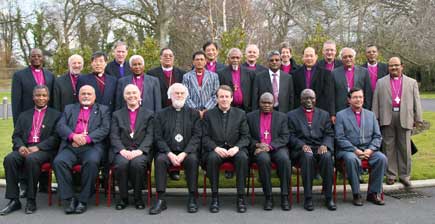
| The Primates in the Dublin sun |
Which leaves the rest of us and the extraordinary Primates' Meeting.
Days 1 & 2, once the preliminaries were over, focused on the substantive issues that Primates face in their own Provinces, not on the Communion itself.
Day 3 began with 'Primacy'. I suspect this is a hot issue now for two reasons. First, the Primates (who, being more elevated, see further than most) were trying to articulate their role in a Church that they can see has already changed - much ecclesiological reflection is post hoc self-justification. The second reason was evident in their method. They took a detailed look at the differences between their roles, activities and powers in the different provinces. This is about the polity of the church, not theology, about preparing to work better in the new Anglican Communion, whatever shape that will have.
The ecclesiological emphasis was also predominant on Day 4. The Archbishop of Burundi, Bernard Ntahoturi, presented the reflections of The Inter-Anglican Standing Commission for Unity, Faith and Order (IASCUFO), a merger of the Inter-Anglican Standing Commission on Ecumenical Relations and the Inter-Anglican Theological and Doctrinal Commission. Snappy.
He told fellow Primates that the December meeting of IASCUFO in South Africa saw the members work in four groups: one studying the definition of ‘church’. Archbishop Bernard said, “We are asking: ‘Is the Anglican Communion a Church or a communion of Churches?’” The second group is looking at the Anglican Communion Covenant and resources for studying it. The third group is studying the Instruments of Communion, their theological meaning and how they relate to one another. The fourth group is considering the topic of ‘reception’, that is how the work of the Instruments and of ecumenical dialogues is communicated and understood at all levels of the Anglican Communion.Day 5 concluded this ecclesiological thread with discussion of the Primates' Standing Committee. It then moved to other matters: gender-based violence and 'a range of [other] issues of international concern'.
| Archbishop Bernard Ntahoturi & Primus David Robert Chillingworth Press Conference: Photo ACNS |
The official papers are available here.
Primatology
I think George Conger is right: it is the end of the Communion we once thought we knew.
The Primates' meeting is to be a consultative forum with no powers of instruction or direction. Powerful and influential, certainly, but these stem from the role of participants within their own Provinces, not across provinces. As the Primus said in the press conference, this is a Communion of independent provinces.
Gonger is also right about the concentration of powers in the hands of the Archbishop of Canterbury. The Standing Committee is to be the Archbishop's 'consultative council'. In effect the Diocesan structure of the English Church is writ global: the monarchical Archbishop rules and courtiers advise. They have no veto.
A Communion for the twenty-first century
So this would now seem to be the shape of the Communion:
- Each province is autonomous.
- There is a stronger recognition of the differences of structure, decision making and distribution of powers within each province. Pressures towards harmonisation have been rebuffed.
- The motif of 'family' has resurfaced, specifically in its aspect of 'blood is thicker than water', i.e. we disagree but continue together. Clearly this is only true for those family members who are prepared to stay together.
- There is a renewed emphasis on regionalism, facilitated by the Primates' Standing Committee. This will be a difficult trick to pull off effectively: on the one hand the centralising agenda will still pull matters towards the Archbishop of Canterbury and, on the other, the defence of autonomy will pull people apart. However, if successful, regional groupings could well supply an intermediate layer of debate and discussion which will enable better co-ordination of a looser Communion to the benefit of all.
- It is an ever more clerical Communion. Unless regional meetings include the laity as full participants they will reinforce the dominance of bishops.
- The more deliberative nature of the Lambeth Conference (if continued) and Primates' Meeting will leave a vacuum. Some people will always want clear and authoritative statements despite and because it's a murky and ambiguous world. There will still be a demand for the equivalent of Lambeth Conference Resolutions - but these should remain of moral and persuasive authority, given force only when incorporated in each separate province following their own distinct procedures .
- Power will flow to the Archbishop of Canterbury. Leadership of global deliberation will flow to the international consultative bodies. Thus power will flow to the Anglican Communion Office. Information and administration is power and it will all go though the ACO & Lambeth Palace staff.
- The Anglican Consultative Council will be marginalised. Like an English Deanery Synod it will make work for itself but its primary function now is merely to vote for (some of the) members of the Standing Committee of the Anglican Communion.
- The SCAC itself, which briefly looked as though it would hold the Communion's strings, will become a rubber stamp to endorse decisions made between the Archbishop of Canterbury, the General Secretary of the Communion, the ACO & Lambeth Palace staff.
I'm still afraid it's the former. If passed the Covenant contains so many powers-in-embryo that it will inevitably be used.
[Slightly amended 6/2/11]
24/01/2011
How authority is transferred
Signing the Covenant will slowly, inexorably convert the Anglican Communion from a family of Churches into one global Church.
Of course it will always carry the DNA of its heritage - not least its anglo-centric culture, its propensity to fit comfortably, complacently with secular power structures, and its manner of grumpy accommodation to changing times and circumstances - it will never be another Roman Catholic Church or World Lutheran Federation.
But it will become a single Church and the Standing Committee will slowly mutate into its government. You may think this is a good thing, but I don't. I would like those who do think this development is desirable to campaign for it openly and honestly. But the opportunity for them to do so has now passed.
The key mechanism by which authority and power will be transferred from currently autonomous churches to the centre lies in section 4.2 of the Covenant.
Any signatory may question (4.2.3) a decision or actions of another signatory body or, indeed, decisions or actions they are considering taking. In itself this would seem to be a good and proper means by which mutual accountability is effected. It sets in motion a process (albeit one that is currently opaque) with the possible result that the central organs of Anglicanism will make a determination of the issue. As things stand at present they can't impose their determination - merely recommend 'relational consequences' (4.2.7).
But don't be deceived. Once a determination is made it will be 'the teaching of the Anglican Communion', even if no province enforces 'relational consequences'. From that point on there will be two classes of teaching: (1) official, Communion-wide teaching and (2) local, provincially authorised teaching. Anomalies will become more visible. The pressure will only be in one direction: to harmonise teaching across the Communion and to do so by seeking more and more central decisions.
I guess that relatively few disputes will in fact trigger the official conflict resolution mechanism. More likely provinces will look over their shoulders, will self-censor and will seek the informal opinion of the Standing Committee before they act.
And, steadily if unevenly, official, Communion-wide teaching will grow and local decision amking, and confidence in local decision making will shrink.
I also guess that, as soon as the tension drops and decisions are no longer measured as homophobia/homophilia, the very bitterness of the conflict from which we are beginning to emerge will entice all provinces to be more sensitive to one another. Junior players in today's war will become the Archbishop-Generals of tomorrow. They will seek to effect the lessons they thought they'd learned while fighting.
So: formal determinations, informal organisational actions and personal predilections will all tend in one direction: centralisation. And once powers have stepped, drifted, been gifted to the centre they will not be returned.
Perhaps, looking some way ahead, the following generation will rediscover the term 'subsidiarity'; perhaps some archivist will read the Windsor report and find it there. But by then it will be too late, the Anglican Communion will have been rebadged as The Anglican Church.
Of course it will always carry the DNA of its heritage - not least its anglo-centric culture, its propensity to fit comfortably, complacently with secular power structures, and its manner of grumpy accommodation to changing times and circumstances - it will never be another Roman Catholic Church or World Lutheran Federation.
But it will become a single Church and the Standing Committee will slowly mutate into its government. You may think this is a good thing, but I don't. I would like those who do think this development is desirable to campaign for it openly and honestly. But the opportunity for them to do so has now passed.
The key mechanism by which authority and power will be transferred from currently autonomous churches to the centre lies in section 4.2 of the Covenant.
| Photo by Scott Gunn & pinched from KinnonTV |
But don't be deceived. Once a determination is made it will be 'the teaching of the Anglican Communion', even if no province enforces 'relational consequences'. From that point on there will be two classes of teaching: (1) official, Communion-wide teaching and (2) local, provincially authorised teaching. Anomalies will become more visible. The pressure will only be in one direction: to harmonise teaching across the Communion and to do so by seeking more and more central decisions.
I guess that relatively few disputes will in fact trigger the official conflict resolution mechanism. More likely provinces will look over their shoulders, will self-censor and will seek the informal opinion of the Standing Committee before they act.
And, steadily if unevenly, official, Communion-wide teaching will grow and local decision amking, and confidence in local decision making will shrink.
I also guess that, as soon as the tension drops and decisions are no longer measured as homophobia/homophilia, the very bitterness of the conflict from which we are beginning to emerge will entice all provinces to be more sensitive to one another. Junior players in today's war will become the Archbishop-Generals of tomorrow. They will seek to effect the lessons they thought they'd learned while fighting.
So: formal determinations, informal organisational actions and personal predilections will all tend in one direction: centralisation. And once powers have stepped, drifted, been gifted to the centre they will not be returned.
Perhaps, looking some way ahead, the following generation will rediscover the term 'subsidiarity'; perhaps some archivist will read the Windsor report and find it there. But by then it will be too late, the Anglican Communion will have been rebadged as The Anglican Church.
23/01/2011
To go forwards, look back
| Bishop Mouneer Anis |
In a conference speech he calls for a return to true Anglican values that are both Scriptural and conciliar. Yet in asking to go back he is in fact setting off in a new direction.
He shares the general conservative analysis that in many parts of the Communion there was a generation of clergy and laity who were not grounded in Scripture and who do not believe in the credal essentials of the Christin faith.
But he also sees more of value in the Anglican tradition than many conservatives appear to. In particular he would like to see the Lambeth Conference and the Primates' Meeting playing a truly conciliar role, giving them authority in matters of faith and order, including the interpretation of Scripture.
Not in Communion as constituted at present, of course, too much trust has been lost and too many have strayed from the orthodox path. And Lambeth 2008 lost almost every shred of its conciliar character with the mistaken idea that 'indaba' meant talking to no conclusion.
He calls on the churches of the Global South, together with other orthodox dioceses, to recover their Anglican heritage and remake it: new conciliar structures would set out the Anglican faith scripturally, definitively and authoritatively.
Bishop Anis is a man of integrity and ability. He is standing with those who no longer have time for the Communion as it stands and who will no longer be distracted from his task by its time consuming dysfunctionality.
So (if Bishop Anis' words are heeded) the irony will be that the Covenant, nominally designed to hold the Communion together, will come to bind those who never wanted it in the first place. Those who wanted a Covenant to discipline TEC and other provinces will go off and establish their own, conciliar framework.
22/01/2011
Primatial boycott
| Global South Primates in Singapore last April |
Of course they point to the consecration of Mary Glasspool - and TEC's refusal to listen to the entreaties of other parts of the Communion - as the occasion for their decision.
But the complaint which evokes most of their righteous indignation is the manner in which the Dublin Meeting has been planned:
... there was hardly any timely and intentional prior consultation and collegial engagement of all concerned (or at least as many as reasonably possible) in preparing for the Meeting to ensure certain degree of significant and principally legitimate outcome to hold and move the Communion together. In light of the critical importance of the Meeting, the preparations are gravely inadequate. As it stands, the Meeting is almost pre-determined to end up as just another gathering that again cannot bring about effective ecclesial actions, ...They asked for the meeting to be postponed, but they were disappointed. Or, in other words, they were not able to dictate the agenda or the outcome or the timing.
They also set out their unconditional terms for their continued engagement in the Primates' Meeting and, I guess, other Communion processes:
Unless and until there is unequivocal commitment to honour the agreed basis of Lambeth Resolution 1.10 and implement the decisions of previous Primates’ Meetings (2005, 2007, 2009) expressed in the respective Communiqués, especially that of Dar es Salem 2007, it will only lead to further erosion of the credibility of the Primates’ Meeting and accentuate our failure to honour the work already done by them. (emphasis added).It remains to be seen how many will actually boycott the meeting. I guess the number and the names will accurately reflect the line of schism. My suspicion is that the most hardline will absent themselves and leave, but that a fair proportion of conservative Primtes will attend and remain, maybe covenanted and certainly dissatisfied - but it will be clear that TEC will remain in the Communion and the western liberals will have won.
But the legacy will be unhappy for years to come.
17/01/2011
Creeds, orthodoxy and the Covenant
There are, I think, three groups of questions about the relationship of creeds to orthodoxy:
First, substantive questions:
By use and antiquity the creeds' propositions have become the inner citadel of What Must Be Believed. They set out the core intellectual framework of Christianity. Assent to the Apostles' and Nicean/ Constantinopolitan Creeds is a prerequisite of knowing oneself and others to be orthodox.
The Athanasian creed is widely accepted but out of fashion. Many are uncomfortable with the 'damnatory clauses' that top and tail it.
(In 1872 Archbishop Tait declared to Convocation that ‘not a soul in the room or in the Church of England takes the damnatory clauses in their plain or literal sense.’ The clauses caused ‘distress and alienation of mind’, he said, and were heard as ‘savage words’.)
But the Creeds are not clear like a line on a map. I suggest that the the individual clauses of the Creeds, and the Creeds as a whole, mark the borders between orthodox and heterodox like standing stones on moorland, way-markers in a complex geography. All the stones are pretty mossy and chipped by now and, though some have slipped over and smaller ones have fallen from view, most are still clearly visible.
What has changed, repeatedly, is the intellectual and social landscape in which the stones are set. Sometimes that change has been slow and barely noticed by those who trek across it. At other times change has been convulsive. This is nothing new, nor is it new to say that the pace of change is quicker too. I believe this latter observation has been made since the early nineteenth century but it could well have had a longer history. However, it is this combination of shifting contexts and ancient stabilities that make orthodoxy both possible and inexorably problematic.
Therefore:
First, substantive questions:
What must be believed? What may be believed? What must not be believed?Second, interpretative questions:
In what manner must or may or must not these beliefs be held?Third, determinative questions:
Who decides? And by what mechanism?The creeds were devised as a way of dividing orthodox from heterodox, friend from foe, in the first four hundred years, give or take, of the Christian Church. They were originally working documents purporting to encapsulate and express truths which were eternally present but only contingently expressed.
| Standing stones on Lewis |
The Athanasian creed is widely accepted but out of fashion. Many are uncomfortable with the 'damnatory clauses' that top and tail it.
(In 1872 Archbishop Tait declared to Convocation that ‘not a soul in the room or in the Church of England takes the damnatory clauses in their plain or literal sense.’ The clauses caused ‘distress and alienation of mind’, he said, and were heard as ‘savage words’.)
But the Creeds are not clear like a line on a map. I suggest that the the individual clauses of the Creeds, and the Creeds as a whole, mark the borders between orthodox and heterodox like standing stones on moorland, way-markers in a complex geography. All the stones are pretty mossy and chipped by now and, though some have slipped over and smaller ones have fallen from view, most are still clearly visible.
What has changed, repeatedly, is the intellectual and social landscape in which the stones are set. Sometimes that change has been slow and barely noticed by those who trek across it. At other times change has been convulsive. This is nothing new, nor is it new to say that the pace of change is quicker too. I believe this latter observation has been made since the early nineteenth century but it could well have had a longer history. However, it is this combination of shifting contexts and ancient stabilities that make orthodoxy both possible and inexorably problematic.
Therefore:
How do we remain faithful to the witness of the standing stones whilst the landscape is changing around us in unpredictable ways?
And how do we do so in a world which is changing in both different directions and at different speeds in different parts of the world?The Church of England has only had power to determine its own doctrine from 1974 (in the Worship and Doctrine Measure) and only had this confirmed by the courts in 1992 (over the ordination of women as priests). Now it's too late: ecumenical agreements and rapid globalisation mean that the CofE is no longer sufficiently autonomous to state and sustain its own doctrine.
| Icon depicting Emperor Constantine (center) and the Fathers of the First Council of Nicaea (325) as holding the Niceno–Constantinopolitan Creed of 381 - Wikipedia |
The Covenant offers only the beginnings of a mechanism for determining doctrine. Any party to the Covenant may question the actions of another if it has concerns. The mechanisms that then follow are only sketched in and will have to be (endlessly) elaborated - but they do look as though they have the potential to be a quasi-judicial mechanism for determining doctrine.
Will it work? It won't. I can say this with confidence having looked at the Church of England's attempts to use courts to determine doctrine in the nineteenth century.
Leaving all theology aside there's a simple matter of group psychology. Say Province A is convinced that Province Z has stepped beyond the bounds of orthodoxy. It asks a court - or Covenant mechanism - to determine that Province Z is heterodox. The process decides Province Z is not unorthodox. Result: Province A is livid, they refuse to accept the finding, and instead attack the whole process. In effect Province A cedes authority over doctrine to the central mechanism only when it supports their own a priori convictions, never when it finds against them.
The inability to resolve doctrinal disputes without a shared mechanism leaves everyone exhausted and frustrated. Ironically, though by no means inevitably, it's more likely to keep people together. The attempt to do so within a shared mechanism is likely to stoke up resentment, deepen difference and fuel dissension. In a globalised world the conflicts will be global: every blogger and their cat will want a say, every Chancellor and Vicar General will guard their interests with vigour.
The standing stones will still be there. But until the day there is one Great Church (as envisaged by some ecumenical Protestants just after the Second World War) no church will be big enough to make definitive judgements. In fact the opposite tendency is stronger: attempts to enforce agreement generate schism.
26/10/2010
How to mount a successful coup in Anglicanism
| Frances and John Colenso, from an earlier conflict |
Each conflict has been historically distinctive however they shared certain common characteristics.
In conclusion,
In the end, no group wins an unalloyed victory. The very process of the conflict changes all sides.
On the other hand the church we have now - in all its aspects - is a result of past conflicts. Dire predictions seldom come to pass and consequential changes are seldom planned or anticipated.
All church conflicts have been waged in the name of truth, authenticity, righteousness and real people have been really hurt.
And still it's worth standing up for what you believe: this is the way the church lives.
First, conflict is normal
Conflict is normal in every church. Differences between faithful christians have deep historic roots and are reflected in almost every aspect of the expression and embodiment of faith. Underlying differences are complex, extensive, often buried in people's everyday attitudes and may reflect incommensurable differences at the level of basic spiritual or philosophical presuppositions.
The present conflict is about large things. It is about the post-modern church, simultaneously dividing into smaller units and drawing together in globalised world. It is about the legacy of calvinist, anglo-catholic and latitutdinarian conflict recast in contemporary terms. It is the exporting of the US Episcopal Church's divided and unhappy history across the globe, and about where the centre of the Anglican world really lies and should lie. It is about the nature of a global Communion in a post-colonial world.
But all of this would remain confined to long books and academic conferences. Therefore,
Second, select your focal point
Because of this complexity, the occasion of conflict is often a relatively small matter, perhaps the actions or teaching of a particular individual. Conflicts take the form of synecdoche in which small matters encapsulate and represent much greater underlying differences.
Homosexuality is a synecdoche for the big things in conflict. It was deliberately chosen (at least in the UK) as a battle ground because it united conservatives, and especially evangelical conservatives, who had been deeply divided over the ordination of women. It is an emblematic issue of the US's culture wars.
Therefore whatever the occasion and focus of the conflict, the underlying issue is always greater. Almost anything can become a focal point of conflict - nothing is minor or adiaphora when the identity of the Church is at stake.
Third, challenge authority
Churches rest on authority: the authorities (scripture, traditions, the formularies, law) are made real by those people who are granted authority to interpret, apply and judge the authorities (clergy, bishops, biblical scholars, theologians, historians, lawyers and also - in their own lives - individual believers) .
All such authority is subject to challenge as normal, it doesn't take a conflict. Church conflicts are the ordering of underlying conflicts around a focal point in order to mount a systematic challenge to the established authorities.
Churches rest on authority: the authorities (scripture, traditions, the formularies, law) are made real by those people who are granted authority to interpret, apply and judge the authorities (clergy, bishops, biblical scholars, theologians, historians, lawyers and also - in their own lives - individual believers) .
All such authority is subject to challenge as normal, it doesn't take a conflict. Church conflicts are the ordering of underlying conflicts around a focal point in order to mount a systematic challenge to the established authorities.
Therefore: a struggle about a matter of Christian belief or practice quickly becomes a struggle for the soul of the church and, equally quickly, a struggle to gain the right to determine how the church decides.
Fourth, never ignore inertia.
However, most church members do not engage in conflict.
Consequently leaders of the contending groups have to work hard to keep their supporters on side and engaged in battle. They do so by increasingly strident rhetoric. They declare the conflict vital to the authenticity of the Church as a whole while denying the possibility of middle ground or conciliation. The focal point of conflict becomes a shibboleth: a test by which to divide friends from enemies amongst people who would otherwise be indistinguishable.
Underlying tensions embedded in the church are highlighted. Shared discipleship and good working relationships are minimised. Big guns (bishops, experts, court cases) are lined up on both sides. Disputes quickly become critical conflicts of self-fulfilling and self-perpetuating seriousness.
On the other hand, those seeking a resolution to conflict have the majority with them although, for the most part, the majority remain silent, dispersed and disengaged. The longer the conflict goes on the harder it is to keep sufficient numbers fighting.
Fifth, change the structures
Those seeking to resolve the crisis perceive that they cannot find a way forwards by dealing with the occasion of conflict head-on. There are seldom clear-cut resolutions of the focal point of the conflict. Because the issues are too great and inherently intractable those driving the conflict and those seeking a resolution may find common cause in moving sideways and shifting the ground of debate onto organizational change.
This has the immediate effect of transposing the conflict into new terms, away from its ostensible focus and onto the ultimate goal: the right and power to determine how the church makes decisions. The Covenant says nothing about sexuality.
Organizational change embodies shifts in ecclesial power.
The alternative is schism. Although the Communion in general and the Church of England in particular likes to think of itself as having a single continuous and unitary history there have in fact been many departures, separations and schisms. In a schism ecclesial power is placed in a new jurisdiction; if it is large enough it will also trigger a re-evaluation of the allocation of power within the parent body.
Those seeking to resolve the crisis perceive that they cannot find a way forwards by dealing with the occasion of conflict head-on. There are seldom clear-cut resolutions of the focal point of the conflict. Because the issues are too great and inherently intractable those driving the conflict and those seeking a resolution may find common cause in moving sideways and shifting the ground of debate onto organizational change.
This has the immediate effect of transposing the conflict into new terms, away from its ostensible focus and onto the ultimate goal: the right and power to determine how the church makes decisions. The Covenant says nothing about sexuality.
Organizational change embodies shifts in ecclesial power.
The alternative is schism. Although the Communion in general and the Church of England in particular likes to think of itself as having a single continuous and unitary history there have in fact been many departures, separations and schisms. In a schism ecclesial power is placed in a new jurisdiction; if it is large enough it will also trigger a re-evaluation of the allocation of power within the parent body.
In conclusion,
In the end, no group wins an unalloyed victory. The very process of the conflict changes all sides.
On the other hand the church we have now - in all its aspects - is a result of past conflicts. Dire predictions seldom come to pass and consequential changes are seldom planned or anticipated.
All church conflicts have been waged in the name of truth, authenticity, righteousness and real people have been really hurt.
And still it's worth standing up for what you believe: this is the way the church lives.
Subscribe to:
Posts (Atom)