Showing posts with label Power and Authority. Show all posts

28/02/2011

Any chance of a fair debate?

I had been preparing a post in praise of soft power in the church.

The 'soft' power I have in mind is opposed to coercive power: education, discourse and debate as opposed to command and enforcement.

But the post became stuck and just seemed naive. Soft power is still power: how can anyone ensure it is used well? Is coercive power needed to guarantee that soft power is not misused? What checks and balances are possible? (Curiously checks and balances seem easier to describe and implement for coercive power.)

The recent press release from the No Anglican Covenant Campaign - Call for fair process and honest debateillustrates the problem.

It's not just that NACC has been sidelined. It's that debate as a whole has been sidelined:
November 2010 — When the Church of England debated the Anglican Covenant, official materials prepared for General Synod members made no reference to the concerns of critics or to the case against the Covenant. This was in marked contrast to what happened in 2007, when the House of Bishops agreed that an additional briefing document presenting opposing arguments should be circulated to all General Synod members in advance of the debate. 
(Note: I had some part in the 2007 paper. In fact this was a last minute concession and we were not allowed to submit a paper on the recently published Draft Covenant, but only on the principle of a Covenant and on the paper Towards An Anglican Covenant which was already redundant by then.)
November 2010 — When Modern Church and Inclusive Church placed advertisements critical of the proposed Covenant in the church press, and when the No Anglican Covenant Coalition was launched, Covenant sceptics were criticized by senior church officials for going public and "campaigning" instead of remaining silent.
December 2010 — When the draft Covenant was formally referred to English dioceses, the referral document provided a random list of quotations from the last General Synod debate, with pro‐and anti‐Covenant remarks mixed up together, followed by a purely pro‐Covenant presentation.
January 2011 — A request by Covenant opponents to the Business Committee of General Synod to circulate material setting out the case against the Covenant was rejected.
February 2011 — The Anglican Communion Office issued an official study guide and list of questions and answers for international use that neither provide a balanced look at the issues nor fairly represent the views of those critical of the Covenant.
And yet: power is needed in any structure - it's what makes the thing go.

So how can the leadership of the Communion be brought to book for their wilful misuse of power? At the moment they can't. Blog posts may annoy them and campaigns may provoke an inappropriate put-down but neither is more than a momentary annoyance.

And the Covenant will make things worse. It is designed to create new central powers and to grant the Communion coercive powers against its members under certain circumstances (to be 'effective and forceful').

Furthermore the lesson for those in power is that this form of soft power works. The Covenant will be achieved without any need for people in the pews or in clerical collars to worry their heads about it.

It is a self-reinforcing process. If keeping all but a tiny minority out of the loop leads to substantive change and more powers accrue to those inside the loop then, doing it again will only give the few even more powers, and again ...

What is lost is perfectly evident to those outside the loop: the effective engagement of the membership.

Each time we go round the loop those on the inside identify themselves more strongly as knowing what's best for the Church, as actually being the Church, to the ever greater exclusion of those outside. Criticism (never mind a campaign) is not merely annoying, it is disloyal. No-one need listen to disloyalty.

Nor will this culture remain within the elite circles of the Communion's central command. In the hierarchy of the Church each successive ring will follow the centre's lead, learn its lessons, and shape itself to fit the circle above.

My response is to seek a more open and honest discussion on the nature and proper exercise of power in the church. It is to call for a church in which every member is valued. But what I fear is more likely is that those at the centre of the Communion are in fact creating a highly unstable and potentially dysfunctional structure wholly inadequate to the needs of an interconnected world.

As facebook and twitter enable some to bring down governments the leadership of the Communion has built up a bunker mentality. It cannot be to the good.

See also: my recent blog posts Players and audience, a look at the pitiful official Study Guide, Q&A, C-, and a paper from 2007 Bouncing the Covenant through the Anglican Communion (.pdf) which identified the strategy of avoiding any serious debate.

17/01/2011

Creeds, orthodoxy and the Covenant

There are, I think, three groups of questions about the relationship of creeds to orthodoxy:

First, substantive questions:
What must be believed?  What may be believed?  What must not be believed?
Second, interpretative questions:
In what manner must or may or must not these beliefs be held?
Third, determinative questions:
Who decides? And by what mechanism?
The creeds were devised as a way of dividing orthodox from heterodox, friend from foe, in the first four hundred years, give or take, of the Christian Church.  They were originally working documents purporting to encapsulate and express truths which were eternally present but only contingently expressed.

Standing stones on Lewis
By use and antiquity the creeds' propositions have become the inner citadel of What Must Be Believed.  They set out the core intellectual framework of Christianity.  Assent to the Apostles' and Nicean/ Constantinopolitan Creeds is a prerequisite of knowing oneself and others to be orthodox.

The Athanasian creed is widely accepted but out of fashion. Many are uncomfortable with the 'damnatory clauses' that top and tail it.
(In 1872 Archbishop Tait declared to Convocation that ‘not a soul in the room or in the Church of England takes the damnatory clauses in their plain or literal sense.’ The clauses caused ‘distress and alienation of mind’, he said, and were heard as ‘savage words’.)

But the Creeds are not clear like a line on a map.  I suggest that the the individual clauses of the Creeds, and the Creeds as a whole, mark the borders between orthodox and heterodox like standing stones on moorland, way-markers in a complex geography.  All the stones are pretty mossy and chipped by now and, though some have slipped over and smaller ones have fallen from view, most are still clearly visible.

What has changed, repeatedly, is the intellectual and social landscape in which the stones are set.  Sometimes that change has been slow and barely noticed by those who trek across it.  At other times change has been convulsive. This is nothing new, nor is it new to say that the pace of change is quicker too.  I believe this latter observation has been made since the early nineteenth century but it could well have had a longer history. However, it is this combination of shifting contexts and ancient stabilities that make orthodoxy both possible and inexorably problematic.

Therefore:

How do we remain faithful to the witness of the standing stones whilst the landscape is changing around us in unpredictable ways?
And how do we do so in a world which is changing in both different directions and at different speeds in different parts of the world?
The Church of England has only had power to determine its own doctrine from 1974 (in the Worship and Doctrine Measure) and only had this confirmed by the courts in 1992 (over the ordination of women as priests).  Now it's too late: ecumenical agreements and rapid globalisation mean that the CofE is no longer sufficiently autonomous to state and sustain its own doctrine.

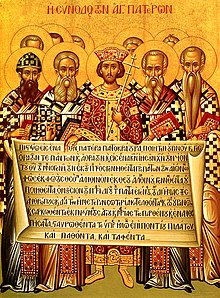
Icon depicting Emperor Constantine
(center) and the Fathers of the
First Council of Nicaea (325)
as holding the Niceno–Constantinopolitan
Creed of 381 - Wikipedia
The Covenant offers only the beginnings of a mechanism for determining doctrine. Any party to the Covenant may question the actions of another if it has concerns. The mechanisms that then follow are only sketched in and will have to be (endlessly) elaborated - but they do look as though they have the potential to be a quasi-judicial mechanism for determining doctrine.

Will it work?  It won't.  I can say this with confidence having looked at the Church of England's attempts to use courts to determine doctrine in the nineteenth century.  

Leaving all theology aside there's a simple matter of group psychology.  Say Province A is convinced that Province Z has stepped beyond the bounds of orthodoxy.  It asks a court - or Covenant mechanism - to determine that Province Z is heterodox.  The process decides Province Z is not unorthodox.  Result: Province A is livid, they refuse to accept the finding, and instead attack the whole process.  In effect Province A cedes authority over doctrine to the central mechanism only when it supports their own a priori convictions, never when it finds against them.  

The inability to resolve doctrinal disputes without a shared mechanism leaves everyone exhausted and frustrated. Ironically, though by no means inevitably, it's more likely to keep people together. The attempt to do so within a shared mechanism is likely to stoke up resentment, deepen difference and fuel dissension. In a globalised world the conflicts will be global: every blogger and their cat will want a say, every Chancellor and Vicar General will guard their interests with vigour. 

The standing stones will still be there. But until the day there is one Great Church (as envisaged by some ecumenical Protestants just after the Second World War) no church will be big enough to make definitive judgements.  In fact the opposite tendency is stronger: attempts to enforce agreement generate schism.


26/10/2010

How to mount a successful coup in Anglicanism


Frances and John Colenso, from an earlier conflict
This is drawn from some work I've done looking at doctrinal conflict in the nineteenth century. It may be a basic primer on how to mount a reformation in the church:

Theological disputes periodically rack the Anglican Church. They have focused, for example, on the meaning of baptism, critical approaches to scripture, the significance of vestments, the limits of intercommunion, the ordination of women. 

Each conflict has been historically distinctive however they shared certain common characteristics.

First, conflict is normal
Conflict is normal in every church.  Differences between faithful christians have deep historic roots and are reflected in almost every aspect of the expression and embodiment of faith. Underlying differences are complex, extensive, often buried in people's everyday attitudes and may reflect incommensurable differences at the level of basic spiritual or philosophical presuppositions. 

The present conflict is about large things. It is about the post-modern church, simultaneously dividing into smaller units and drawing together in globalised world.  It is about the legacy of calvinist, anglo-catholic and latitutdinarian conflict recast in contemporary terms. It is the exporting of the US Episcopal Church's divided and unhappy history across the globe, and about where the centre of the Anglican world really lies and should lie.  It is about the nature of a global Communion in a post-colonial world.

But all of this would remain confined to long books and academic conferences. Therefore,

Second, select your focal point
Because of this complexity, the occasion of conflict is often a relatively small matter, perhaps the actions or teaching of a particular individual. Conflicts take the form of synecdoche in which small matters encapsulate and represent much greater underlying differences.

Homosexuality is a synecdoche for the big things in conflict.  It was deliberately chosen (at least in the UK) as a battle ground because it united conservatives, and especially evangelical conservatives, who had been deeply divided over the ordination of women.  It is an emblematic issue of the US's culture wars.


Therefore whatever the occasion and focus of the conflict, the underlying issue is always greater. Almost anything can become a focal point of conflict - nothing is minor or adiaphora when the identity of the Church is at stake.

Third, challenge authority
Churches rest on authority: the authorities (scripture, traditions, the formularies, law) are made real by those people who are granted authority to interpret, apply and judge the authorities (clergy, bishops, biblical scholars, theologians, historians, lawyers and also - in their own lives - individual believers) .


All such authority is subject to challenge as normal, it doesn't take a conflict.  Church conflicts are the ordering of underlying conflicts around a focal point in order to mount a systematic challenge to the established authorities.

Therefore: a struggle about a matter of Christian belief or practice quickly becomes a struggle for the soul of the church and, equally quickly, a struggle to gain the right to determine how the church decides. 

Fourth, never ignore inertia.
However, most church members do not engage in conflict. 

Consequently leaders of the contending groups have to work hard to keep their supporters on side and engaged in battle. They do so by increasingly strident rhetoric. They declare the conflict vital to the authenticity of the Church as a whole while denying the possibility of middle ground or conciliation. The focal point of conflict becomes a shibboleth: a test by which to divide friends from enemies amongst people who would otherwise be indistinguishable. 

Underlying tensions embedded in the church are highlighted. Shared discipleship and good working relationships are minimised. Big guns (bishops, experts, court cases) are lined up on both sides.  Disputes quickly become critical conflicts of self-fulfilling and self-perpetuating seriousness. 

On the other hand, those seeking a resolution to conflict have the majority with them although, for the most part, the majority remain silent, dispersed and disengaged.  The longer the conflict goes on the harder it is to keep sufficient numbers fighting.

Fifth, change the structures
Those seeking to resolve the crisis perceive that they cannot find a way forwards by dealing with the occasion of conflict head-on. There are seldom clear-cut resolutions of the focal point of the conflict. Because the issues are too great and inherently intractable those driving the conflict and those seeking a resolution may find common cause in moving sideways and shifting the ground of debate onto organizational change. 


This has the immediate effect of transposing the conflict into new terms, away from its ostensible focus and onto the ultimate goal: the right and power to determine how the church makes decisions. The Covenant says nothing about sexuality.


Organizational change embodies shifts in ecclesial power.


The alternative is schism.  Although the Communion in general and the Church of England in particular likes to think of itself as having a single continuous and unitary history there have in fact been many departures, separations and schisms.  In a schism ecclesial power is placed in a new jurisdiction; if it is large enough it will also trigger a re-evaluation of the allocation of power within the parent body.


In conclusion,
In the end, no group wins an unalloyed victory.  The very process of the conflict changes all sides.


On the other hand the church we have now - in all its aspects - is a result of past conflicts.  Dire predictions seldom come to pass and consequential changes are seldom planned or anticipated.


All church conflicts have been waged in the name of truth, authenticity, righteousness and real people have been really hurt.


And still it's worth standing up for what you believe: this is the way the church lives.


15/03/2009

Has the tide turned?

Public execution of two gay men in Iran

I sense a tide has turned. There’s no way to know but it looks to me as though the future shape of the Anglican Communion is slowly emerging.

I guess there will be one grouping based on the present GAFCON, another on TEC, and a third, centred around the CofE, which collects together all those not wishing to fight ideological battles around the shibboleth of homosexuality.

GAFCON provinces will keep strong links with other conservative provinces who, in turn will have varying degrees of linkage with the middling group, some of whom will have strong links with TEC. The CofE will try to stay friends with everyone.

There will be compacts, or agreements, or even covenants to formalise such linkages. But I suspect that the reality of a wired world means that the majority of effective links are likely to be more fluid and more complex. Many will be small-scale (diocese-diocese, parish-parish, interest group based links) and cumulatively significant. They will be more horizontal, untidy and personal links, some brief and some long lasting. Others will be more formal and organizational, some deliberately designed to bind people together, other doing so incidentally. On some themes (e.g. a international Anglican history group) they will deliberately cross the stronger divides.

Some more provinces (Australia?) may break up, as TEC has done. There will be more cross-border interventions and more pain (and court cases) from internal readjustment before things more or less settle down (though I can see a continuing trickle of movement in one direction and another as personalities and issues in conflict change).
These predictions have been brewing for a while. They were sharpened by the way accounts of the actions of the Church of Nigeria (Anglican Communion) continue to spread across the Anglican blogosphere.

Thinking Anglicans have done their usual good job in rounding up press reports and have a 5 page pdf of the full submission of the church to the legislature. Colin Coward has pointed to the silence on the American right about the Nigerian events and rhetoric.

But the fact is that we are all using the issues of homosexuality as a means to an end: to influence the character of the future Anglican communion. We are attempting to use the Nigerian antipathy towards homosexuality as much as the development of authorised blessings of same-sex unions in the Diocese of Ottawa and Niagara. (The response of the Archbishop of Canterbury when he was told about Niagara was said to be 'less than fulsome.')

On the other hand we don't get worked up about what happens to gays in Iran - torture and execution. Nor about what happens to gay and lesbian people in other countries where their lives are in danger. Nor, for that matter, about the largely untroubled acceptance of gays and lesbians in Scandinavia. (See Wikipedia for a global overview).

In other words we are using the fate of gay and lesbian people for other purposes and losing sight that the primary concern of the church should surely be those people themselves: their love and self-fulfilment, their hopes and sufferings, their position in unjust social structures, and the use of systematic brutality to enforce social norms.

If I am even vaguely right about the beginning of the end of realignment then it is time to look away from the distractions of battle and towards the post-war settlement. Towards the end of the Second World War, but before it was over, the cry was taken up in the churches as in the political parties ‘We have won the war, now how can we win the peace?’ The wholesale disruption of civil society meant that, briefly, anything seemed possible.

We need to start up a similar cry in Anglicanism: ‘The war is coming to an end, how shall we shape the peace?

What will a new Anglicanism look like? How can Anglicanism in England be both open to all and inclusive in its attitudes at home if it is to be constrained by the impossible stretch of keeping in with everyone else abroad?

How, in a new and less fevered Anglicanism, can we welcome the marginalised and excluded into a new-old faithful church?

==============
My guess for the three major groupings, based largely on ignorance:

Conservatives:
The Diocese of Sydney, Anglican Church of North America, Bangladesh?, Burundi, Central Africa, Congo, Indian Ocean, Jerusalem & The Middle East, Kenya, Nigeria, Rwanda, South East Asia, Southern Cone, Sudan, Tanzania, Uganda, West Africa, West Indies, Bermuda.
Middling:

Australia (bar Sydney), Aotearoa, New Zealand & Polynesia, England, Hong Kong, Ireland, Japan, Korea?, Melanesia, Myanmar, North India, Pakistan?, Papua New Guinea, Philippines, Scotland, South India, Southern Africa, Wales, Ceylon, Lusitanian, Spain, Falkland Islands.

TEC-aligned:

Brazil, Canada, Central America, Mexico, Cuba.

How the relative weight of these groups is to be measured is another question altogether.

08/03/2009

A question for Inclusive Church


Eucharist at a previous IC conference

I attended an Inclusive Church roadshow in Newcastle a few days ago (not really a show, nor on the road, but an introduction to what IC does and hopes to do).

I put a question at the meeting and was invited to pursue it further. In a more worked form it became:
How may power in the Church of England be patterned such that there is a reasonable chance that it might move towards a sustainably inclusive church?
(Instead of the verb pattern you might substitute structured, embodied, enacted, realised, controlled, or others, each of which has slightly different connotations.)

Of course, the question could be put to any church but Inclusive Church is specifically focused on the CofE.

It's much easier to see contrary examples, of which parts of the Province of Central Africa has been a repeated refrain on this blog, but it is much harder to construct a positive framework, even theoretically, which might evoke godliness while guarding against the sins of the godly.

One might, for example, consider Mad Priest as a test case. His excellent sermon on bearing the cross of mental illness is well worth the read - including the way he was dealt with by the church, with a follow-up here. How might a truly inclusive church have acted?


.

14/02/2009

Canutism


Further reflection on power

As everyone knows King Canute went down to the beach with his courtiers and there he commanded the tide to cease. Foolish King.

Or, as every sophisticated person knows, King Canute went down to the beach with his sycophantic courtiers in order to teach them a lesson: not even the King can command the waves.

So why on earth is the British government so trapped in the myth of Canutism? In the hope that it will be re-elected it has set itself to give the voting population confidence that it is in control. Of everything.

Therefore, as soon as things don't go right, the government gets the blame. It could not command the financial bubble. It can't control teenage pregnancies or truanting. It can't control knife crime. It can't control the weather.

Crime is a clear equivalent of Canute's tide. By definition crime is what happens beyond governmental controls. Hence the emphasis on punishment - knowing that it cannot control crime the government emphasises its reaction. But punishment (as a political tool, not the reality) is smoke and mirrors - designed to obscure the fact that crime cannot be controlled. (Though it may be possible to manage it.)

Blair and a strong economy meant that the impression of control was sustainable. Brown and a collapsing economy mean the impression that everything is out of control. In fact nothing has changed in the government's capacity to control the people. (Lots of controls and constraints have been put in place and their legacy will last decades, but it still cannot control the uncontrollable.)

And the Church has swum in the same stream. Faced with people not doing what the leaders want of them there is an instinctive turn to demand more powers - to control the words and behaviour of the people. It won't work, can't work. But it can do a lot of damage on the way.

We need to lose the Canute myth and rediscover a more sophisticated Canutism.

The authorised version:

Canute began by being a Bad King on the advice of his Courtiers, who informed him (owing to a misunderstanding of the Rule Britannia) that the King of England was entitled to sit on the sea without getting wet. But finding that they were wrong he gave up this policy and decided to take his own advice in future - thus originating the memorable proverb, 'Paddle your own Canute' - and became a Good King and C. of E., and ceased to be memorable.

1066 And All That, W.C. Sellar and R.J. Yeatman, 1930.


.


06/02/2009

A quick primer on power and the Church of England

Sculptor Kevin Stone's image of power and authority. It's for sale.

Power is a complex term, the Church is a slippery organization, and very few people address the combination directly except, perhaps, to complain.

[Note 1 In the literature on the Church of England there is one book I can bring to mind and a couple of articles which overtly address power – and a vast literature on authority. This is not an accident].

This is prologue to the questions: what is, should be, could be the proper relationships between bishops, clergy and laity in the Church of England? How should the Church of England be constituted?

My working definitions:
· Power – the capacity to effect or prevent change
· Authority – the right to take decisions.

Neither power nor authority are objects or object-like (notwithstanding all the language which treats them as such) [ Note 2: That is, there is a body of literature which conceptualises power in this way. I reject it: it serves those who hold power]
. Power and authority are relational (i.e. exercised between people) and, though either may be latent, both exist only insofar as they are exercised.

Both are essential: power is what makes anything happen and stops anything else [Note 3: This is a distributed model of power in which, bar complete extremes, everyone has some power and some people have a lot]
. Authority says what’s right. Together they form the organizational foundation which sustains society.

Furthermore:
· Power is always limited
· Authority is always contested

Both power and its limits are visible whenever power is exercised.

Authority is created in the process of overcoming those who would contest it.

Neither can stand still. Each has its own internal logic which is inherently imperial – power, to be recognised, has to be exercised over others; authority, to be sustained, has to defeat those who would contest it. The greater the concentration of power or higher the claim to authority the more the needs for enemies.

Power and authority are inherently unstable: like a pile of sand they must continually be built up or tide and time will simply wash them away.

Power and authority
Power and authority are thus clearly separable. They are also intimately connected. In particular:
· Those who use power crave legitimacy. Thus authority serves those with power.
· The claim to authority is not authority. It is, however, also a claim to the right to power. Thus power is bent to the service of those with authority.
· The claim to authority is also a claim for deference. To fail to defer is to challenge the illusion of authority and to expose its lack of power.
· The claim of moral authority is a demand for deference in the explicit acknowledgement of the lack of power.
· On the other hand, there is no point claiming power you don’t have – threats that are exposed as empty merely render you ridiculous.
· The grounds of the claim to authority, and thus to the legitimacy of action, are never [Note 4: So far as I can conceive today]
coterminous with action. There is always discontinuity between authority and power, intention and action, legitimation and result.

Therefore there is always the possibility, and maybe always the probability, that any action will contradict the stated reasons (whether in the manner of those actions or the results) and new post hoc legitimation will always be needed.

Curiously these inbuilt disconnections are also the grounds of hope: power is limited and authority contested and nothing lasts forever. This is politics: what made and maintains one configuration of authority and power can always unmake it and create another.

Jurisdiction
Jurisdiction [Note 5: Etymologically, ‘law-speaking’]
, in the normal course of events, is the codification of authority and power in harness.

A jurisdiction is a declaration of who has authority to make certain decisions within defined bounds. The bounds would frequently include: subject matter, geographic territory, persons subject to the jurisdiction, and due process. It generally (though not inevitably) also specifies the terms on which coercive power may be used to implement decisions properly made within the jurisdiction.

Jurisdiction is generally a nested hierarchy. Lower levels may be constrained along any of the bounds which constrain that jurisdiction (e.g. Magistrates Courts can only hear cases related to their geographic area and can’t hear more serious cases; when they deal with civil matters, e.g. licensing, they do so under different rules). Lower levels are controlled by higher levels which can generally review and, if thought necessary, reverse lower level decisions.

Bishops have jurisdiction (their function as ‘ordinary’) over their diocese, its clergy and lay people, in matters relating to doctrine, worship and the discipline of clergy. They do so in accordance with legislation and in consultation with other bishops. However there is no higher level of hierarchy: there is no body which can review or reverse their decisions (though in some areas it may be possible to challenge the exercise of their jurisdiction in secular courts and tribunals).

Bishops, power and authority
Bishops have no power over the laity (effectively lost in the C18). Their power over clergy is generally more persuasive than directive. Power over appointments is a strong lever.

(I’m not up top date on progress towards common tenure for clergy. Hitherto freehold has nominally left clergy impervious to episcopal power and those with licences wholly dependent on episcopal power, even if the reality was much more blurred.)

Such power that bishops do have is generally reactive and negative – the power to prevent change but not the power to effect change.

Bishops have little power but they claim high authority. They expect deference (some more overtly than others).

The Church is not a democracy. However few people take the next step of then saying how, in political terms, the Church of England should be designated. I suggest that the Church is a constitutional monarchy, like the British State. However in the State the emphasis is on the constitution; in the Church the emphasis is still on the monarchical. Making the Standing Committee of the Diocesan Synod the Bishops Council was a deliberate fudging of centres of power in favour of the Diocesan bishop. The bishop’s council (cf. Privy Council) is a court. Influence in a diocese (a milder but real form of power) stems from the goodwill of the bishop, and is sustained by continued access to the bishop’s ear.

(Incidentally this is organizationally dysfunctional and works counter to any possibility of a ‘learning organization’. Influence comes from telling the prince what he wants to hear. If influence depends on continuing to have the ear of the bishop then it is not in your interests to share your knowledge with anyone else. It is in your interests to exclude other sources of information in your area of knowledge – like using ‘pre-emergence’ weedkiller to keep potential competitors from ever seeing the light of day.)

Bishops, clergy, laity
The creation of synodical structures (in 1919 and 1970) were deliberate attempts to include the laity in the government of the Church. The particular structures of Synod reflect the attempt to incorporate the laity without reducing the power of the bishop.

General Synod was a trade-off with Parliament. In effect it allowed the laity the minimum voice possible which would enable church leaders to persuade Parliament to transfer to it jurisdiction over worship and doctrine (in the Worship and Doctrine Measure 1974), a goal that had been sought since at least the 1840s.

A key element is ‘consultation’. Where those who are consulted must give their assent they have real power to stop change. Where they do not they are, at best, advisors. At worst they merely provide additional legitimation for actions that those with power wish to take on other grounds.

In General Synod it is possible for one House to refuse assent to proposed Measures (or other votes). Both clergy and laity thus have a veto and thus also constructive power in the shaping of Measures. Diocesan Synods were intended to parallel General Synod: the bishop cannot have his views overridden in synodical decision making and every effort is made to ensure that such a possibility is not exposed by avoiding putting bishops in the position where they would be forced to exercise their power of veto.

Since the creation of General Synod, and especially since the mid-1980s, I believe there has been a steady assertion of the authority and power of bishops at the expense of both clergy and laity.

I also believe that the laity are the heart of the Church. I think the centre of worship should be in the nave, not the chancel. I know that the whole superstructure rests on funds provided by the laity. I suspect that the ratio of paying laity : all clergy : senior staff and bishops has been shifting towards the clergy as a whole and towards the more expensive clergy in particular. I am convinced that a church which excludes the laity from doctrinal debate and engagement is thereby impoverished and (lacking any serious notion of reception) is ecclesiologically deformed.

And the greater the claim that bishops know best the bigger the mess will be made of things.

I suggest a thought experiment: mentally remove each class of laity, clergy, bishops, and see what remains: would there still be a church without any one of these groups?

Paul Bagshaw
6/2/09