Showing posts with label Wales. Show all posts

23/04/2012

What do we make of Wales?

A little more clarity about what has happened in Wales over the Covenant comes with the publication of Highlights of the Church in Wales Governing Body April 2012 (pdf). (Previous press release.)

This makes clear that Gregory Cameron (wikipedia) proposed the substantive motion that the Church in Wales 'subscribe' to the Covenant.

The amendment - that the Church in Wales should delay any determinative decision until after the ACC meeting in November 2012 - was moved by Bishop John Davies of Swansea and Brecon. Furthermore Martin Reynolds reports (in Comments to a Thinking Anglicans item on April 18) that the Bishop of Monmouth, Dominic Walker, was preparing to propose that the motion should not be put to the meeting.

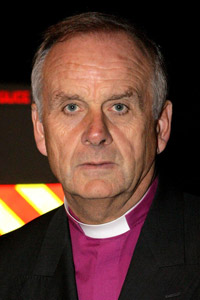
Church in Wales bishops at
Gregory Cameron's consecration (from wiki)
There are 6 diocesan bishops in the Church in Wales. Until recently the Church had been consistently opposed to the Covenant at a fundamental level but this appeared to have been swept aside at the previous meeting of the Governing Body. That meeting commended the Covenant to the Dioceses for consideration and endorsement. It may or may not be significant that Gregory Cameron, one of the key players in creating the Covenant, joined the bench of bishops in early 2009.

Two things happened which changed the landscape between the two Governing Body meetings. The Archbishop of Canterbury announced his retirement and the Church of England voted against the Covenant. The first meant that the natural desire not to undermine Rowan Williams was no longer a weighty consideration. The second showed that the Covenant was no longer 'the only game in town' - other futures were and are imaginable.

Thus, to avoid a public split in the bench of bishops, a positively worded motion was devised which put off a decision. If, as Martin Reynolds suggests, Gregory Cameron himself suspects the ACC will discard the Covenant then he has not lost face. And if the ACC should persist with the Covenant then those who continue to oppose it in Wales will have a further opportunity to defeat it in 2013.

Therefore, despite my earlier caution, I will move Wales from 'probably Yes' to 'probably No' on my table of how the provinces might vote.


16/03/2012

The end of criticism in Wales

The Church in Wales, led by Archbishop Barry Morgan, was once highly critical of the Covenant. It made strong, cogent arguments against and propounded an alternative view of the future of Anglicanism.

But all that seems to have vanished now.

Submission 1
In February 2007 The Church in Wales' official response to the consultation (pdf; all official responses.) on the 'Nassau' draft of the Covenant was extensively critical. It  particularly opposed the allocation of power to the Primates, a threat that has now passed. It looked for a way out of the whole process:
Perhaps we need to get away from ideas of negotiation altogether and think of ‘interchange’ instead. We need to become in heart and mind as the other is in our disagreements. We seem in far too much of a hurry to reach agreement before we have reached that depth of understanding in which healing and forgiveness can be effected. The Covenant, if undertaken too hastily, would be a politically expedient but short-termed solution and without the prior work of reconciliation would be unlikely to hold.
It saw the Covenant programme as a move towards a Confessional Church, 'an increasingly secular style of  doctrinal decision-making' and 'a topdown model of collective authority'. 'We fear', it said, 'that an over-structuralised Communion will lead to a loss of the present Anglican engagement with local issues and prompting of the Holy Spirit.' It reminded people of the 'fallibility of the Instruments of Communion.'.

In conclusion,
The language of the Covenant indicates a change of emphasis from autonomous provincial government with consultation to a global body with central authority for leadership with powers of exclusion.
they proffered a different ecclesiology to that which they saw in the Covenant:
Within the Anglican Communion as a whole it is only the ACC that approaches a synodical status. We see the ACC as pivotal and the Anglican Communion as primatially-led but synodically-governed by the Primates within the ACC. This we believe to be consonant with Anglican polity. 
Submission 2
The Church's response to the St Andrew's Draft (pdf; n.d.) of the Covenant repeated the Church's desire to give the ACC a more prominent role, reflecting the understanding that 'The Anglican concept of authority is a dispersed one focused through conciliarity.' A 'conciliar model' was one in which 'authority should be modelled on participatory and egalitarian principles' however difficult that might be for some.

But the fundamental question for the Church in Wales, engaged in a programme of constitutional revision, was the perceived threat to its autonomy:
The question then arises as to whether it [The Church in Wales] would be willing to surrender its autonomy in matters of faith, doctrine or morals at a time when it has made itself more autonomous in other areas?  .....  In other words, it [the Covenant] would be giving others “the ability to give direction about the course of action that the Church in Wales should take”.  The present appendix gives that power to others and could prove problematic. 
This threat to autonomy and the legal problems it provoked was to lead to a revision of the language of Covenant action against offending provinces. The capacity to be directive was simply inverted: in the final draft directions became 'recommendations' made not to the offender church but to everyone else. (See, a legal fiction.)

Submission 3
The third submission (pdf; n.d.) was to Section 4 of the Ridley Draft:
The Covenant appears to be understood in some quarters as a tool for the reordering of the Church which will be used to effect a rapid severance between Provinces whose contexts and understanding of Christian discipleship are, for now, too different to lie within a single ecclesial body. We hope that this is not the case, and that the Covenant will remain an instrument intended to unite Anglicans around  a common and flexible understanding. We are concerned lest the current draft of Section 4 of the Ridley Draft could lead to chaotic, painful and protracted disputes with little, if any, sense of how such disputes are to be resolved. (emphasis in the original)
Therefore the Church recommended a 'reorientation of Section 4 ... towards a theology of reconciliation.' In effect, a re-writing of the Covenant.

The submission then critiqued the proposal:
  • If neither the Primates' Meeting nor the ACC had been deemed suitable locations for the authority to interpret the Covenant, what was the rationale for placing such authority in both, through the [then] Joint Standing Committee? 
  • What resource would the JSC need to fulfil this role?
  • The sole power of recommending a course of action to provinces could simply lead to chaos 'as  Provinces reach  wildly different conclusions following a recommendation from the JSC. It is not clear how this will lead to resolution of a conflict.'
  • The Covenant now embodies a strong emphasis of provincial autonomy. But, 'We should like to invite further reflection on the nature of the Provinces’ autonomy.' ... focused on our theological responsibilities to each other as a properly catholic and apostolic body. This needs to be married to a properly theological account of the Covenant’s authority and the demands of discipline.'  (emphasis in the original)
Instead of Section 4 as written the Church in Wales commended a theology of reconciliation and hope such as that described in Communion, Conflict and Hope: The Kuala Lumpur Report of the third Inter-Anglican Theological and Doctrinal Commission. (ACC, 2008). This document too sees hierarchical views of power and authority as part of the problem, not the solution (para. 119).
 
Finally the submission picked up the point that a culture of global communications is often seen as a threat to Church unity without a clear argument why that should be so.
We should like to point out that free communication and easily available travel gives rise to unrealistic expectations of uniformity and sets up a series of false cultural norms. A false cultural norm of pseudo-uniformity is created when, in reality, the different norms of one place do not impinge upon the daily life of another. The ‘flattening’ of human culture – the sense that there is a certain ‘default’ setting – is characteristic of modernity. By contrast, Anglicanism has long celebrated diversity, but not for diversity’s sake. Rather, the varied expression of Anglicanism is born of the conviction that the Gospel, because of its richness which exceeds all particularity, can be mediated in many ways.
So, what happened?
The Governing Body of the Church in Wales in session
The No Anglican Covenant Campaign would argue, I'm confident, that most of these questions and critiques still apply. 

The motivation behind the Covenant and, probably, the reality of its implementation have not changed that much from the beginning. Mechanisms have changed, and the language has become more subtle, but the instinct to centralise, to move toward uniformity, and to embody hierarchical views of power and authority within and across the Communion still seems very strong.

But I guess that when you're involved in international negotiations you accept what you think is the best outcome you're going to get - even if it's a long way from what you have been arguing for over so many years.

Whatever the process, a longish briefing paper (pdf) from The Doctrinal Commission of the Church in Wales 
... commends the Anglican Communion Covenant to the Governing Body of the Church in Wales. We regard it as a theologically coherent description of the nature of the Church and the form of the Christian life as expressed in Scripture and Church tradition. The Covenant falls within a discernable trajectory in the development of Anglican identity.
Though this was clearly not a unanimous view within the Commission, perhaps only a bare majority:
Most members of the Commission welcome the Covenant, regarding it as an opportunity to deal more clearly with the many tensions that have beset the Anglican Communion in recent years. Some would rather the Covenant were clearer concerning the consequences of fractured relations. Other members of the Commission express some reservations concerning the Covenant, pointing out that, of itself, it solves none of our difficulties. Much depends on the way in which the Covenant is received and lived. Properly used, the processes outlined in the Covenant should assist this process of discerning the work of the Spirit within the Anglican Communion. However, this will only be possible if a conscious effort is made to foster proper lines of communication and deeper bonds of friendship across the Communion. However, the Covenant is an attempt to describe and clarify the nature of our mutual commitments and the form of life required to begin the process of discernment towards deeper communion and a more intense participation in the life of God made known in Jesus Christ by the power of the Holy Spirit.  
Archbishop Barry Morgan
Thus the question went to the Church's Governing Body in April 2011. There, Archbishop Barry Morgan reversed his previous opposition to the Covenant and backed it. 
In his opening remarks, Archbishop Barry quoted the Archbishop of Canterbury: “The Church is challenged to show that it is a safe place for people to be honest.” This final version of the Covenant looks at the Anglican Communion in terms of relationships, accepting the autonomy of each province. There is a reduced emphasis on sanctions for a province which wishes to withdraw from the Covenant, or where there are objections to its actions. The Covenant seeks to deal with differences through conversation and mediation, and to try to build up trust across the Communion. (Highlights of the Church in Wales Governing Body April 2011, p.6, pdf)
Anglican Consultative Council members the Very Revd. Chris Potter (St Asaph) and Mrs Helen Biggin (Llandaff) also backed it. The Bishop of St Asaph summed up the discussion: 
We need the Covenant, not as a new instrument or artificial construction, but to hold friends together.
The Governing Body then, unsurprisingly, voted for to commend the Covenant to the Dioceses for reflection. Members have the opportunity to comment directly on the Covenant. However, given the Governing Body's vote, nothing is likely to change.

Where now?
A private note I have seen says that the argument from the ACC members at the Governing Body meeting also included the assertions that, first, the teeth of the Covenant had been drawn so it would be safe to approve it and, second, that the last ACC meeting the members attended was so benign that a vote in favour would only encourage greater mutual respect.

But
  1. Have the earlier questions and critiques of the Section 4 proposals (in Submission 3) been answered? If so, what were the answers? And, if not, do they still have force? Or will 'recommendations' not now lead to chaos across the Communion?
  2. What happened to the vision of an Anglican ecclesiology of ' primatially-led but synodically-governed by the Primates within the ACC'? What has happened to the appeal to a 'theology of reconciliation'? Should we just forget it? Indeed, will the Covenant reduce the ACC to little more than the electorate for the Standing Committee? Have ' hierarchical views of power and authority' been neutered across the Communion? Or are they now acceptable?
  3. Has the initial punitive motivation for the Covenant vanished, leaving solely more constructive motivations? Or has it just been clothed in more subtle language?
  4. What happens if, in future, the benign atmosphere of international gatherings should evaporate? After all, to maintain such benignity will require all provinces and Instruments of Communion to be respectful, considerate and generously inclined all of the time; to destroy it will need just one province, perhaps on just one occasion, to insisted on asserting its truth.
The Governing Body of the Chuch in Wales next meets 18-19 April 2012 in Llandudno.


30/01/2009

New Anglican Province: utter nonsense

Barry Morgan, Archbishop of Wales

If I was a person who had heroes, and if being a Primate in the Anglican Communion didn't rule a person out ex officio, then Barry Morgan might just be my hero.

From the Living Church
The Primate of the Church in Wales will oppose any attempt to form a parallel Anglican jurisdiction when the primates of the Anglican Communion meet next week in Alexandria, Egypt. Leaders of the GAFCON movement, however, have pledged not to back down from their support of Bishop Robert Duncan and the Anglican Church in North America (ACNA), setting up the potential for a clash of views when the primates meet.
On Jan. 24, Archbishop Barry Morgan of Wales told delegates attending the annual council meeting of the Diocese of Virginia he would oppose the creation of the ACNA with “every fiber of his body.” Another North American province was “total nonsense,” he said, according to a report by Anglican blogger Mary Ailes, but the archbishop conceded that his views were in the minority among primates.
He may well be in a minority. However by expressing himself publicly before the meeting I think he will encourage those who share his views. I suspect he is speaking out now because of a well-founded anticipation that the ACNA and GAFCON crew will try to pull a stunt in Egypt, whether or not a new North American province is formally debated by the Primates.

From The Times:

The Archbishop of Wales, Dr Barry Morgan, said he would oppose a new province “with every fibre of my being.”

He warned that if the Archbishop of Canterbury and the Anglican Communion allow traditionalists to set up a new province to exist as a parallel jurisdiction to the US Episcopal Church, no province would be safe and the worldwide Anglican Church would splinter into many fragments.

...

In an interview with The Times, Dr Morgan said the concept of a new province in the US “makes no ecclesiological or theological sense.”

New provinces are usually set up for demographic or missionary reasons.

Dr Morgan said: “It makes no sense for a province to be founded on doctrinal grounds.”

...

Dr Morgan said: “I hope we will see the same spirit of generosity and openness that we had at the Lambeth Conference last summer. There was then an overwhelming desire to stay together, and I hope that will be the same for the Primates’ meeting.”


On my very brief contact with with him I found Barry Morgan to be gentle, thoughtful, listening and immensely able. Even if plucky little Wales isn't politically strong in the Primates' councils, let's hope the obvious logic of his position is.


.

18/12/2008

And quite right too


Welsh Refugee Council

Archbishop of Wales blasts policy towards refugees
Dec 18 2008 by David Williamson, Western Mail


ARCHBISHOP of Wales Barry Morgan last night warned that the nation would be
judged by its attitude to the poorest members of society.

He said he was alarmed at the plight of refugees and asylum-seekers in
Wales who are in abject poverty. The Anglican leader is concerned by the effects
of 2002 legislation, which withdrew social support for rejected asylum seekers.

Tomorrow, the Welsh Refugee Council will relaunch its hardship fund to
provide blankets for newborn babies, a winter coat for a newly-arrived refugee,
and food parcels for destitute families.

Nearly half (47%) of all people using the UK’s main refugee advice
services this year were destitute – of these 56% were from Iran, Iraq, Eritrea
or Zimbabwe.

Questioning whether it was realistic to expect people to return to
countries defined by danger, Dr Morgan said: “Very often their countries are
unsafe and unstable. Are you going to send people back to Zimbabwe or the
Congo?”

Describing his shock at learning of the Congo’s mortality rate, he
said: “I heard 20% of children under five die either as a result of disease or
war, but the thing is there is a child at the heart of Christmas. God reveals
himself as a child.” Dr Morgan said that in the Christmas story Jesus was
revealed as the child of refugees.

He believes the Nativity story should inspire society to protect the
most vulnerable children.

He said: “It is interesting. According to the Christmas story Jesus was a kind of refugee, having to flee to Egypt.

“If you believe that God reveals himself in Jesus then he reveals
himself as a refugee and he reveals himself as a child. What does that tell you
about the value of a child?”

Adamant such modern-day families should not live in destitution, he
said: “A country is ultimately judged by what it does with its poorest people.”

The policy of cutting off support to failed asylum seekers who could
not return to their home nation and banning them from working was earlier this
month condemned in a report from a think-tank founded by former Conservative
leader Iain Duncan Smith.

At least 26,000 failed asylum seekers in the UK survive on Red Cross
food parcels.
....

For more information about the Welsh Refugee Council’s hardship fund, click
onto http://www.welshrefugeecouncil.org/

01/12/2008

It's just a matter of time

or, perhaps, Providence.
The Archbishop of Wales with the Bishop of New Hampshire
In a TV documentary to be broadcast on BBC One Wales on Wednesday, the Archbishop of Wales reveals, amongst other things, that

Describing the circumstances in which he would consecrate a bishop in a gay relationship, he said: “Personally, I have absolutely no problem at all with the full acceptance of gay and lesbian people into the church of God because they are made in God’s image. It’s not a matter of choice and therefore if the church of God
cannot welcome these people then I don’t think it’s being a ‘church’ at
all and it’s not being true to the gospel and the values of Jesus.”

He continued: “If the electoral college went ahead and if then the bench of bishops
endorsed the nomination – so there are a couple of big ifs there – then I as
Archbishop would have to decide to do one of two things: Go ahead and risk the
ire of the Communion or refuse to consecrate and then possibly be taken to the
provincial court of the Church in Wales for refusing to carry out what I’m
canonically sort of mandated to do.”

If such a moment was reached, he said: “I feel that I would have no choice at that
juncture but to consecrate.”

Not tomorrow, nor the next day. But one day.
Dr Williams did not invite the openly gay Bishop of New Hampshire Gene Robinson
to the Lambeth Conference this summer. However, Dr Morgan chaired a pre-Lambeth gathering of liberal Anglicans at which the bishop was present.


01/10/2008

Blessing a civil partnership in Wales

St Hywyn's in Aberdaron.

From BBC Wales (23.9.08)

A vicar in Gwynedd has been reprimanded by the Archbishop of Wales for blessing a gay civil partnership between two women.

The service was conducted by the Reverend Jim Cotter at St Hywyn's Church in Aberdaron, with the approval of the local church council.

A complaint was made to the Archbishop who wrote to the Rev Cotter telling him he had exceeded his authority.

The Church in Wales said it had "no liturgy" for same-sex unions.

The vicar said he had been given approval by the local church council to carry out the ceremony in July, and he was not aware of any opposition locally.

He said around a dozen friends of the couple attended, along with three members of the church council.


=======

Sorry this is old news. I used to know Jim a liitle and always had a great deal of regard for him.

And I'll be away now for a couple of days so after today I won't post again after today until the weekend.

02/09/2008

Jeffrey John: some historical notes

Bishop? Jeffrey John

You will remember Jeffrey John was to be suffragan Bishop in the Diocese of Oxford in 2003 until a public campaign pressured Rowan Williams into pressuring John to stand down. (MCU's contributions to the issue are here.) Now it seems there is the possibility that he may be elected bishop in the Church in Wales: The Times, The Guardian, Pluralist, and I can't raise Thinking Anglicans but they'll have all the links.

Over the previous two centuries there have been campaigns against a number of episcopal appointments. What made this one different was that it was the first to succeed.

There was, for example, strong opposition to the appointment of Frederick Temple as Bishop of Exeter in 1869. Convocation had condemned Essays and Reviews in 1864, and Temple had been one of the essayists. In the face of demands that he renounce its supposed heresy - from other bishops as well as campaigners - he stuck to the grounds of law.
But all consideration only brings me back to this, that the one safe rule for me
to follow is the law of the Church of England. While I am neither refusing to
say nor do what the law does not require, I am on safe ground; and the
responsibility lies with the law and not with me. The moment I step beyond these
limits, I take the responsibility on myself, and I cannot shift it; and whatever
ill consequences follow, the blame is mine. (In Sandford's Memoirs of Archbishop Temple, vol I, p. 293)

In other words: he met all the conditions required and no-one else had authority to demand more of him.

In 1917 Hensley Henson was nominated to Hereford and his well known modernist views (he was never really a liberal) similarly provoked an outcry and a campaign to prevent his appointment. Again several bishops, led by Charles Gore, were also in the opposition. Amongst other reflections Henson saw that, if he withdrew following his nomination, it would hand his enemies the power to demand statements of belief - tests of faith - well beyond what was legally required. In his case the English Church Union would become arbiters not only of who was a fit person to serve as bishop but also of the doctrine of the Church of England.

Both Temple and Henson had the support of the Archbishop of Canterbury.

But in Jeffrey John's case the Archbishop of Canterbury vacillated. In twisting John's arm to withdraw he handed Anglican Mainstream (what happened to them?), and behind them the organized ranks of conservative opinion, the power to determine both who shall be bishop in the C of E and to stand in judgment on a man's life.

But, perhaps, not the power to decide for the Church in Wales. Whether John is appointed or not let it be because the proper constitutional processes have been followed, and not because sectional and sectarian groups in the church flex their muscles.