Showing posts with label Ecclesiology. Show all posts

16/01/2013

What does it mean to discern the will of God by vote in General Synod?

It's not my place to comment of the forthcoming meeting of the House of Laity concerned with the chairmanship of Dr. Phillip Giddens. (I'm ordained, not a member of Synod, and wasn't there.)
Dr Phillip Giddings

But it has caused a fine brouhaha. See Thinking Anglicans (not least the comments): 2 Dec, 10 Dec19 Dec9 Jan11 Jan15 Jan.

I first took note of Dr Giddings' name as I was trawling through the records of General Synod. Now this was some time ago, and I can't remember the context nor the subject matter. But I remember being struck because whatever position Dr Giddings was asserting at the time he backed it by a claim that it was the will of God. I think he was the first, and one of very few, to have done so in Synod's history.

Dr Giddings knows his mind. He is firm in his views and has been passionately partisan. But to claim to know the will of God - even if spelled out in Gospel words - is inherently destructive of synodical government.

Synodical government is government by council and counsel. Its foundation is that devout and faithful Christians seek the will of God collectively. It presupposes that all members are faithful Christians, that they disagree in their collective task, and that any answer to the question in front of them is always provisional. Uncertainty and transience, mutual regard and (party) politics are built into the process from its foundation stones.

To declare this is the will of the Lord in such a context and process is simply destructive. It is a claim to authority that can only be accepted or dismissed. It to assert that the speaker has privileged access to the mind of God and that anyone who disagrees is faithless or worse. It is the antithesis of taking counsel together.

Second,
(Oh dear. My second point appears to have been taken from me between starting this blog and getting to this point. The page on Anglican Mainstream which was here now seems to have been taken down. Nonetheless...)
Tom Sutcliffe

The missing page quoted Tom Sutcliffe asking
Do we as a Church really believe that obedience to the majority at any given time is an important part of our faith?
He goes on to cite noble examples of people who stood out against the prevailing consensus - as if that were sufficient to show we should answer 'no way' to his question.

But I wish to answer 'yes', at least in the terms set out above.

In practice synodical government is about majority votes. When Synod concludes an issue by such a vote then (any subsequent processes permitting) that decision is the settled view of the Church. Minority and dissenting opinions are permitted and expected. But it is the majority vote which, in effect, declares that is the belief of the Church -  on that particular issue, within the jurisdiction of the Church of England, and until a different majority vote takes place.

The underlying question is: what does it mean to discern the will of God?

The underlying dissonance is that 'the will of God', 'truth' (and sometimes 'faith') are conceived in absolute terms: x is either the will of God or it isn't - there is no middle ground, no shades of grey, there is no need for debate nor any right to one. Therefore voting (and politics, and all that accompanies it) is seen as grubby, inferior, even wrong in matters of belief. In this perspective church politics is the evidence and symptom of our lack of faith.

But (even accepting these categories) it remains the case that all knowledge of God is mediated through human beings. And, as God is inherently so much more than humanity, such knowledge is always partial, contingent, self-interested, small. None of us can definitively know the mind of God.

Fill in the blanks, but
use a washable ink.
Alternatively, we could celebrate these characteristics. We are as God made us - knowing his creation, knowing God and God's love and judgement revealed in the life, ministry and teaching of Jesus, and always trapped in our own limitations of knowledge, circumstances, hopes and the inability to see what will happen tomorrow.

Together - making a virtue of all that divides us - we have some chance that our collective discernment may be better (by any criteria) than the discernment of one individual or party.

But howsoever good it might be (and I don't know how you would judge in the abstract) any discernment remains characterised by the constraints of the people who took the decision: inevitably local, limited, transient and cast in the presuppositions of its times.


27/12/2012

Radical?

Perhaps, in a previous post, I was too quick to be scathing about how one member, one vote could possibly be considered 'radical' in today's world.

I forgot. The Church of England is not like other institutions. It does things differently.

Specifically the it has a very low opinion of democracy. The reasons are seldom articulated in public.
Politically the church is a constitutional monarchy. This describes the British state too, and the CofE is the State Church. 

In the State, however, the emphasis is firmly on the constitutional end of that oxymoron whilst the church clings hard to the emphasis on the monarchical.

Bishops are princes in their own domains. (A couple still live in palaces.) And it's just been announced that Archbishop Williams will now be a life peer and Baron.

When synodical government was created a great deal of thought was given to the relationship of bishop to diocesan synod:
Bishop Mervyn Stockwood
  • Synods were carefully structured so that they could not outvote their bishop. 
  • The most explicit blurring of the monarchical and the constitutional is in the merging of the Diocesan Synod's Standing Committee with the Bishop's Council. Advising the bishop and formal responsibility for maintaining local government were conflated. Consequently the representation of the laity and inferior clergy [technical term] was subsumed into the Prince's court. 
  • Bishops remain judges in their own diocesan courts. This role is normally delegated to the Chancellor of each diocese. However Bishop Mervyn Stockwood (corrected, thanks to Frank Cranmer for pointing out my earlier mistake), Kingston-upon-Thames, fell out with his Chancellor, Garth Moore. Afterwards the bishop simply sidelined his officer and made most legal judgements himself. (Moore remained Chancellor but the two never spoke to each other again.) 
The Bishop is a prince in his court (in the sense of his personal council) - and is thus surrounded by courtiers. Subsidiary power in a diocese comes from access to the bishop and therefore there is every incentive to protect such access. Consequently sharing information horizontally can be foolish thing to do - even though (or, perhaps, because) it might be best for the organization as a whole.

Autocracy (however tempered) evokes sycophancy (however disguised). It is not good for human or spiritual flourishing, nor for objective or accountable decision making. 

This is a description of the polity of the CofE. It is not about 'good' and 'bad' bishops. It is the capacity for arbitrary decision making which is destructive, whether or not it's exercised, whether or not it's effective or the bishop loved. (And what is done by the Prince is echoed in each lesser fiefdom: parish priests may act arbitrarily because their bosses can.)

So this is the main reason why one member, one vote might be considered 'radical'. It suggests that the CofE might possibly step a little closer to being a membership church, maybe. 

One member, one vote is radical in the sense that the 1832 Reform Act was radical. It allowed a much wider section of the community to vote for their governing representatives. It did not bring chaos or instigate government by the working classes. The ruling class simply accommodated and adapted - and so will the Church.

One member : One vote


12/03/2012

How about some ecclesiology?

The Bishop of Sodor and Man,
Rt Revd Robert Paterson
The Bishop of Sodor and Man, Robert Paterson, has blogged about the defeat of the Covenant in his diocese last Saturday. I find his views quite revealing.

First, it's very personal 
The Bishop writes,
It was with a very heavy heart that I left the meeting of the Diocesan Synod on 1 March. ... I confess that I was not only shocked by this vote but I felt - and still do feel - personally wounded by it. It is a self-inflicted wound because of my own failings.
Now I don't know anything about the workings of Sodor and Man, so these are my more general reflections. However I doubt the Bishop should carry all the blame, Jonathan Clatworthy tells me he's highly respected in his diocese.

But, personalising the vote reflects the culture of ministry in the CofE which is still very personal. Each bishop does their own thing (at least, within the diocese) and each incumbent does too. If clergy are judged by their peers according to the solidity or charisma or prayerfulness of their own ministry then one corollary is that a concern for continuity across time, entailing a degree of personal restraint for the good of the whole body, feels like a negation of one's own ministry - and therefore one's self.

Another corollary is that a corporate defeat is seen as a personal rebuff. This is why an appeal for loyalty to the Archbishop of Canterbury may sway votes although it is simultaneously an appeal to set aside the merits of the argument. The other side of the appeal to the personal is the devaluing of synodical structures and an ecclesiology of dependence on hierarchy (father really does know best).

Yet synodical government was created - slowly and against the clerical grain - to embody the corporate nature of the Church. It was based on the presumptions that we are stronger together, that all members should be effective participants in governance, and that the bishops remained in charge.

There was extensive debate about the place of the bishop in diocesan synods which resulted in two key elements. First, that no vote could require the bishop to act in a way he was not willing to act. Second, by making the standing committee of the diocesan synod the same as the Bishop's Council they con-fused two distinct functions and stacked the odds heavily in favour of episcopal control of diocesan government. (Rule 34 (k)(1) of the Synodical Government Measure but, a little ironically, not included in a version of Church Representation Rules printed for the Diocese of Sodor and Man (pdf) which has some distinct legal features.)

Furthermore the price that Parliament required of the Church of England for it to pass to the Church control of its own affairs, in particular over doctrine and worship, was that lay people should be full members of the constitutional governance of the Church.

But the over-valuing (in my opinion) of personal aspects of ministry erodes synodical government. It's not the only thing that does. There has been a general and steady trend to marginalise lay people from decision making such that 1970 seemed to mark a high point rather than a beginning. Partisanship itself is not a problem for synod, but effective withdrawal from the governance of a diocese by certain parties certainly is. By demanding separateness such groups also demand direct access to the bishop (and often to some other bishop as well) in any matters of governance which they think affects them.

In my judgment corporate governance is thus significantly weaker than is good for the Church.

Second, there are those in the know, and there's the rest
The Bishop also makes the point from his personal experience that some people are 'in' (including himself) and the rest are out. As an insider he had not noticed the gulf. He notes that people in the  Church of England has a different understanding of the Communion than is held elsewhere. He comments that people don't have experience of the inner workings of the Communion, and that such experience people have is of the positive side of international links but not the negative aspects of division. He concludes,
The Anglican Communion across the world
You would have to have been at Primates' Meetings, at the Anglican Consultative Council and at numerous international Anglican gatherings to know that the existing instruments simply are not enough to hold together some national churches (and individuals) who have not discovered that "there is a time to be silent, and a time to speak" (Ecclesiastes 3.7) During the last decade and a half I have been privileged to have been round the table at a number of such gatherings in various parts of the world. It is obvious that I failed to communicate this experience and the trust I put in the international oversight of the Archbishop of Canterbury.
I don't think it's simply that those engaged in international Anglican diplomacy have failed to explain things sufficiently to the wider audience. I think it's that the wider audience was not deemed important.

Third, putting the personal and the corporate together and coming up with ecclesiology
Whatever happens to the Covenant the experience of debating and voting on the issue will have and effect on the Church of England. I would like part of that effect to be a new debate about ecclesiology.
Bishops in the House of Lords

I believe that the Established character of the Church of England has been a substitute for ecclesiology. It has been a sufficient description of the nature of the Church.

Furthermore any discussion of ecclesiology presupposes the autonomy of the Church and the capacity to determine its own structure, ethos and theological justification. Therefore even to discuss ecclesiology is to raise a potential challenge to the Establishment.

Consequently changes to the government of the Church of England - and the Covenant would entail further changes to its government if passed - has always been done piecemeal, with no over-arching or internally shared ecclesiology.

Admittedly there has been a remarkable consistency of purpose since around 1850: to patriate powers from Parliament without endangering the Establishment. This project has been largely successful, though it is not yet complete, but I think it's no longer sufficient.

I think it's time for a new and systematic debate on what kind of a Church the Church of England would like itself to be. This might include:
  • Are relationships between the Church of England and all its partners - the Anglican Communion, Ecumenical partners, the state, voluntary Anglican societies and other organizations - appropriate, coherent, mutually beneficial?
  • Is the structure of governance right: 
  • Is the balance between bishops, clergy and laity the desirable one? 
  • Is the balance (or relationships) between General Synod and the wider Church correct? 
  • Is the balance between parishes, deaneries and the diocese the best it could be? 
  • Is decision making efficient, effective and in accord with our stated purposes?
  • How are all members enabled to play their part in the life of the Church?
  • Is there sufficient and appropriate accountability? 
  • Do the multiple laws which govern the Church need codifying, revising, reducing?
  • Is the Church of England the body of Christ in a manner which makes Christ visible to those outside it (or even inside)? If not, how might it be so?
Church bows to State
When we say 'Establishment' what comes to mind first is the legal nexus of Parliament and the Church. But we also need to remember that the emotional heart of Establishment, and what I believe most members would fight for, is the relationship between the Church and the monarchy. I don't think very many people at all care about the intricacies of legal structures but the personal and symbolic association with the Queen is something complete strangers will fight about.


28/02/2012

What about the money?

I keep asking what the Covenant will cost? Or, to be more realistic, what might be a general figure for annual running costs and what might the additional cost be in case of a dispute being resolved through its mechanisms.

But there is merely silence.

And this silence is not solely from the powers-that-be but also from those I know to be critics of the Covenant. I feel as though I'm talking loudly on a phone about someone's vasectomy while the rest of the railway carriage are all studiously trying not to listen.

Which got me to thinking more about money, accountability and the Church of England in particular.

There are differences between different churches. When I attend Methodist worship I am always struck and amused by the fact that, where Anglicans stand as a mark of respect to status and power as the clergy process in, Methodists equally automatically stand as the money is carried forward to be blessed by the minister. It's a question of priorities.

I would also guess that attitudes to money are more significantly different where there is a more direct link between a particular congregation's giving and the employment of 'their' minister.

In mid-1950s in England one of the central arguments for more inclusive synodical government was that lay people deserved a bigger say in church government because they were the ones who paid for it. Fifteen years later, with the Synod in place, that argument had been almost completely forgotten.

In the Church of England the idea that clergy receive a stipend, not a salary, that they are office-holders, not employees is very strong. Whether or not it's right one consequence is that it conveys the message that parish clergy need not account to anyone: they fulfil they duty merely be being in place.

In my world - a small, local charity - you can't propose anything without costings, a budget and a funder. You can't do anything without the money. And, while a funder chooses to support your proposal it is also true that the project is bent to fit what a funder would approve of. Thereafter the need to report back on the questions the funder wants answering is an important part of the design of that project. I have to account for every penny spent to show it has been spent in accordance with the terms on which it was given - and rightly so.

But not in a church. All paid clergy and others who are employed by the church rely ultimately on the generosity of individuals in the pew. Yet there is little or no sense that clergy should be accountable to their congregations, let alone that archdeacons, bishops and other non-parochial clergy should account directly to those who pay. Clergy get accommodation, secure employment and a reasonable income and seldom say thank you, never mind have to show what they did for the money. Administrative procedures firmly separate donor from ultimate recipient.

No emotional blackmail here, then
I know, I know, not every aspect of this argument is true for every individual. And I know that, by law, financial information has to be collected, audited and available. But none of this seems to me to undermine the central argument: that clergy act as though they deserve payment, that congregations are exhorted to give out of Christian duty, and that those who donate have no right to ask for anything in return. Accountability is not part of our ecclesiology.

This is sustained by regarding money as a worldly thing and therefore beneath the notice of the truly devout cleric whilst simultaneously sacralising money that comes into the Church as for God's use - and thus out of the reach of the laity. The action of blessing money seems to move it out of profane into sacred hands.  Thereafter clergy alone can determine its use but they need not, perhaps must not, give any account.

I think this is unhealthy. It is an unhealthy attitude to money, to the material world, and to ministry.

I remember going to a meeting of Baptist ministers many years ago to talk about doing theology in the city (or something like that). Before the meeting they were all comparing house prices. In order to start the meeting they stopped that discussion. It was a secular topic and they met for theological purpose. They couldn't see how house prices might be (an example of) just what we were intending to talking about.

However - before anyone sets up an aunt Sally - do not I think that clergy should be paid by results, given bonus incentives for work above the minimum, or have to share their everyday household expenses with every member of the congregation who put a pound on the plate. I don't think clergy should be motivated by money and I don't think congregations should neglect the material needs of their vicar.

But I do think more honest conversation about money and faith, cash and spirituality, and the relationships created in giving and receiving (both personal and institutional) ought to be a more normal part of church life.

In my experience clergy tend to be a self-validating lot who seek to conform to the norms and expectations set (informally) by other clergy. This reinforces myopia in a number of areas not the least of which is the relationship with those who pay.

But I'm not sure that any of this explains the silence surrounding money and the Covenant. Perhaps because the Covenant is presented as of overwhelming importance money becomes irrelevant - it will just have to be found somehow. Perhaps something else will be closed down so money can be transferred to the Covenant office. Perhaps the assumption is that the Americans will continue to foot the bill even when threatened with exclusion. I have no idea, no-one is saying.

All that said, I am repeatedly impressed by the brass-necked optimism of the 'vicar's hymn' (Fran­ces Ha­ver­gal's Take my life, and let it be):
Take my silver and my gold; not a mite would I withhold.


And, full disclosure: I have benefited from this system in the past and may wish to do so again. So I have a vested interest in the system continuing. That doesn't make it right.


01/07/2011

Church and city

I've been pondering on the theme of the Church in the city, specifically the church building, along these lines: 

The Cathedral in Bristol, UK
At least in England but probably in the Old World generally: 1) Until mediaeval times the church ordered reality: time (the hours, the seasons), space (parish and polis), politics (against both heretics and the 'infidel'), finance (no usury). It did so to embody and proclaim a God-centred cosmology. Cruciform churches were set at the heart of the city in a conscious representation of the ordering of the universe. Other religious institutions - schools, hospitals, monasteries and convents - also helped form the city around them.

Furthermore churches - to varying degrees - hosted the life of the city physically as well as spiritually: markets, court hearings, daily politics were conducted in their precincts.

2) Nowadays the opposite is the case. Churches exclude the quotidian business of the city and are largely excluded from the places it is conducted except, perhaps and in some places, for ritual and long-since-forgotten historical reasons. Whether they continue to dominate the skyline - or not - churches are now left as largely empty spaces visited by tourists and devotees.

For the most part this is a matter of regret and anxiety, not least financially. The Roman Catholic Church and the Church of England, and no doubt others, still remember in their bones and their ordering the days when they were at the heart of the city and the loss of this position still pains them. Bishops continue to be titled after cities. Cathedrals remind them of the place they have lost. The Pope may still address Urbe et Orbe.

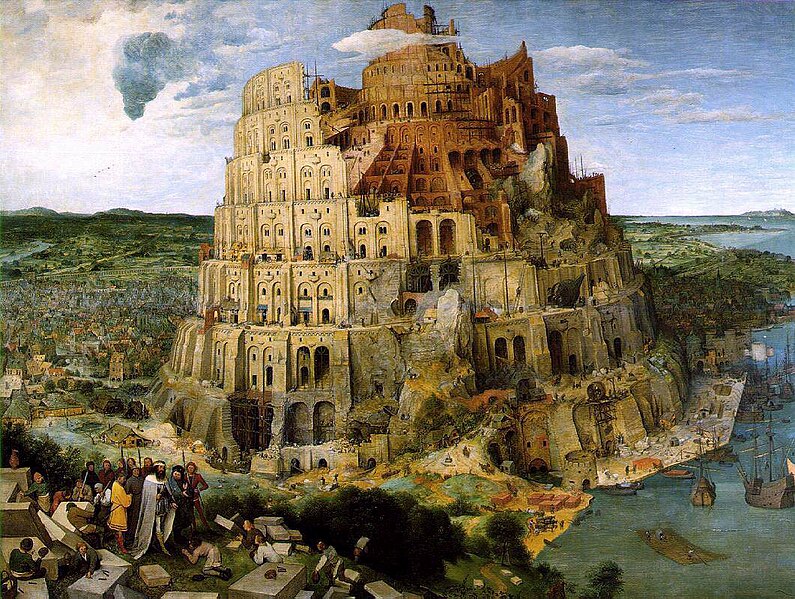
3) But the city is in many ways antithetical to the divine ordering of creation. (This largely from a superficial reading of Jacques Ellul’s The Meaning of the City). Cities order themselves by their own logic: once for warfare and now for commerce. Most profoundly they set themselves against God by their hubris: they are engines of human self-sufficiency and self-legitimation and, like Babel, they aspire to touch heaven by their own efforts (taking heaven here as a secular metaphor).


Pieter Bruegel the Elder, The Tower of Babel
4) To see churches as empty spaces in the city need not mean the acceptance of defeat or an invitation to despair. If the city is antithetical to the will of God then such empty spaces may have an equally profound role as mirror images to the hubris of the city.

Churches are not, of course, entirely empty (leaving the redundant aside, by definition). They are in fact alternative places: where death is not shunned but articulated, where an alternative to urban self-sufficiency is articulated, where people may receive help because they are in need, where there is quiet and healing and people are valued merely because they are children of God. They are places of prayer and worship through which we continuously re-orientate our relationship towards God.

The deliberate differentness of a church is inherently counter-cultural: the in-group language and concepts, the endorsement of dissentient values, strange ritual behaviour, clerical clothes and odd patterns of singing. It delights and puzzles me that (some) Christians who read newspapers that are deeply, even viciously, antagonistic to immigrants will still give money, food and time to support asylum seekers. The spiritual narrative of Christian faith, of self-giving, of death and the hope of resurrection, is deeply opposed to the narratives of success and value dominant in the city.

Church buildings may also be reversing mirrors of certain specific places in the city. The opposite of a prison or court cell – insofar as Christian practice is the opposite of policing and judgement. The opposite of databanks and the secure vaults of traditional banks – Christian knowing is indestructible (though not immutable), Christian treasures are not of this world and Church doors are (nominally) open to all. Churches are the opposite of secret places in people’s homes where trafficked women are kept enslaved. Churches are places of non-violence.

Christians and church structures are deeply conformist and have a strong tendency towards conservative social and political views and values. Yet the place that they value, because it is a place for prayer, is inherently a subversive space.

31/01/2011

A different Church

What kind of church?
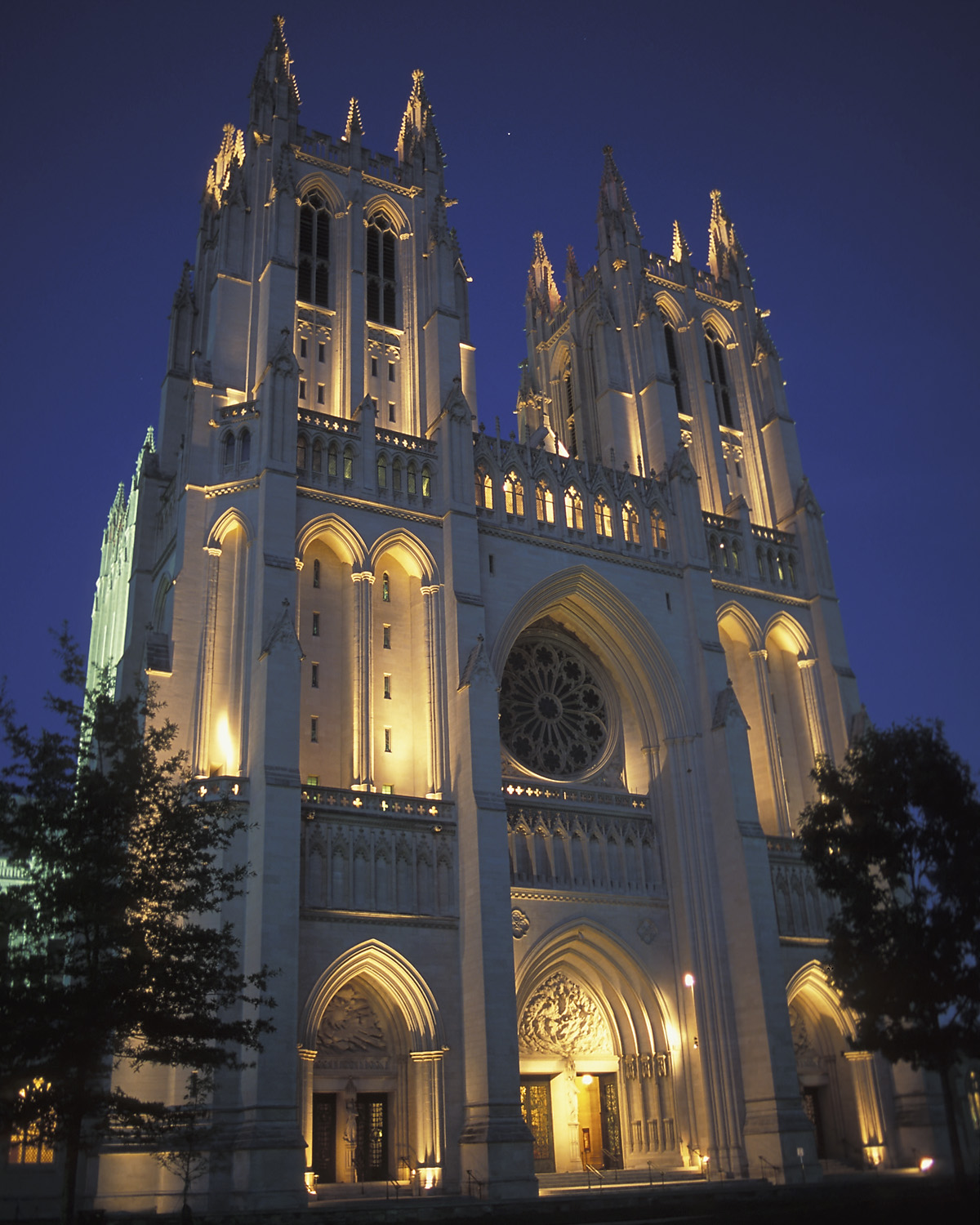
Washington National Cathedral


The question of whether homosexuals should be full members of the church has been the occasion of conflict or, more exactly, it became the focal point of a much deeper and pre-existing conflict.

The underlying compliant has always been that the western church, of which TEC is seen as the forerunner and epitome, has subordinated itself to secular mores, values and agenda.

Instead, say the conservatives, a church should ground itself wholly in scripture and thence oppose the secular world and its values.

In-and-against
I think this is a false dichotomy.

I would assert that every church is inevitably and inescapably in-and-against the state (both secular society and government). The walls of a church are porous, they allow in secular ways of thinking whether those taught in universities at one end of the spectrum or those held privately beneath the public radar at the other end. Their walls also hold their distinctiveness: the Christian faith (as inherited and as lived), special buildings, clear leadership and most important, communal worship.


Ecclesiology 
I suggest that more fundamental questions are: in the context of in-and-against the state, what is the church itself? What could it be?

The critique from conservatives is that the church should be against the state (both secular society and where they fall short of Christian values, secular governments too). A church should proclaim a redemptive critique of the society in which it is set. I note, for example, the statements of the Church in Nigeria criticising corruption and other aspects of the Nigerian State as well as Western morals.


For these conservatives, the authority, content and imperative with which to make such a critique lies wholly in Scripture.

Liberals are not merely perceived to have failed in this redemptive proclamation but to have taken a spiritually fatal step further. They have embedded secular values and structures in the church itself, displacing scriptural values. Thus liberal democratic notions have been allowed to reshape (some of) Anglicanism along secular lines which are antithetic to the things of God. Conservatives regard this as an ecclesiological impossibility, hence the rhetoric of a ‘new’ faith or religion.

Their alternative is an ecclesial monarchy: as God is Lord of the Church so too archbishops and bishops should be lords within an episcopal church.

Ironically this is particularly important for those who put so much weight on the authority of scripture. The authority of scripture is essentially anarchic: everyone who can read the Bible is their own interpreter and, in citing scripture, everyone has the authority of God.

Therefore those who believe that Christians should come together in ordered communities of any sort and who believe that scripture is the sole and sufficient source of authority for that community have a problem. The problem is solved by making church leaders authoritative and authoritarian.


Thus the Word of God was liberated from the control of the Catholic Church and Protestants then imprisoned the reader.

Mouneer Anis
I believe Bishop Mouneer Anis to be a devout and honest conservative and a good spokesman for that strand of Anglicanism. He is utterly convinced of the exclusive authority of scripture and yet still wants to hang onto the importance of Anglican tradition as far as, and so long as, it accords with his valuation of scripture.

He gives examples of the Church of England, and the Anglican Communion, repeatedly reasserting the centrality and authority of scripture. Be because these statements are not binding they are insufficient. As a result the Church has fallen away from the rectitude it once held into its present morass.

He forgets the deeply Erastian nature of the Church of England from the honestly named 1533 Submission of the Clergy Act onwards. He forgets the legacy of conformity to state and society which the CofE bequeathed to much of the Communion – the CofE rejoiced in being the ‘national’ church in as many meanings as it could sustain. He uses statements from the past, like proof-texts, selectively and in a wholly ahistorical manner.

Anis’ remedy is a conciliar-command structure for the church. Difficult or contested questions should be debated by those with the authority to do so (primarily bishops and primates). Once a decision is reached it would then be binding on all believers. Again, he omits to mention that such powers currently reside in a province (depending on its own constitution) and that to grant these powers to the Communion would be a significant innovation.

He also, incidentally, wishes to ‘start Biblical literacy programs’ - to encourage people to read the Bible and, no doubt, to ensure they do so correctly.

A different church
Mouneer Anis is talking about a different church from the one he has inherited.

Conservatives want a command structure where there never was one. They want a church which is wholly and exclusively scripture-based, though Anglicanism never was. They long for a church whose function is to oppose the standards and values of the society in which it is set, forgetting that the Church of England has always been willingly subordinate to the state.


And this is why schism is inevitable.

Undoubtedly some kind of modus vivendi over homosexuality could have been worked out, given time, not least because the vast majority of people are bored with the fight and want to get on with life. We could all learn to agree to disagree over degrees of in-or-against the state practised in the different national settings of the church. The re-assignment of power in the Communion as a result of the conflict is being worked out through the Covenant at the moment.

But conservatives want much more. They want a new church, one never before seen in Anglicanism. Their ecclesiology will not fit into the same shoe as the majority ecclesiology of Anglicanism. Therefore there must be division. Working things out is not an option.

Only this won’t be another Great Ejection, more like a dribbling apart.

03/12/2010

Not a real Church?

Perhaps I was wrong in my belief (yesterday) that the mystical hierarchy model of the church is practically defunct.

Lesley Fellows at Lesley's Blog (and referring back to the Church Mouse) highlights the contrast between the silence around the offer of Methodists to join the CofE and the brouhaha surrounding the Ordinariate created to enable Anglicans to join the Roman Catholics.

Perhaps, she speculates, the Catholic model of the Church is still so strong that the Methodists don't really count: they are not a real Church.

Perhaps, though she doesn't mention this, it is simply a matter of Anglican arrogance, even snobbery.

It is interesting to watch a vicar enter a meeting room.  You can often spot them a mile off: collar to the fore, they emanate an air of confidence, the presupposition of a right to be present and the expectation of being taken seriously, whatever the context.  (Not every one of them, of course, and a good number of those that do would be horrified to have it pointed out to them. I guess I did much the same in my vicaring days and I'm not convinced I've entirely lost it.)

I suspect the presupposition of a representative of the Established Church, a certain standing in society, an organization which builds vicars up and congregational deference which means that many never get the corners knocked off, all contribute to this arrogance.  A high view of priesthood would certainly contribute to this attitude but it seems to apply to vicars wherever they are on the candle.

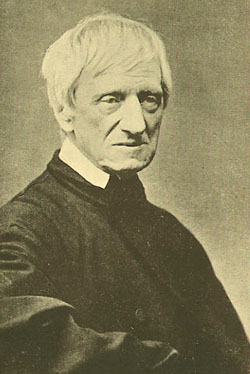
John Henry Newman
As John Henry Newman said in Tract 1 (1833):
... on what will you rest the claim of respect and attention which you make upon your flocks? Hitherto you have been upheld by your birth, your education, your wealth, your connexions; should these secular advantages cease, on what must CHRIST’S Ministers depend? Is not this a serious practical question? 
And maybe some residue of his next comment remains:
We know how miserable is the state of religious bodies not supported by the State. Look at the Dissenters on all sides of you, and you will see at once that their Ministers, depending simply upon the people, become the creatures of the people. Are you content that this should be your case? Alas! can a greater evil befall Christians, than for their teachers to be guided by them, instead of guiding?
His solution was,
There are some who rest their divine mission on their own unsupported assertion; others, who rest it upon their popularity; others, on their success; and others, who rest it upon their temporal distinctions. This last case has, perhaps, been too much our own; I fear we have neglected the real ground on which our authority is built,—OUR APOSTOLICAL DESCENT.
(from Project Canterbury)

While I would heartily reject Newman's answer it is interesting that the question remains cast in much the same terms: how do the clergy know who they are, individually and as a class, except by placing themselves over against the laity?

02/12/2010

Formation

I signed off yesterday's post and then thought: 'formation', as you do.

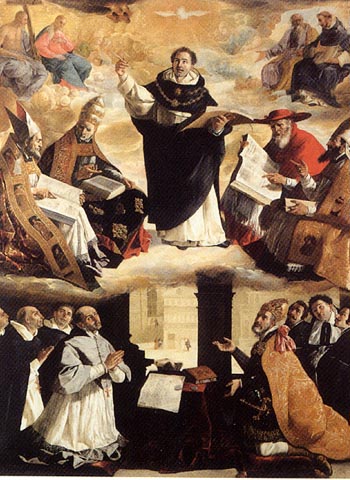
"St Thomas, Count of Aquino, Dominican Friar and
the Angelic Doctor of the Catholic Church
understood hierarchy and taught popes
and bishops, emperors and kings,
 how to exercise it." 
For the most part the idea of formation has traditionally been focused on priestly formation in the more Catholic tradition: the shaping of a malleable man into a priest; and thence the shaping of a priestly elite more educated, more deeply spiritual, more endowed with the qualities of leadership and pastoral wisdom than the laity.  An elite defined by being separated out from ordinary people.

Add in a belief that, in the divine hierarchy, to be a priest is to be nearer God than the laity and yet to be a priest is to be but the shadow of a bishop's closeness to God, and you have a powerful, driving ideology which once achieved great things in the Church.

Yet it is an ideology which is now almost (not quite) intellectually and practically defunct.

The concept of formation remains significant, however, and deserves to be revisited.  Just how do we form, shape, create disciples - lay, clerical and episcopal disciples - adequate to the tasks of mission, service, holiness in today's world? How do we form the whole church, not merely a top slice of it?

This is the perennial task of the church: to make real and consequential what it is to be a Christian today. To reverse this sentence: the way Christians act and speak (as Christians rather than as, say, engineers) is what it  means to be Christian.  Christians form the Church which formed them.

This is based on an epistemology profoundly antagonistic to the epistemology which saw the universe as fixed in a great pyramid stretching up towards God in which the most Godly humans stood just a feathers' breath below the angels.

To the contrary, it is based on the understanding of a world continually coming into being, in which every moment closes down some possibilities and opens up new ones, in which beauty and passion are as important as facts and analysis, in which ideology (theology, world-view, common opinion) is an essential building block in the creation of organizations, and organizations are essential to the development of knowledge and understanding.

That is: the Church is as the Church does.  As the Church does, so its members corporately make real the idea of the Church that they embody and enact.  Each action closes down some possibilities and opens others.

Clearly some decisions and actions have much more extensive and longer-lasting consequences.  Some (do I need to mention the Covenant?) appear to be much more likely to close down options than to create new opportunities.  The rhetoric of order and discipline is intended to signal that the desirable path of formation is to curtail and prevent innovation and new expressions of faith.

Fun in St Neots Church
But instead of putting 'discipline' and 'order' first, foremost and final as the concepts which should guide the formation of the future Church, I suggest we should look for other ideas.  Perhaps holiness and compassion, devotion, sacrifice and, who knows, even fun can be guiding concepts.

Though I would add quickly that I am not opposed to either discipline or order per se. I think both are necessary elements of any structure.  I recognise the reality of sin in any church or group.  I think, however, that when discipline is needed it will be because of some failure of the Church. The actions of discipline and the re-imposition of order should be seen as causes of shame and sorrow, occasions for repentance, not celebrated as guiding principles of the Communion.

I also suggest that the ontological hierarchy which so elevated bishops remains with us in a changed, and cheaper, version.

The Catholic tradition placed hierarchy on the foundation of divine law made visible in natural law.  In the Anglican Church that foundation is (a somewhat dated) organizational thesis.  The centralization of the Church, the elevation of the primates, the focusing of power in the General Secretary and the Archbishop of Canterbury, is being pursued for organizational efficacy: to better enable the control of member churches.

Surely we can do better than this.

13/11/2010

What is the Covenant supposed to solve?

It will hardly come as a surprise to anyone reading this that I really don't like the Covenant.  More than that, I think it is profoundly misguided, a denial of so much that is precious in the Anglican tradition that we have inherited, and a pitiful response to the deep divisions of the Church.

There are always alternatives.
The most prominent alternative, the Jerusalem Declaration, will serve to bind together most conservative Evangelicals - at least while the enemy that threatens them (the values they see corrupting the western church and leading it out of the fold of Christians) is bigger than they are.

The great weakness of any confessional statement is that it must be either vague, so that large numbers can endorse it, or so exact that it convey the views of its authors' precisely, thus guaranteeing that relatively few people will sign up.  Hence the critique by Bishop John Rodgers in SPREAD that the Covenant is 'too weak for the orthodox and too strong for the revisionists'.

The normal way - these days, anyway, following western states' use of government by fear - is to sound the alarm.  The enemy is massing at the gates - defend the citadel!  Of course the enemy within is more dangerous than the enemy without so any confessional statement is simultaneously intended to unite and divide - a shibboleth by which to discriminate between people who would otherwise look just the same. (See: the fourth point of how to mount a coup).  Such statements last only as long as the threat is real.  Afterwards the statement is consigned to history and people get on as though it wasn't there apart, perhaps, from an occasional, formal, acknowledgement.  Or the statement is taken seriously, in which case people fight over the exact interpretation and take sides within its framework.  (The historical option - get sufficient agreement and use force to impose it on everyone else - is not really available to the Communion.)

Rodgers' choice of the Primates' Meeting, rather than the Standing Committee, as the implementing body has already been defeated.  And it now looks so divided as to be unable to take on this role if the task were thrust upon it.

But what problems is the Covenant supposed to solve (now, as opposed to when it was first conceived)?

First, the unity of the Communion.  Sadly, I think it's too late - and perhaps was always too late.  In fact it increasingly seems that pushing people to sign will be the last step in the de facto schism.  By going for a Covenant that was acceptable to a sufficient majority of the players in Global Anglicanism the Covenant Design Group has failed to bring enough of the Communion on board.

This is described as a civil war cannon and
 a toy that really works and is safe.
 The perfect illustration
Second, to provide the framework for future disputes.  Sadly the Covenant procedures will almost certainly only work for little disputes or issues exclusively between two parties. And they could probably be resolved in any framework.

Or they will work to exclude TEC and Canada - and then everyone will take fright because they could be next. They will move quickly to dismantle the Covenant - it will prove to have been a disastrous one-shell cannon.

The Covenant framework will not be adequate to any significant dispute.  It's back-to-front: what happens is that administrative structures & agreements work because people agree to make them work.  In normal times conflicts flow through, and are contained by, the channels of the pre-existing system: people and systems are in continual dialogue.  In abnormal (though not uncommon) times disputes overflow the system and leave it in pieces.  Then people coming together, pick up the pieces and rebuild. The cycle starts over again: systems cannot be imposed without assent.

Third: as one more step in a long-term programme to reform the Communion by centralising and reducing the differences between provinces.  This goal might well be met, in part at least, by the process to arrive at a Covenant as much as by the document itself.  In the course of debate, it seems to me, the previously normative idea that the Communion was a federal structure with central consultative bodies seems to have been replaced by the normative idea that the Communion is a single entity whose centre needs to be strengthened because its component parts are too fissiparous.

Some possible alternatives
First, the diverging Communion.  Reality-defying projects have their place and can create wonderful things.  But often they just crash.  I would now go for recognising the reality of division and seek to keep as many people as linked together as possible by multiple informal networks - of liturgists, historians, mothers' union, mission societies, even train-spotters - to keep communication channels open despite formal division.  I would try to keep as many parish-parish, diocese-diocese, mission society links as strong as possible for as long as possible. I would offer small no-strings grants to foster them.  I would encourage them to publicise their work.  But I would not try to control them. When the dust settles we will need those continuing friendships and conversations to build the new Anglicanism.

Second: conflict resolution.  Perhaps the task is to rebuild the communion from the base up - and on the presuppositions that it is a voluntary association, that all are faithful followers of Christ, that each member will offer hospitality to any other - no matter how alien the expression of faith may seem.

I would also offer skilled, experienced people who can lead non-binding arbitration to help resolve small disputes and those between two-parties.  In other words, to encourage Christians not to go to court, but to come to a resolution between themselves: a resolution they are responsible for (i.e. not determined by some other body).  Non-binding arbitration gives people choices without sanctions.

Third: I would strengthen the links between provinces and the central bodies of the Communion and also the direct links between provinces (the formal expression of the informal networks in my first point).  I would stress that the role of the central bodies is to facilitate and broker relationships, to provide financial, technical and educative aid.  There is no lack of energy and initiative in the provinces, dioceses and parishes: let the centre support the exchange of information and wisdom such that the whole Communion benefits.

Location-specific networks?
But, to be fair, this is a western, IT-informed vision.  I'm not sure that it'll sell in Nigeria or Burma or Japan.  I'm not sure it will work well in areas of Africa with minimal and expensive internet access.

I can see too that it rests on a presumption of people's inherent goodness.  It will certainly have to be tough enough to cope with human evil but the primary safeguard is that networks and arbitration are voluntary: anyone can walk away without ceasing to be part of the wider church.

If it is to work it will have to be fundamentally people-focused. Technology should be secondary and appropriate to the people involved: mobile phones in central Africa, super-fast broadband in New York and Tokyo and old-fashioned pen and paper anywhere.

To be people-focused is also to take into account the disparity of wealth and poverty. Networks should be fostered in ways that will enable people to live out their faith in shared ways, not burden them with costs and duties that distract from the primary tasks of discipleship.

I dare say my vision will be nonsense to many but, on the other hand, I can see how very, very few are enthused by the Covenant.

23/10/2010

And always keep a-hold of Nurse ...

 I wrote this for another context but it seemed worth repeating here, with a few corrections and some footnotes.


--------------------------------.

Church and State: the Church of England's capacity to determine its own worship and doctrine.

Until 1965 the CofE had no legal power to alter its own worship [Note 1].  There was a revised Prayer Book in 1928/29. Parliament refused to authorise it and after a major row Church-and-State row the bishops issued a statement that they would never sanction prosecution of clergy who conducted worship within the parameters of the revised book and no-one tested it legally [Note 2].  A revised book (again, technically illegal) was published in 1945 on the personal authority of Archbishop Fisher.

In 1961 the New English Bible was published and enthusiastically welcomed by clergy. However, legally, they could not use it in the Eucharist as the reading were printed in the BCP which could not be changed. A Measure (Church law authorised by Parliament) was prepared to allow the New English Bible to be used as an alternative to that printed in the BCP. [Note 3]

However, while this was in preparation, negotiation between the Church and the government of the day suggested that the Government would allow 'delegated legislation' i.e. Parliament delegated to the Church the power to determine its own worship - but only for a limited, experimental period of 2 to 7 years - in the Prayer Book (Alternative and Other Services) Measure.


That experimental period (taking 14 years) produced Series 1, 2, 3 styles of worship.  In 1974 the Doctrine and Worship Measure gave the Church further powers which led to the Alternative Service Book 1980 (to give it its full title - the date showed it was meant to be temporary).  This was valid for a decade and then a second decade's life was added.  The original intention had been to produce a single New Book of Common Prayer which Parliament would have been asked to authorise and which would have been set in legal stone.

But the Church had pulled off a coup: the temporary delegation of powers was finessed into a permanent delegation. The Church acquired - for the first time in its history - the power to determine its own worship.

The Doctrine and Worship Measure also gave the CofE power over its own doctrine. Thus was tested in law in 1994 and again in 1996 [Note 4] over the question of the ordination of women.  The court determined that, so long as the Church followed its own rules in making doctrinal decisions (explicitly or implicitly), there was no legal power to interfere in the substance of those decisions.

This autonomy was gained, critically, without the Church ceasing to be the Established Church. It was an invisibly amazing achievement: the goal had first been articulated in 1840 or 50 and it had been pursued for 120+ years.

And the relevance of this to a Covenant is:
(a) because the CofE is a State Church it has no ecclesiology - it has had no capacity to think for itself what kind of church it is and should and could be, 
(b) the CofE has had centuries of training in the arts of being subordinate and acting as though it was autonomous - it exists through a sophisticated systemic exercise of willful blindness and realpolitik.
(c) The point at which it acquired the power to determine its own doctrine was too late for it to exercise such power.  From the mid-1980s ecumenical agreements and the changing shape of the Anglican Communion meant that in practice it could only make definitive doctrinal statements in concert (if not uniformly) with other churches and the rest of the Communion - see, for example, the statement on Baptism, Eucharist and Ministry.

So to adopt the Covenant for the CofE would simply be to accept a new overlordship while continuing to pretend it is superior to it. It will make sure its officers are embedded in the operation of the Covenant so that nothing potentially embarrassing comes to the light of public debate. And thus it will ensure it still doesn't have to think about its ecclesiology - what principles - actually and ideally - underlie, predispose and can be used to judge the words, structures and action of the Church of England?

========================
Notes:
1. ‘... a clerk has no right in performing divine service to alter, omit, or add anything to the prescribed form, including the lessons to be read.’ Ecclesiastical Law, reprinted from Halsbury’s Laws of England, Third Edition, (London, Butterworth & Co., 1957)

2. "... the Upper House of the two Convocations, with the acquiescent cognisance of the Lower Houses, recommended, with only four dissentients, that the bishops should not, in their administration, feel bound to interfere with clergy whose deviations from the Book of Common Prayer were within the limits of the deviations which the Prayer Book Measure of 1928 would have sanctioned."  Church & State: Report of the Archbishops’ Commission on Relations between Church and State, 1935 (London, The Press and Publications Board of the Church Assembly, 1935) [The Cecil Report], p. 39.

3. In the first version of the Prayer Book (Versions of the Bible) Measure no other version of Scripture was to have been permitted.  But, on a steer from the Government, the Measure was redafted to permit any versions which Church Assembly (General Synod's precursor) might approve.  It became law in 1965.

4. The case (in fact a series of cases) was brought by a Rev. Williamson whose persistence led to him being formally barred from further action as a 'vexatious litigant' in 1997.  The nineteenth century had several examples of the same process: convinced litigants brought cases which only strengthened the causes they were arguing against.

See also: http://en.wikipedia.org/wiki/Alternative_Service_Book

01/05/2010

Fragments and secrecy

The ACC's new constitution has been voted for by at least two-thirds of the members of the ACC between their meetings in Nottingham, UK in 2005 and Kingston, Jamaica, 2009.

And (all credit to the managers in one sense) the constitution - and the Memorandum and Articles of the new charitable company - don't appear to have been leaked into the public domain.

So I asked around and the only reference my correspondent on General Synod could find to these changes was:

From the House of Bishops meeting January 2007


1. Deemed Procedure

The following Reports and papers were either agreed or noted under the House’s deemed procedure:
(iv) Anglican Consultative Council: Proposals for Constitutional and Procedural Reform
It scarcely makes the heart race. I could find no reference to it on the General Synod website.

The inference must be that the Church of England voted in favour of the changes and the bishops were informed. (I'm guessing that 'deemed procedure' means there was no debate in the House of Bishops.)

Who the 'Church of England' was that voted, I don't know - presumably the representatives on ACC. If so, they took a considerable amount on their own backs without public discussion - Synod is, after all, the Church of England by representation.


But I want to make a wider point: much too much has been done behind closed doors. If power can be accrued by discussion and deals in secret there is every reason to believe that this way of working will be embedded in the new structures of the Communion.

Those 'in the know' will have no incentive to share. Those who would like to be 'in the know' will have every incentive to learn the ways of discretion and secrecy.

This may make life easier in the short-term for power-brokers and bureaucrats but in the longer term it will sap the commitment and energy of the church, it will lessen the willingness to participate and engage with bigger questions, it will limit the quality of decision making, and it will engender increasing resentment amongst those who have no voice.

Furthermore such secrecy is a direct denial of the voluntary nature of Church membership. It is a denial of the episcopal nature of the Church in the sense that decisions won't be taken by bishops whether alone or in synod. Decisions will be taken by a few - some of whom may chance to be bishops - but most bishops will simply be told what has been decided. And some of the few will be lay people or ordinary clergy. But they will be few.

And for decisions read 'authority'. Authority in the church is leaching from bishop-in-synod to small groups of people in the loop.

To keep information amongst a small group is a rational and understandable response to the communications capacity of the internet. Most internet chatter (including this) is ill-informed, speculative, partisan, sometimes malicious and always a nuisance to those who are trying their best to undertake the serious task of church leadership.

But an equally rational response is to engage in a careful, planned, positive and informative manner, putting as much as possible into the public domain as soon as possible.

Of course every organization rightly and properly has to consider the public statements it makes and some things should not be posted for the world and her uncle to see. But let the presumption be in favour of openness and disclosure (including the rules as to what should not be disclosed and the timetables for making matters public). Some poeple will always fret and want more, but we will know where we stand.

We currently have the farce of a consultative body (the ACC) keeping their consultations secret. We have the offence of a governing body (the SCAC) being set up without any formal notification that it was being done - let alone the rules by which governance will be exercised.

We will end with the tragedy of a Church led by small groups in close touch with one another and increasingly distant from every other member. The attempt to concentrate authority and to make it forceful and effective (to cite the Windsor Report) will in the predictable result in a loss of credibility and deep unhappiness across the body of Christ.

07/02/2010

The coup has already occurred


One of the key objections to the Covenant was that it would lead to a concentration of power within the Communion and a centralising of decision making.

That doesn’t matter now. Concentration and centralisation have already happened: the coup has occurred and very people seem to have noticed.

(Some have, of course. See, from a couple of points on the spectrum, Mark Harris, Bishop Mouneer Anis, and the Anglican Communion Institute.)

The Standing Committee of the Anglican Communion has become the executive body for the Communion and is in the process of arrogating more powers to itself. If the Covenant is passed it will become the governing body of the Anglican Communion.

How we got here.
1) Joint standing committees
From its beginning the Anglican Consultative Council has had a standing committee in order to conduct its business between meetings. This is a sensible and unexceptional arrangement for many organizations, not least an elected body that meets every 3 years.

In ACC-10 (Panama, 1996) joint meetings of the standing committees of the ACC and the Primates’ Meeting were noted as a ‘recent practice’. The hope, following a suggestion in the Virginia Report, was that the then Standing Committee of the ACC could be expanded ‘to allow an appropriate balance of bishops, clergy and laity, with consideration to age and gender’ [Resolution 6].

At ACC-11 (Dundee, 1999) and 12 (Hong Kong, 2002) the ACC had its standing committee, the Primates’ Meeting had theirs, and there were also joint meetings. Matters were referred either to the ACC standing committee or to the joint standing committee depending on the nature of the business.

In 2002 further constitutional revision was requested which was agreed at ACC-13 (Nottingham, 2005) [Resolution 4]. Five Primates were added ex officio to the membership of the ACC in a little class of their own and were appointed to the standing committee.

In constitutional terms this is quite misshapen. The joint standing committee is thus only partly accountable to each of its different parents and its members are elected by different mechanisms and for different terms (I’m guessing, since the Primates’ mechanisms are entirely opaque). Politically, however, it makes perfect sense to bring the key people of the three most active Instruments of Unity together formally.

Resolution 6 is indicative of the concern that members of the ACC must have had about their creation. They asked that the standing committee

circulate the agendas of Standing Committee meetings to all members of the
Council prior to meetings, and the minutes of the Standing Committee meetings to
all members of the Council as soon as possible following the meetings.
Only in this way could they possibly hope to keep any sort of watch on the activities of their runaway child.

Most recently, at ACC-14 (Kingston, 2009) the ACC asked for a quid pro quo for their largess in allowing Primates privileged access to their Council. They requested that ‘an equal number of non-Primatial members of the Standing Committee [should attend] as non voting participants in the Primates' Meeting.’ Thus the boundaries blur still further. [Resolution 38]

Furthermore, it would seem (resolution 39) that the ACC now has a new constitution which is operative, has had the assent of two-thirds of its members and yet has not been made public. If this is a straw in the wind it is a worrying indicator of the way the new communion will work.

This is why the title ‘Standing Committee of the Anglican Communion’ does not appear in the resolutions of the ACC. But it was referred to by Bishop John Patterson in his concluding sermon:
Anglican polity has always held that it is bishops in synod, or bishops in council, that are able to make decisions that guide the life of the church locally. For the Communion, the Primates’ Meetings cannot do that, although we should be able to look to our Primates for wise guidance and theological insights, but in my view that is quite different from making binding decisions
from which the rest of the Church is excluded.
We have now moved to seeing what we have known as the Joint Standing Committee of the primates and the ACC become more simply the Standing Committee of the Anglican communion, possibly meeting more than once a year, with the right balance of Primates, clergy and laity represented. That is a significant advance in the tightening of our structures, a significant advance in helping the four ‘Instruments of Communion’ work more cohesively together, without taking anything away from any of those Instruments.
2) A charitable company
In 1978 the ACC was registered as a charitable trust in England (no. 276591). Between 1999 and 2009 discussions led to agreement that the ACC should also be a charitable company. At ACC-13 Memorandum and Articles for this new company were endorsed though not made public – then or now. [Resolution 3] The finances of the ACC have been transferred to this new company.

The detail of the rules is important (there has been dark discussion of a ‘secret’ constitution on some conservative sites). But there is a much more immediate and significant point. Trustees cannot be mandated by another body but must exercise their own discretion. Directors are legally responsible for the financial and other aspects of their company. They are autonomous.


and the point of this is ...
Thus is created the fifth instrument of unity of the Anglican Communion (if we forget, as everyone else apparently forgets, that this accolade was once formally given to Canon Law).

The Standing Committee of the Anglican Communion is legally constituted, controls the finances of the Communion (except, on this latter occasion, the costs of the Lambeth Conference), and is embedded in the Primates’ meeting and the ACC. It is governed by the law of England and Wales. It gives an account to Companies House and the Charity Commission.

No doubt it will also report to the Primates’ Meeting and the ACC. But, formally, this is now a courtesy. Neither of these bodies can instruct the SCAC and, if its members accepted such instruction, they would be at risk of breaching their duties as trustees and directors.


The effect of the Covenant
In this setting the Covenant takes on a new significance. The ACC has given all its powers (except those specifically reserved to the Council) to its standing committee (previous Constitution, Article 8). Presumably, though its procedural rules are not online, the same applies to the Primates’ Meeting.

The point and effect of the Covenant is now this: to turn the Standing Committee of the Anglican Communion into a body which, whatever its origins, will have significant powers of governance in its own right – in fact, a whole new tranche of powers which do not currently exist.

The Standing Committee of the Anglican Communion will thus become the regulator of relationships between Provinces. It will have the capacity to limit the degree of participation Provinces may have in the communion’s Instruments of Unity – and potentially also its commissions, working groups and other international bodies. All, that is, except one: invitations to the Lambeth Conference will remain in the personal gift of the Archbishop of Canterbury.
.

04/10/2009

ACNA - a way forwards for liberal Anglicans?


'Archbishop' Bob Duncan


I have not been keeping up with comment on Anglican affairs recently.  Therefore if this is old hat then I apologise. However I thought it worth posting.

It is the length it is because I have sent it to MCU's Signs of the TimesHowever I may well work on a longer version because I think the subject deserves it.


The Anglican Church In North America


The Anglican Church In North America (ACNA) is the major schismatic grouping in North American Episcopalianism. It was created on 22 June 2009 and has received a welcome amounting to formal recognition from some Primates and leaders in other parts of the Anglican Communion. It purports to be a ‘Province-in-formation in the global Anglican Communion’ and claims a membership of 100,000 with 800 clergy.


ACNA has published its Constitution and Canons (www.acnaassembly.org). These documents encapsulate the leaders’ aspirations and commitment and simultaneously betray their weakness. They assert ACNA’s continued part in Anglicanism and create a radical new polity.


ACNA’s Constitution and Canons assert a juridical existence on a par with the 38 autonomous (their choice of adjective) Provinces of the Anglican Communion. Together they establish the structure of governance of the new entity with a presiding Archbishop, College of Bishops, a governing Provincial Council and an advisory Provincial Assembly. However the constitution inverts the monarchical ecclesiology espoused and exported by the Church of England and makes the whole structure accountable to the congregation.


The background to this development includes the fact that the polity of the Episcopal Church in the US has always been more egalitarian and inclusive of its laity than the majority of the Anglican Communion. Second, there is a strong conservative predilection for free market economics and resistance to the centralised state which is as strong in America’s religion as in other aspects of society.


More specifically ACNA’s origin is as a protest movement with many mothers. The Constitution lists eleven groups as founder members several of which owe allegiance to other parts of the Anglican Communion (including Rwanda, Kenya, Uganda and the Southern Cone). Article VIII specifies that each member is a jurisdiction in its own right and retains all authority except that which it willingly grants to the umbrella body: no-one is giving up their separate identity.


One key element in the conservative protest against TEC centred on money. As they left many congregations went to court to retain ownership of church property and other assets. Most lost. Article XII of the ACNA constitution and Canon 6.6 recognise that parishes own their real and personal property and exclude the Province from any current or future claim over it. Furthermore congregations are given the right to change allegiance within ACNA or to secede from it altogether. Exhortations to tithe and to support the Provincial structures reveal the fundamental weakness of the federation. In churches, as in other walks of life, to know where power lies follow the money.


The congregation is not merely the owner of property. It is ‘The fundamental agency of mission in the Province’ (Article IV.1). Wider groupings depend on the congregation for their legitimacy and finance. The Canons come with an application form for any other ‘diocese, cluster or network (whether regional or affinity-based)’ or any such group ‘in formation’ which might wish to become a member. Thus wider groupings of congregations may be geographic or affinity based and congregations from several different members of the Province may co-exist in the same place. It is post-modern Anglicanism.


At the other end of this new polity the Archbishop, currently Bishop Robert Duncan, is elected for 5 years. He is thus made and kept accountable to his electorate (the College of Bishops) who are accountable to the congregations.


Perhaps ACNA offers the way forward for Anglicans. With a different preamble and affirmation of faith any group, or group of groups, could come together on something like this constitution. In this new Anglicanism power flows from the pocket and the hierarchy must give an account of their actions acceptable to those who chose them. It is worth further investigation.


Or, perhaps, another rule of organizations will come into play: over time power and wealth flows to the centre.


Paul Bagshaw


05/08/2009

Election hype already

Ruth Gledhill

In a typical piece of over-writing Ruth Gledhill declares that liberals have "declared war" of conservatives in the C of E.

Rubbish.

She's reporting pre-planning for the synodical elections. To the best of my knowledge this has happened at every synodical election amongst every group which wants to be effectively represented on Synod.

Of course it's a struggle, engaged in by every side, to get a majority on Synod. Not because Synod holds power (though it still has significant powers) but because it is the route to the Archbishops' Council and other bodies which do have power. Though the battle for 'the soul of the established church' will be won in the House of Bishops, not Synod - which is why getting the right (or liberal) bishops is far more important that electing a liberal Synod.

But, if these subversive liberals get in, then in the Gospel according to Ruth dire consequences will follow:

If they take enough of the 400-plus seats in the houses of clergy and laity, the liberals will attempt to bring in total acceptance of homosexuals, overturning all restrictions on their ministry and approving same-sex blessings for civil partnerships and gay ordinations and consecrations.

Which I'm sure is intended to rally the conservatives. Though it also betrays a high degree of insecurity or fear at the damage liberals could do simply by recognising gay people as full members of the church.

If a majority of the Synod were liberal (and for any constitutional change it would have to be a majority of two-thirds plus 1 in both elected houses) then they would still have to contend with the House of Bishops who are notoriously reluctant to rock any boat.

So support the liberal cause by all means. Maybe one day it will be victorious. But that will merely set the stage for the next battles to come. The Church, I contend, is shaped in its battles, made real in its conflicts and energised by the desire to assert one manner of believing (with its social consequences) over the alternatives.

But the cause of change in the Church (in a strong sense of causation) is social and political change in the culture and community in which the Church is set. In England civil weddings are officially recognised, the civil rights of people irrespective of sexual orientation are both recognised and upheld as desireable social values, and the Church will inevitably follow. The Church consistently follows social change while giving a platform to those who fear and oppose it - in divorce, for example.

It won't be the liberals wot won it, but the liberal cause will win - unless, of course, society and political leadership become more reactionary again.