| From the Harare Standard Gandiya faction constructs own Anglican churches JENNIFER DUBE, Saturday, 12 May 2012 18:01
THE Anglican Church of the Province of Central Africa (CPCA) has started buying land to build new churches as the property wrangle with ex-communicated Bishop Nolbert Kunonga continues. ....Land has been acquired in Ruwa where the Mothers’ Union intended to build a training centre and a conference centre. Glenview parish has bought land while Warren Park parish is fundraising. Norton and other parishes have also secured land. Kunonga told the journalist, “Assist them by telling them that they should not build in the name of the Harare diocese and Anglican because they would have built for me as the law gave me custody of the church and all its properties,” he said.All here |
13/05/2012
The Anglican Church in Zimbabwe sets out on a new course


04/05/2012
No Anglican Covenant - next steps
Until now the No Anglican Covenant Campaign has, for obvious reasons, focused strongly on England and the vote in English dioceses.
A number of changes have followed the defeat of the Covenant in England.
Lesley Fellows has stood down as International Moderator and she deserves great praise and gratitude for the manner in which she performed this role.
Malcolm French has taken on the tasks of International Moderator.
Jean Mayland, a lifelong campaigner for change in the Church of England, is now the English Convener for the group.
Press Release here.
NACC attention is now turning to the US where the mood is difficult to read.
The Episcopal Church's General Convention meets in July in Indianapolis, Indiana. Three motions have already been proposed and the NACC motion is currently looking for sponsors. (OK, I'm being pedantic here. These proposals are all called resolutions. I believe that a motion becomes a resolution when it is agreed (resolved) not when it's put forward. But, when in Indianapolis ... So, I concede, and the texts will hereinafter be called resolutions.)
 Three resolutions have so far been proposed. One for the Covenant, one for continuing engagement with the Covenant process, and one against the Covenant. All resolutions are listed here.
The one for the Covenant comes from a group who call themselves Communion Partners (firmly conservative) and was announced in 2009. The one opposing the Covenant comes from the Episcopal Church’s Executive Council. And the one in the middle seems to be a response to these two with the intention of keeping the ball in the air until everyone else has declared what they think. (Comparison at Preludium)
All these, and any others received in time, then go into a mincing machine which people have explained to me and I still have no clear idea how it all works.
 |
| Malcolm French |
A number of changes have followed the defeat of the Covenant in England.
Lesley Fellows has stood down as International Moderator and she deserves great praise and gratitude for the manner in which she performed this role.
Malcolm French has taken on the tasks of International Moderator.
Jean Mayland, a lifelong campaigner for change in the Church of England, is now the English Convener for the group.
Press Release here.
NACC attention is now turning to the US where the mood is difficult to read.
The Episcopal Church's General Convention meets in July in Indianapolis, Indiana. Three motions have already been proposed and the NACC motion is currently looking for sponsors. (OK, I'm being pedantic here. These proposals are all called resolutions. I believe that a motion becomes a resolution when it is agreed (resolved) not when it's put forward. But, when in Indianapolis ... So, I concede, and the texts will hereinafter be called resolutions.)
The one for the Covenant comes from a group who call themselves Communion Partners (firmly conservative) and was announced in 2009. The one opposing the Covenant comes from the Episcopal Church’s Executive Council. And the one in the middle seems to be a response to these two with the intention of keeping the ball in the air until everyone else has declared what they think. (Comparison at Preludium)
All these, and any others received in time, then go into a mincing machine which people have explained to me and I still have no clear idea how it all works.
Time to open up the ACC
 |
| The Anglican version of the Olympic opening ceremony, ACC Nottingham 2005, Photo: ACNS |
Traditionally the ACC has been very circumspect about sharing its deliberations and the event programme says "The ACC needs to get on with its own work in relative privacy,".
But it's not 'its own work', it's the Church's work (and, we would hope, God's work). The secrecy, with only selective and carefully managed press releases coming out of the conference, followed by the bare list of resolutions, is wholly inadequate.
The role of the Anglican Consultative Council (ACC) is to facilitate the co-operative work of the churches of the Anglican Communion, exchange information between the Provinces and churches, and help to co-ordinate common action. It advises on the organisation and structures of the Communion, and seeks to develop common policies with respect to the world mission of the Church, including ecumenical matters. (Anglican Communion site)
 |
| From Dave Walker |
I accept that members may not want to release the details of everything while debate is still going on. I accept that, occasionally, some matters may be confidential (though, having written that sentence, I puzzle over what would require confidentiality, and on what grounds). But what would be the harm in releasing transcripts or, at least, detailed summaries of each debate once the event is concluded?
Secrecy in government is both necessary and corrosive. As a rule I believe the balance should be struck by beginning with the presupposition that everything is public; exceptions should then be justified on a case by case basis according to previously agreed criteria.
 |
| Logo from the AnglicanChurch of Canada |
But the ACC is not making judgments on commercial matters, nor dealing with information that's market sensitive. It's not debating matters which entail the disclosure of sensitive personal information. It's not a private club. There are no security implications of its debates. I even struggle to think of issues that it would simply want to hide.
So why is it so secretive? Why is information about its deliberations so sparse as to be almost vacuous? Whose Communion is it anyway?
Time for a new campaign: for an open minded, hearted, and voiced Communion.
01/05/2012
Final voting figures on the Covenant
Alan Perry has produced a final tally of the statistics on the Covenant vote (and I've added some comments).
In all, 3588 people voted in the 44 diocesan synods, including 94 bishops, 1584 clergy and 1910 laity. (Bishops' votes did not count toward the results, but were nevertheless recorded.)
The proposal to endorse the Covenant was defeated by 26 Dioceses to 18. This is a significantly bigger margin than the difference in individual votes.
It is important to remember that this voting system was devised as part of synodical government. It was never a system of individual votes where people happened to be gathered geographically.
Matters referred to dioceses under Sections 7 & 8 of the Synodical Measure are proposals for significant change in church life. Therefore the bar which a proposal had to pass was set noticeably higher than 50%+1. The intention was to find a way of ensuring, so far as possible, that a positive vote really reflected sufficient support for change around the country and amongst both clergy and laity.
 Therefore one way of looking at the discrepancy between the votes of bishops and those of the laity and clergy is to suggest that synodical government structures have proved effective. Bishops may be out of step with their people but the synodical system provided an effective brake on their forward march.
Whether the lesson you draw is that diocesan voting should be circumvented or strengthened depends on deeper questions of how you perceive the nature of the church.
Percentages of the vote by houses:
| All voters | ||
| For the Covenant | Against the Covenant | Abstained |
| 49.25 | 46.29 | 4.46 |
| Voters excluding bishops | ||
| For the Covenant | Against the Covenant | Abstained |
| 48.43 | 47.14 | 4.44 |
| Bishops only | ||
| For the Covenant | Against the Covenant | Abstained |
| 79.79 | 14.89 | 5.32 |
| Clergy only | ||
| For the Covenant | Against the Covenant | Abstained |
| 46.65 | 49.49 | 3.85 |
| Laity only | ||
| For the Covenant | Against the Covenant | Abstained |
| 49.90 | 45.19 | 4.92 |
Number of dioceses voting for and against by houses:
| Bishops only | |
| For the Covenant | Against the Covenant |
| 37 | 7 |
| Clergy only | |
| For the Covenant | Against the Covenant |
| 18 | 26 |
| Laity only | |
| For the Covenant | Against the Covenant |
| 22 | 22 |
It is clear overall that the Covenant was unable to secure majority support amongst either the clergy or the laity. The bishops voted overwhelmingly for the Covenant.
In 22 dioceses both clergy and laity voted against and only in 4 dioceses was the Covenant defeated in a single house (clergy).
28/04/2012
Reading the FoCA tea leaves
The lineaments of the Anglican polity of the Fellowship of Confessing Anglicans have become a little sharper after their London conference, though a great deal still needs to be clarified.
The fundamentals are:
 Consequently:
The epistemic divide is clear. FCA members have objective criteria (both biblical and from within traditional church teaching, though the former is definitive) by which to critique both secular society and Christian praxis.
In particular history in the sense of legitimating and identity-forming narratives is replaced by salvation history: judgement by objective biblical and theological criteria. Concluding a survey of 500 years of Anglican polity the Revd Dr Ashley Null concluded,
Therefore, rejecting the error of subordination to secular mores, Anglicanism has a great and godly future:
In this context the focus of media commentary on the proposal that the Primates' Meeting should be chaired by an elected member for, perhaps, a 4 or 5 year term is peripheral. It is merely a statement of how the FoCA will order itself internally, drawing from inherited patterns of Anglican polity but adapting it to suit their programme.
More significant was the view that the election of the Archbishop of Canterbury was a matter for England alone. It will be the leaders of the FoCA who decide whether or not to accept him as part of the Fellowship: no-one is acceptable (i.e. godly and Anglican) merely by virtue of their office.
Instead there will be a steady continued tearing of the fabric as distinct ecclesial units (parishes, dioceses and provinces as well as individuals) align themselves explicitly with the FoCA. The legalities will depend on the law of each country (property and pensions being governed by secular law) and on the ecclesiastical structure of each Church.
I anticipate that the FoCA churches will thrive, purposeful and enthusiastic for at least the medium-term foreseeable future. It will thus be self-legitimating.
On the other hand I guess the remaining churches will flounder for a while before accepting the reality that there will be no accommodation between the two Anglican entities. Then they too will revise their own relationships, structures and communications and will settle into the new geography of Anglicanism where, in most places, there will be one dominant Anglican Church and a minority owing allegiance to its mirror image.
I don't think who is appointed as Archbishop of Canterbury will make much difference to this process - except, perhaps, to the timing.
The fundamentals are:
- The Jerusalem Declaration sets out both what is of God and what is truly Anglican.
- Consequently those who cannot or will not assent to it are neither godly nor Anglican (historic continuity is irrelevant if the path followed has departed from the ways of God).
- Authority to determine contested issues and who may be recognised as Anglican rests with ultimately with the Primates whose provinces accord with the principles of the Jerusalem Declaration, meeting as equals.
- The goal of the Fellowship of Confessing Anglicans is to 'rescue' the Anglican Communion - from cultural relativity, from deserting the plain meaning of the Scriptures and from becoming no more than a 'movement for social betterment'.
- In practice the rescue comprises: (a) those provinces which endorse the Jerusalem Declaration will establish their own structures of communication and decision making and (b) individuals and larger groupings within other provinces will be recognised as Anglican under (varied) structures which are overseen by those provinces which endorse the Jerusalem Declaration.
- The Anglican Communion's 'Instruments of Unity' are 'dysfunctional' not because they don't work but because they do not serve to conform the Communion to the principles of the Jerusalem Declaration - and in particular because they are not able to 'exercise discipline in the face of overt heterodoxy' (Being Faithful: The Shape of Historic Anglicanism Today).
- The FoCA has no need to institute schism. They are happy to remain in communion with all faithful Anglicans. If there are those who have left the proper Anglican path to promote a 'false gospel' that is a matter of deep regret and, ultimately, of the salvation (or not) of those individuals: but it is they who have left, not faithful confessing Anglicans.
* * *
 |
| Archbishop Peter Jensen, key mover in the Fellowship of Confessing Anglicans |
In particular history in the sense of legitimating and identity-forming narratives is replaced by salvation history: judgement by objective biblical and theological criteria. Concluding a survey of 500 years of Anglican polity the Revd Dr Ashley Null concluded,
Effectiveness in mission is the highest historic priority in Anglicanism, for the church derives its existence, purpose and power from the faithful proclamation of the gospel in word and sacrament. Because of this divine call, the church has God’s assurance of his abiding presence among his people. Nevertheless, since the church as a human institution can err, adapting the proclamation of the gospel to a specific culture can all too often lead to the culture adapting and changing the gospel to its own human idolatries. Therefore, a global fellowship is necessary to help individual national churches to discern whether a specific gospel proclamation is adapting to the culture or capitulating to it. (FCA Leaders' Conference Statement and Commitment.)Thus historic continuity is replaced by a confessional church, as they say in their title. (A fellowship of confessing Anglicans began as a lower case description of people who would attend or align themselves with the Global Anglican Future Conference (Jerusalem, 2008). I also guess that 'Gafcon' was unacceptable as a long term title.)
Therefore, rejecting the error of subordination to secular mores, Anglicanism has a great and godly future:
We do not need to repudiate or belittle our history, but learn from it and set ourselves now to walk humbly with our God into the future and the hope that he has planned for us. (Archbishop Wabukala, emphasis added)There are hints that the FoCA is still in early and slightly unstable days. However there is also a clear sense that the enemy which brought the group together is now less important to its identity than its own internally generated programme. Sexuality is still significant as a shibboleth but the issue is little more than a symptom of the much deeper malaise from which the FoCA will rescue both church and society.
* * *
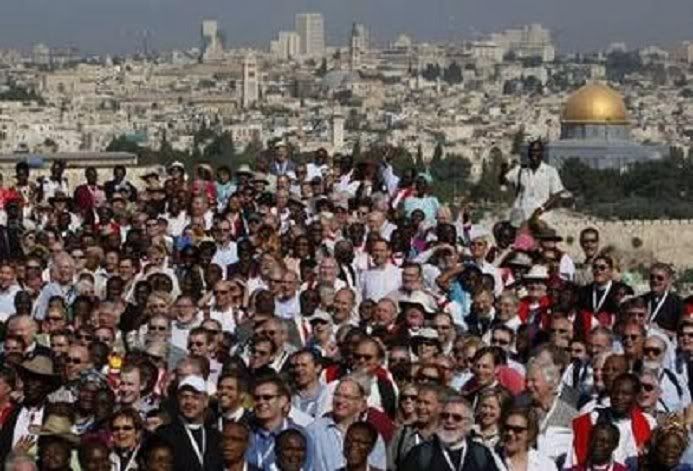 |
| Gafcon members on the Mount of Olives, Jerusalem, 2008 |
More significant was the view that the election of the Archbishop of Canterbury was a matter for England alone. It will be the leaders of the FoCA who decide whether or not to accept him as part of the Fellowship: no-one is acceptable (i.e. godly and Anglican) merely by virtue of their office.
* * *
Therefore there will be no schism in the sense of one organization separating itself out from another on a certain day, followed immediately by either or both bodies setting up new structures and legal identities.Instead there will be a steady continued tearing of the fabric as distinct ecclesial units (parishes, dioceses and provinces as well as individuals) align themselves explicitly with the FoCA. The legalities will depend on the law of each country (property and pensions being governed by secular law) and on the ecclesiastical structure of each Church.
I anticipate that the FoCA churches will thrive, purposeful and enthusiastic for at least the medium-term foreseeable future. It will thus be self-legitimating.
On the other hand I guess the remaining churches will flounder for a while before accepting the reality that there will be no accommodation between the two Anglican entities. Then they too will revise their own relationships, structures and communications and will settle into the new geography of Anglicanism where, in most places, there will be one dominant Anglican Church and a minority owing allegiance to its mirror image.
I don't think who is appointed as Archbishop of Canterbury will make much difference to this process - except, perhaps, to the timing.
The final diocesan votes
Today sees the last two dioceses to vote on the Covenant. As the proposal has already been defeated the issue cannot return to General Synod until the summer of 2015 at the earliest.
Newcastle Against
Bishops For: 2, Against: 0, Abstained: 0
Clergy For: 8, Against: 18, Abstained: -
Laity For: 14, Against: 15, Abstained: 0
York For
Bishops For: 4, Against: 0, Abstained: 0
Clergy For: 26, Against: 5, Abstained: 0
Laity For: 38, Against: 5, Abstained: 1
Dioceses for the Covenant to date: 16
Dioceses against the Covenant to date: 26
25/04/2012
An Archbishop for our times
 |
Modern Church's annual conference will be at High Leigh
By whose authority? An interfaith look at women and religious authority
|
an archbishop who will
- articulate and defend the Church's unity in diversity;
- respond to controversies by seeking consensus without being unduly influenced by the prospect of schism or demands for quick resolutions;
- consider each proposal for change on its merits, without any presupposition against innovation;
- see it as his role not to tell the faithful what to believe but to encourage the ongoing processes of enquiry; and
- be willing to hear the voice of God speaking through the moral and spiritual concerns of ordinary Christians and non-Christians.
 Inevitably we look backwards when we want to address the future. This submission asserts a 'classic Anglicanism' - embracing diversity, enabling change, supporting learning and the celebration of new insights, responding positively to the insights of secular society. It seeks an Archbishop who embodies and would promote this vision of which Modern Church is a guardian.
I too would love to see such a person. In fact, when Rowan Williams' name was announced in 2003 I was delighted because I believed we did indeed have such a person. That naivety soon faded.
I guess I now see things in a harder way than Modern Church. Indeed, the term 'Classic Anglicanism' suggests it has already passed away, stuffed and mounted in some display cabinet. It has echoes of 1970s corporatism, a presupposition of agreement if only there were goodwill enough, a suggestion that if we give uncertainty and ambiguity their proper place no-one will want to draw lines in the sand.
In a harder world responding positively to secular society means (or could mean) taking on a more strident tone, more individualistic self-assertion and a more calculating approach to relationships, discarding the notion that the state is good (debilitating for a state church), the commodification of anything and the costing of everything.
 |
| Archbishop Tait, for no particular reason |
- a technocrat who understands the changing impact of new communications technology and an historian who will not lose tradition
- a prophet who will side with the poorest globally and locally
- a woman who will stand up to bullies and choose her fights carefully
- a theologian who will talk plain common sense and a media operator who will never say anything to give hostages to fortune
- a team player and a figurehead contra mundum
- a devout hard-liner and a liberal and generous soul
So that's what I want, what I really, really want: a different sort of ABC altogether.
24/04/2012
For and against the Covenant
A couple of pdf files arrived today - one, a speech to the Christchurch Diocese in favour of the Covenant (but not delivered), and the other a summary of the discussion about the Covenant in the diocesan synod of Argyll and the Isles.
Speech for Christchurch Diocese
Bryden Black's argument for the Covenant turns on two points: first, that it had largely been accepted by the New Zealand Church already. Its General Synod had accepted Sections 1-3 and, apart from a 'legal nicety' it could have been adopted already.
The legal nicety - to which no answer has yet been made public - concerned the interrelation of the Covenant, the Standing Committee and the constitution of the ACC. I would have thought this a fairly basic consideration.
But his main argument is that, in the absence of a Covenant,
Black obviously knows that Anglican Churches do currently recognise one another. I assume he knows that those Churches which are members of the ACC are listed, authoritatively, in an appendix to its constitution.
So what would be different that would comprise 'genuine' recognition? Theological agreement - to what degree of precision? Mutual recognition of orders - including those of women? What degree of uniformity would be deemed sufficient? Would those churches which declined to sign the Covenant no longer be recognised as Anglican?
In the end what we are left with is a proposal for a different Communion: a single Church formed in part by dropping overboard any current member which didn't want to don the straitjacket: unity created by exclusion. Our Anglican identity would indeed be imperilled, though not in the way I guess Black intended.
Discussion in Scotland
Meanwhile, on the other side of the world, discussion was phrased in different tones. It's always hard to read the notes of a discussion cold, with no sense of tone of voice or the mood of the meeting. However the conclusion from Argyll and the Isles was:
The Covenant was seen as divisive and no solution to existing divisions.
Speech for Christchurch Diocese
Bryden Black's argument for the Covenant turns on two points: first, that it had largely been accepted by the New Zealand Church already. Its General Synod had accepted Sections 1-3 and, apart from a 'legal nicety' it could have been adopted already.
The legal nicety - to which no answer has yet been made public - concerned the interrelation of the Covenant, the Standing Committee and the constitution of the ACC. I would have thought this a fairly basic consideration.
 |
| The start of work to build Christchurch's Transitional Cathedral was marked with a sod-turning ceremony on Sunday afternoon. |
there is no means for churches to formally and properly and duly recognise each other as being indeed party to Anglicanism.
[and later] What the Covenant achieves is to present to us all the clear means of mutual recognition across the world-wide Anglican Communion, one born of a suitable interdependence which then prompts an appropriate accountability.
Furthermore, the Covenant also enables other Churches to recognise formally who exactly is a member of the Anglican Tradition and who not.
[and ends] In sum. Without the Covenant, how would current Anglican Provinces genuinely recognise each other? And without the Anglican Communion Covenant, how would other Churches be able to recognise those voices as Anglican who seek to speak and act into the global Church of the 21st C? Brothers and sisters; our very Christian identity as Anglicans, I suggest, is here at peril.(I've kept the emphases as in the original but, to be fair, it should be remembered that this was written as a speech.)
 |
| Celtic cross |
So what would be different that would comprise 'genuine' recognition? Theological agreement - to what degree of precision? Mutual recognition of orders - including those of women? What degree of uniformity would be deemed sufficient? Would those churches which declined to sign the Covenant no longer be recognised as Anglican?
In the end what we are left with is a proposal for a different Communion: a single Church formed in part by dropping overboard any current member which didn't want to don the straitjacket: unity created by exclusion. Our Anglican identity would indeed be imperilled, though not in the way I guess Black intended.
Discussion in Scotland
Meanwhile, on the other side of the world, discussion was phrased in different tones. It's always hard to read the notes of a discussion cold, with no sense of tone of voice or the mood of the meeting. However the conclusion from Argyll and the Isles was:
The overall feeling of the Diocesan Synod was that the Anglican Liturgy was valued but that the Anglican Covenant would not solve the cultural and theological tensions and was too restrictive.There did not seem to have been any recorded comments positively in favour of the Covenant, though a couple in favour of the Communion (and a question about whether it mattered).
The Covenant was seen as divisive and no solution to existing divisions.
23/04/2012
What do we make of Wales?
A little more clarity about what has happened in Wales over the Covenant comes with the publication of Highlights of the Church in Wales Governing Body April 2012 (pdf). (Previous press release.)
This makes clear that Gregory Cameron (wikipedia) proposed the substantive motion that the Church in Wales 'subscribe' to the Covenant.
The amendment - that the Church in Wales should delay any determinative decision until after the ACC meeting in November 2012 - was moved by Bishop John Davies of Swansea and Brecon. Furthermore Martin Reynolds reports (in Comments to a Thinking Anglicans item on April 18) that the Bishop of Monmouth, Dominic Walker, was preparing to propose that the motion should not be put to the meeting.
This makes clear that Gregory Cameron (wikipedia) proposed the substantive motion that the Church in Wales 'subscribe' to the Covenant.
The amendment - that the Church in Wales should delay any determinative decision until after the ACC meeting in November 2012 - was moved by Bishop John Davies of Swansea and Brecon. Furthermore Martin Reynolds reports (in Comments to a Thinking Anglicans item on April 18) that the Bishop of Monmouth, Dominic Walker, was preparing to propose that the motion should not be put to the meeting.
 |
| Church in Wales bishops at Gregory Cameron's consecration (from wiki) |
There are 6 diocesan bishops in the Church in Wales. Until recently the Church had been consistently opposed to the Covenant at a fundamental level but this appeared to have been swept aside at the previous meeting of the Governing Body. That meeting commended the Covenant to the Dioceses for consideration and endorsement. It may or may not be significant that Gregory Cameron, one of the key players in creating the Covenant, joined the bench of bishops in early 2009.
Two things happened which changed the landscape between the two Governing Body meetings. The Archbishop of Canterbury announced his retirement and the Church of England voted against the Covenant. The first meant that the natural desire not to undermine Rowan Williams was no longer a weighty consideration. The second showed that the Covenant was no longer 'the only game in town' - other futures were and are imaginable.
Thus, to avoid a public split in the bench of bishops, a positively worded motion was devised which put off a decision. If, as Martin Reynolds suggests, Gregory Cameron himself suspects the ACC will discard the Covenant then he has not lost face. And if the ACC should persist with the Covenant then those who continue to oppose it in Wales will have a further opportunity to defeat it in 2013.
Therefore, despite my earlier caution, I will move Wales from 'probably Yes' to 'probably No' on my table of how the provinces might vote.
21/04/2012
Covenant defeated in Christchurch
From Lawrence Kimberley, No Anglican Covenant Convener in New Zealand
Update:
From Bosco Peters' blog:
Good news! The covenant was defeated in the synod of the Diocese of Christchurch which met today.
Part of Christchurch Cathedral after the earthquake
more pictures here.

There was a long debate and a high quality one. Most speakers spoke against the motion. There was a vote by secret ballot.
It passed in the house of laity and was defeated in the house of clergy. The voting numbers were not released.This will be bad news for their pro-Covenant Bishop, Victoria Matthews.
Update:
From Bosco Peters' blog:
By those in-the-know I was told this was one of the highest-quality debates seen in the country. I think it was done respectfully and with a great deal of listening. I must say I am surprised and delighted by the outcome. We now join three other Pakeha dioceses (of the seven in our province) against the “Covenant” as well as joining with Tikanga Maori’s resolve against it. The debate now moves to General Synod/ te Hinota Whanui.And from Peter Carroll (who proposed the motion and sets out his speech in his blog):
It was a good debate. We had plenty of time (too much really, as we ran short on other things later in the day). We voted in as decisive a manner as one can do (by houses) and the outcome was the motion did not pass, defeated in the house of clergy, although passed in the house of laity.Lawrence added later, in a response to a question about Bishop Matthews' response:
+Victoria was gracious – a tone of graciousness had already been set in the debate anyway. Basically she simply announced the numbers with a little light humour.
Southwell & Chichester vote
Chichester For
Bishops For: 2, Against: 0, Abstained: -Southwell and Nottingham For
Clergy For: 29, Against: 9, Abstained: -
Laity For: 39, Against: 25, Abstained: -
Bishops For: 2, Against: 0, Abstained: 0
Clergy For: 15, Against: 5, Abstained: 0
Laity For: 31, Against: 6, Abstained: 1
Summary
Dioceses for the Covenant to date: 18
Dioceses against the Covenant to date: 25
There are 2 dioceses yet to vote: Newcastle and York next Saturday, 28 April.
20/04/2012
Don't Just focus on Section 4
Part of the problem with debate on the Covenant is that so much attention has been focused on section 4.2.
This clause is the basis for the paradoxical enforcing of the bonds of amity which is the linchpin of the document:
 But - just because this is widely unacceptable - it should not be allowed to make the earlier sections look tolerable.
I have in mind some people in the US and NZ (and probably elsewhere) who, with no doubt the best of motives, would be prepared to accept the first three sections of the Covenant, just not the last.
The Covenant is written as a single, integrated whole. Sections 2 and 3 describe and thus prescribe the basis of our unity; Sections 3 and 4 elaborate particular implications for the expression of unity. In fact the logic which links the two parts is very weak, but it was never written as an intellectual exercise. It is a political document which only needs sufficient logic to be acceptable. Like all too many church (and other) policy documents the beginning was written to justify a priori conclusions.
Section 1 would establish an extensive credal and ecclesiological base for the Communion which has never hitherto been needed. If adopted it will set the battle-ground for future divisions. It is too detailed to be comprehensive and too vague for theologians. It will demand endless 'elaboration' and 'clarification'. The more it is clarified the more critical it will become for an ever-diminishing groups of people whilst being ignored by almost everyone else.
Section 2 I don't find inherently objectionable, though otiose. However the phrase,
This clause is the basis for the paradoxical enforcing of the bonds of amity which is the linchpin of the document:
(4.2.5) The Standing Committee may request a Church to defer a controversial action. If a Church declines to defer such action, the Standing Committee may recommend to any Instrument of Communion relational consequences which may specify a provisional limitation of participation in, or suspension from, that Instrument until the completion of the process set out below.
But - just because this is widely unacceptable - it should not be allowed to make the earlier sections look tolerable.I have in mind some people in the US and NZ (and probably elsewhere) who, with no doubt the best of motives, would be prepared to accept the first three sections of the Covenant, just not the last.
The Covenant is written as a single, integrated whole. Sections 2 and 3 describe and thus prescribe the basis of our unity; Sections 3 and 4 elaborate particular implications for the expression of unity. In fact the logic which links the two parts is very weak, but it was never written as an intellectual exercise. It is a political document which only needs sufficient logic to be acceptable. Like all too many church (and other) policy documents the beginning was written to justify a priori conclusions.
Section 1 would establish an extensive credal and ecclesiological base for the Communion which has never hitherto been needed. If adopted it will set the battle-ground for future divisions. It is too detailed to be comprehensive and too vague for theologians. It will demand endless 'elaboration' and 'clarification'. The more it is clarified the more critical it will become for an ever-diminishing groups of people whilst being ignored by almost everyone else.
Section 2 I don't find inherently objectionable, though otiose. However the phrase,
may read differently in the light of the demand by the Vatican for a single unitary Anglicanism as a precondition of further ecumenical talks."We affirm the ecumenical vocation of Anglicanism to the full visible unity of the Church in accordance with Christ’s prayer that “all may be one” ...." (2.1.5)
It is intriguing that the majority of explicit biblical references are in this section, perhaps on the principle of 'argument weak here, shout louder' (references in the Introduction, the other area of concentration, don't count).
Section 3 creates a conflict prevention/resolution structure which, if adopted, would inevitably lead to demands for enforcement. Some version of the current Section 4 would inevitably be necessary if this section was endorsed.
Therefore:
Vote against the Covenant.
Just because Section 4 is worse does not make Sections 1 - 3 good.
16/04/2012
Auckland adds a No to the Covenant
Bosco Peters (of Liturgy blog) posted on the No Anglican Covenant Facebook wall that

Te Pihopatanga o Te Manawa o Te Wheke (the diocese which runs through the centre of the North Island) and Te Tairawhiti (on the East coast of the North Island) had already rejected the Covenant before the November debate.
The Tikanga Maori is committed to remain part of the Communion in a full sense. Nonetheless its primary ground for rejection is that the Covenant would ride roughshod across both the autonomy and the character of the Tikanga Maori (which is much wider and deeper than merely a part of the Anglican Church).
This rejection does not deny the depth of the division nor the need to find ways by which the disparate elements of the Communion can, together, work through difficult issues. The conflict prevention and resolution mechanisms are good ideas in themselves.
Second there is a concern that full membership of the Communion will not, retrospectively, apply solely to provinces that have signed the Covenant. The idea of first and second class members of the Communion was always one of its least attractive aspects.
"Tai Tokerau Anglicans have rejected the proposed Anglican Covenant after a robust discussion at the Hui Amorangi (diocesan synod) at the Church of the Holy Sepulchre in Auckland."I don't think this vote will change things as the Tikanga Maori rejected the Covenant last November, except to strengthen opposition to the Covenant.
Te Pihopatanga o Te Manawa o Te Wheke (the diocese which runs through the centre of the North Island) and Te Tairawhiti (on the East coast of the North Island) had already rejected the Covenant before the November debate.
The detail of the Tikanga Maori rejection is of interest, in particular 3(b). The full resolution is was follows:
That this Te Runanganui,
1. noting that the General Synod/te Hinota Whanui has approved in principle Sections 1-3 of the proposed Anglican Covenant, and asked Episcopal Units to study the proposed Covenant and respond to its 2012 Session, resolves as follows:
(a) Sections 1 & 2 of the proposed Anglican Covenant may be considered to be a useful starting point for consideration of our Anglican understanding of the Church of Christ2. Notes that Nga Hui Amorangi o Te Manawa-o-te-Wheke and Te Tairawhiti, as well as some of the other Episcopal Units of this Church, have rejected the proposed Covenant, and anticipates that a variety of views on the proposed Covenant will be expressed by the various Episcopal Units.
(b) Section 3 of the proposed Covenant contains an acceptable description of the basis for relationships between the churches of the Anglican Communion, and suggests a series of commitments which provide a useful framework within which churches of the Communion could discuss differences between them.
(c) Clause 4.2 of the proposed Covenant contains provisions which are contrary to our understanding of Anglican ecclesiology, to our understanding of the way of Christ, and to justice, and is unacceptable to this Runanganui.
3. Te Runanganui resolves:
(a) To reject the Anglican Covenant.
(b) Asks General Synod/te Hinota Whanui,
(i) If it rejects the proposed Covenant in part or as a whole, to commit itself by Standing Resolution to following processes similar to those set out in Section 3 of the proposed Covenant if another church of the Communion raises concerns about actions this Church takes or considers taking.(c) Asks the General Manager to forward this Resolution to the General Secretary of this Church.
(ii) To request its representatives to the Anglican Consultative Council to bring a motion to the 2012 meeting of the Anglican Consultative Council to affirm that full membership of the Anglican Communion is not conditional on adoption of the proposed Covenant.
 |
| The chapel at Te Hepara Pai, the Christchurch marae, spiritual home of Maori Anglicans in the South Island. |
This rejection does not deny the depth of the division nor the need to find ways by which the disparate elements of the Communion can, together, work through difficult issues. The conflict prevention and resolution mechanisms are good ideas in themselves.
Second there is a concern that full membership of the Communion will not, retrospectively, apply solely to provinces that have signed the Covenant. The idea of first and second class members of the Communion was always one of its least attractive aspects.
Pro- and Anti- Covenant in Christchurch
The Diocese of Christchurch, New Zealand, has put a page called Everything you wanted to know about the Covenant on its website. It has links to both pro- and anti- Covenant material.
Its first link is to youtube. It suggests you search for "Anglican communion covenant" which brings up mostly pro-Covenant material first. But if you search for "Anglican covenant" you get mostly anti-covenant material. Mr. CatOLick gets a good showing on both.
The main pro-Covenant argument suggested is that of Andrew Goddard on the Fulcrum site.
It is always good to find both sides of the argument being offered before debate, unlike a number of English dioceses, and particularly because the Bishop of Christ Church, Victoria Matthews, is known to be staunchly in favour of the Covenant.
Its first link is to youtube. It suggests you search for "Anglican communion covenant" which brings up mostly pro-Covenant material first. But if you search for "Anglican covenant" you get mostly anti-covenant material. Mr. CatOLick gets a good showing on both.
The main pro-Covenant argument suggested is that of Andrew Goddard on the Fulcrum site.
It is always good to find both sides of the argument being offered before debate, unlike a number of English dioceses, and particularly because the Bishop of Christ Church, Victoria Matthews, is known to be staunchly in favour of the Covenant.
15/04/2012
Diocese of Harare case in Zimbabwean Supreme Court soon
From The Zimbabwean, 14 April 2012
All here
All here
Anglican campaign goes international
A dossier containing shocking details of the persecution of defenceless Christians handed to President Robert Mugabe by outgoing Arch bishop of Canterbury, Rowan Williams, has not helped.
....
Persecution and violence
 |
| Mothers' Union members in Zimbabwe |
There have been many instances of persecution and violence. Church members have been tear-gassed and hit; priests have been evicted from their homes and falsely imprisoned; intimidation has been used; care assistants have been evicted from orphanages leaving orphans without proper care.
Because of his closeness to the Mugabe regime, Dr Kunonga has obtained the assistance of the police to evict clergy, teachers and medical personnel from churches, schools and medical centres. The police, without an authorising court order, have assisted and managed to arrest a number of legitimate occupants.
The situation today
The legitimate church has repeatedly appealed in the courts against unfair and illegal action, but there has been a lot of delay.
The Archbishop of Canterbury and some African Archbishops visited Harare in late 2011. They reaffirmed their support for the current Bishop of Harare, Chad Gandiya, and visited President Mugabe to provide him with a dossier of incidents of violence and oppression which the diocese has suffered at the hands of Dr Kunonga, his supporters and the police.
At last, the appeals which the Diocese of Harare has been making to the Supreme Court of Zimbabwe will soon be heard. Scheduled for the middle of 2012, the Chief Justice of Zimbabwe will hear all the appeals in connection with the issue of control of church buildings, which include churches, vicarages, schools and medical centres.All here
How the Communion might vote
I've created a page with my guesses as to how the different provinces and member churches might vote on the Covenant.
It is prefaced with a pile of caveats. I don't have any insider knowledge and I wouldn't be at all surprised if the equivalent table at the ACO had many differences from mine.
So I'd very much appreciate any information, hints, even gut feelings that might add to the reliability of the guesses. Please let me know in the comments box - I'll attribute the contributions unless told not to. Thank you in advance.

It is prefaced with a pile of caveats. I don't have any insider knowledge and I wouldn't be at all surprised if the equivalent table at the ACO had many differences from mine.
So I'd very much appreciate any information, hints, even gut feelings that might add to the reliability of the guesses. Please let me know in the comments box - I'll attribute the contributions unless told not to. Thank you in advance.
14/04/2012
The Covenant in (some) other Provinces
Wales
 |
| Archbishop Barry Morgan |
The briefing paper (.doc) refers to advice received from the "Chairman and Deputy Chairman of the Standing Committee of the Governing Body, and ... the Doctrinal Commission of the Church in Wales." and
... concludes that no new questions are raised for the doctrine or discipline of the Church in Wales in the proposed Anglican Communion Covenant, so that the adoption of the Covenant can be best addressed directly by a motion of the Governing Body rather than requiring a Bill.This is despite the objections raised by the Church in Wales to the whole ethos and character of the Covenant in previous submissions. Few of its criticisms and suggestions have been answered, at least not publicly and not in the Covenant as promulgated.
Scotland
 |
| The Rt Rev David Chillingworth (second left) congratulated by the other Scottish Episcopal Bishops on his election as Primus |
In my view this would be utterly foolish. The General Secretary of the Anglican Communion makes no such distinction. As far as he is concerned the Irish have signed on (as have South East Asia which made different reservations in their adoption of the Covenant).
The ACNS report of the decision says that in debate it was stressed that "this would leave the Covenant subordinate to the the Preamble and Declaration of the Church [of Ireland] and does not affect the sovereignty of the Church of Ireland or mean any change in doctrine." But what is said in debate is not necessarily the same as the terms of signing up to the document.
The US
 |
| At the last general Convention, 2009 |
Here in The Episcopal Church there are now three resolutions that have been publicized, one from Executive Council and two from members of the House of Bishops. The Executive Council resolution is perhaps the least supportive of the Anglican Covenant, although even that one is clear that it is not the Covenant as an idea that is a problem (although for some of us it is) but rather "its current form." The two other resolutions, one from Bishops Douglas, and others, and the other from Bishop Bauerschmidt and others, are more affirmational to varying degrees.
Ecumenically
And a point to which I had not given enough weight became clearer recently. John Milbank's article After Rowan: the Coherence and Future of Anglicanism, included the sentence:It is important for Catholic readers to realise that Rowan Williams had sought this covenant, in part, for ecumenical reasons. The Vatican signalled to him at the start of his primacy that conversations leading to further unity could only be re-commenced if the Catholic Church could be sure that the Anglican Church was truly capable of acting as one body.
 |
| The Vatican: projecting Christian power in a post-Christian world |
But the Covenant has not been argued for by direct reference to this precondition to negotiations (however gently expressed). It's been referred to in the general terms that it would make ecumenical discussion easier as our ecumenical partners want to know where we stand as a communion.
Furthermore this signal clearly also communicates that, if discussions were to recommence, they would do so on terms set by the Vatican. So the Covenant, and the reconstruction of Anglicanism as a single, centrally governed denomination, was to be (in part) for the benefit of the Pope as much as for Anglicans.
I wonder whether many of the more Evangelical Anglican Churches would have been happy with this, and I'm pretty sure Henry VIII and Elizabeth would think we'd missed the point.
But it's always been about power. That's what makes Churches.
03/04/2012
Russia's decaying heritage
From Open Democracy:
Russia’s wooden architecture, especially its churches, was hardly a priority during Soviet times and now many of the unique old buildings are very close to total ruin. A new book documents the tragedy in some of the most inaccessible parts of Russia’s north. The numbers are daunting, but a tiny ray of hope has appeared on the horizon, which could rescue one or two of the near-ruins, says Alexander Mozhayev.
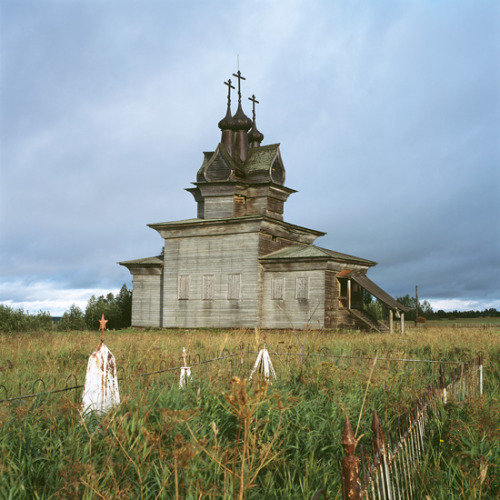
Over the last 100 years the landscapes of the Russian North have not changed for the better. The majority of the churches have either decayed or been transported to open-air museums in Arkhangelsk, Kostroma, Novgorod and other major cities. There are no precise statistics for churches lost in this way, but one has only to look at the authoritative work Russkoye derevyannoye zodchestvo [Russian Wooden Architecture], published in 1942. Of the 70 churches presented in it, just 27 have escaped destruction, 2 are close to death and 7 have been turned into museums. Moreover, with rare exceptions, it is the most impressive churches that have perished.The glimmer of hope is that, in some places, volunteers are getting together and beginning to work on the restoration of some of the decaying wooden buildings.
All here
01/04/2012
Church Times letters

Sir,
In the post-mortems that will follow the death of the Anglican Covenant in England it may be easy to miss another victim: the damage done to synodical government.
From the Windsor Report onwards there was a recognition that extraordinary steps would be needed to get round, through or past the 44 autonomous decision making bodies across the Communion whilst avoiding the chance of any of them making unilateral amendments.(see para. 117).
This set the tone across the Communion. In England General Synod debated the principle of a Covenant but never the wording of a draft available to them at the time.
The Covenant was commended to Dioceses on a number of grounds, including the endorsement of General Synod. It was asserted that the Covenant was necessary to hold the Communion together, that there was no alternative, that the thankless work of and personal loyalty to the Archbishop of Canterbury should be sufficient reason to vote in favour, and (in the latter stages) that it was necessary as a means to support other, smaller and embattled Provinces.
At no time were advocates of the Covenant prepared to engage in discussion of the actual wording and proposals. Yet it was always the document itself, and not the general principle, which would have been implemented.
It may seem that defeat of the Covenant marks a resurgence of synodical self-assurance but I think this would be to misread what has happened. In place of reasoned debate among equals we have seen arm-twisting, debates structured to maximise the vote in favour, general arguments and bland reassurance, avoidance of any question of substance and attempts at emotional blackmail.
Of course bishops have always been partisan and reluctant to lose in 'their' synods. But from the Windsor Report to the present we have seen systemic attempts to marginalise and diminish synodical government itself in the name of a greater good. The failure to address the substance of the Covenant reflected a refusal to recognise synod members as fully responsible parties in the government of our Church.
Perhaps it is time to recall the vision and persistence of the Evangelical leader George Goyder who, from 1953 to 1969, battled to create synodical government. His plea was simple, reasonable and still pertinent: for proper partnership in decision making.There was also a letter from Jean Mayland on the same subject:
 |
| Jean Mayland at the last Lambeth Conference |
Sir,
When the Covenant was referred to the dioceses, it was sent only with material in favour and not, as with women bishops, with a list of points for and against.And you might also enjoy: The stupid and ungodly culture of the Church of England (Eliziphanian)
Initially, the dioceses sent out only material in favour. It was after only a great deal of effort that some diocesan authorities were persuaded to send out balanced material.
In many dioceses, there was only one speaker making the presentation about the Covenant — ostensibly balanced, but in fact a speech in favour, mentioning a few points against.
In the majority of dioceses, the bishop made a strong speech in favour before the debate began.
In one diocese, the bishop made a passionate speech in favour, and showed the Archbishop’s video, and then the proposer made a formal but detailed speech in favour. Only after all this was the young man speaking in opposition able to open his mouth. Luckily, he kept his cool, and in that particular diocese both Houses of Clergy and Laity voted strongly against.
In another diocese, there was a tie in the House of Laity, and at the recount a senior layman who had abstained changed his vote and voted in favour, and so it was just carried in that House.
Never again should the Church of England deal with an important matter in a manner that contravenes all standards of fair debate in England.
The second area of concern is the House of Bishops, whose votes were distinctly out of kilter with those of the clergy and laity. We are told that they felt that they must support the Covenant out of loyalty to the Archbishop of Canterbury. Many wrestled hard with their consciences on this matter, but only a handful had the courage to vote against.
This is because they are now bound by ideas of collegiality which go back to the approval by the House of Bishops of a report, Bishops in Communion: Collegiality in the service of the koinonia of the Church, written by Bishop John Hind and Dr Mary Tanner, and adopted by the House of Bishops in 2000. The Bishops need to break out of this false collegiality, and model for the Church and society a pattern of leadership which is open and honest about differences.
It used not to be like this — certainly not in the first 20 years of synodical government, to my knowledge. When the General Synod failed to obtain the necessary percentages of votes for the Anglican-Methodist Unity Scheme to be accepted, the Archbishop of Canterbury at that time, Michael Ramsey, was bitterly disappointed, but he did not attack or blame those who thought differently. He stood up in his great chair with his eyebrows beetling up and down and called out “Long live God! Long live God!”
That is the message that we, with all our honest differences, need to proclaim to our nation today.
Take the Covenant process first. Why were the Bishops so out of touch? Why was so much effort invested - in a frankly morally dubious fashion - by the institutional establishment in pushing through a measure where there was clearly no consensus? The disconnect between the hierarchy and the rank and file - and especially, the disconnect between the episcopacy and the clergy - should really be a wake-up call to the hierarchy to carry out a fundamental review of how Bishops work. ...
A globular Communion
My guess is that defeat in England will not stop those who see the Covenant as the future of the Communion.
 They will continue to try to persuade provinces to sign up, probably adding the argument that England will come on board after 2015.
Death of the Covenant from other causes
But the Covenant will die nevertheless. What will kill it are the internal contradictions within the Communion itself. It simply will not be fitted into a single document.
Consider the GAFCON churches. I blogged long ago about the different attitudes of Global South Churches towards the Covenant (I see my maths was no good then and it's not improved). This diversity is, I believe, still the case. The Southern Cone and the West Indies have already declared their adhesion to the Covenant. But I can't see Nigeria, Uganda or Kenya signing up (though, of course, any of these guesses are hostages to fortune).
I can also see a number of churches (the US, perhaps Canada) simply not coming to a decision at all.
Either way, the presupposition that membership of the Anglican Communion means uniform relations between all participants (whether as fact or ideal) has broken down in practice. I anticipate this is likely to be confirmed in organizational structures - and the longer some push for the Covenant the worse will be the collapse of the ACO, its Networks and Ministries, when it does happen.
The Covenant entailed the explicit declaration of uniform relations between participants. It is likely to contribute to its opposite - the formalisation of uneven relationships. In effect we end up, not with the end of the Communion, but with a significantly different configuration.
(I confidently predict that, when churches self-identify in this way, they will not choose 'lump' as the official designation.)
A significant bonus of this reshuffling of relationships is that it need not necessarily threaten bi-lateral or multi-lateral links at parish, diocesan or organizational level. The Mothers' Union in Africa, for example, can remain strongly associated with the MU in London even when the churches officially belong to differing clusters.
Not managing the Communion
Mapping such Anglican-heritage churches will be a difficult and undoubtedly fluid exercise. Managing a globular Communion will be impossible.
Instead of 44 autonomous provinces and member churches there will be, say, half a dozen primary lumps each with their own communication structures, decisions about interoperability, and lumps within lumps. Each lump will have varying degrees of interaction with each other lump, and the distinct members of every lump will each have differing associations across the globular whole.
The fact is this kind of development is already happening. The Covenant would have fitted ill with those who assent to the Jerusalem Declaration. Some provinces are sharing theological education initiatives. Some already recognise bodies which are not in communion with the rest.
These circumstances will eventually force change in whatever central structures survive. (So too will money, but that's another story.)
My suggestion would be that the term, idea and value of 'manage' should be discarded. In its place should be 'facilitate', 'enable', 'resource' and similar terms: explicitly servicing the various lumps on their own terms. In this the internet offers a huge potential.
The Communion's existing networks should not be co-opted to further the ACO's centralising mindset but could be great assets in supporting and resourcing the agenda's of the various lumps - learning from one another but allowing the component parts to use what
Of course, these observations are neither a blueprint nor at all adequate to the task. I offer them only as starting suggestions of how the Communion might develop in the decades to come: not towards 'A Church', but towards servicing the Church which is already here.
These developments would also make a mess of ecumenical convergence on a global scale. But I think it would be more honest, and ultimately more fruitful, to base the search for ecumenical convergence in the reality of church life, and not on a notion of what church life might become.
And, by way of warning, in searching for suitable images I also came across Bonini's Paradox:
 They will continue to try to persuade provinces to sign up, probably adding the argument that England will come on board after 2015.
Death of the Covenant from other causes
But the Covenant will die nevertheless. What will kill it are the internal contradictions within the Communion itself. It simply will not be fitted into a single document.
Consider the GAFCON churches. I blogged long ago about the different attitudes of Global South Churches towards the Covenant (I see my maths was no good then and it's not improved). This diversity is, I believe, still the case. The Southern Cone and the West Indies have already declared their adhesion to the Covenant. But I can't see Nigeria, Uganda or Kenya signing up (though, of course, any of these guesses are hostages to fortune).
I can also see a number of churches (the US, perhaps Canada) simply not coming to a decision at all.
Either way, the presupposition that membership of the Anglican Communion means uniform relations between all participants (whether as fact or ideal) has broken down in practice. I anticipate this is likely to be confirmed in organizational structures - and the longer some push for the Covenant the worse will be the collapse of the ACO, its Networks and Ministries, when it does happen.
The Covenant entailed the explicit declaration of uniform relations between participants. It is likely to contribute to its opposite - the formalisation of uneven relationships. In effect we end up, not with the end of the Communion, but with a significantly different configuration.
 |
| A globular protein - PyruvKinase, I think, - and a way of visualising the Communion? |
The death and re-birth of the Communion
I think we will end up with a globular Communion - clusters of provinces coming together on what are basically grounds of congeniality (in which social and theological attitudes all have an important place).
Some of these lumps will have members (ACNA and other groups with which the Communion in not currently in Communion) which are not recognised by those in other lumps. Some lumps (one including Nigeria, for example, and another including TEC) may not talk to one another. But for the most part churches which primarily identify with one lump will maintain a variety of formal and informal links with churches in other lumps.
(I confidently predict that, when churches self-identify in this way, they will not choose 'lump' as the official designation.)
 |
| Mothers' Union members meeting in West Africa |
Not managing the Communion
Mapping such Anglican-heritage churches will be a difficult and undoubtedly fluid exercise. Managing a globular Communion will be impossible.
Instead of 44 autonomous provinces and member churches there will be, say, half a dozen primary lumps each with their own communication structures, decisions about interoperability, and lumps within lumps. Each lump will have varying degrees of interaction with each other lump, and the distinct members of every lump will each have differing associations across the globular whole.
The fact is this kind of development is already happening. The Covenant would have fitted ill with those who assent to the Jerusalem Declaration. Some provinces are sharing theological education initiatives. Some already recognise bodies which are not in communion with the rest.
 |
| Mapping complexity, in this case networks of climate change sceptics and supporters. Similar tools could be used for the Communion |
My suggestion would be that the term, idea and value of 'manage' should be discarded. In its place should be 'facilitate', 'enable', 'resource' and similar terms: explicitly servicing the various lumps on their own terms. In this the internet offers a huge potential.
The Communion's existing networks should not be co-opted to further the ACO's centralising mindset but could be great assets in supporting and resourcing the agenda's of the various lumps - learning from one another but allowing the component parts to use what
Of course, these observations are neither a blueprint nor at all adequate to the task. I offer them only as starting suggestions of how the Communion might develop in the decades to come: not towards 'A Church', but towards servicing the Church which is already here.
These developments would also make a mess of ecumenical convergence on a global scale. But I think it would be more honest, and ultimately more fruitful, to base the search for ecumenical convergence in the reality of church life, and not on a notion of what church life might become.
And, by way of warning, in searching for suitable images I also came across Bonini's Paradox:
Everything simple is false. Everything which is complex is unusable.
Subscribe to:
Posts (Atom)